We are drowning in data. Every day, humanity generates approximately 328.77 million terabytes of information. From the billions of photos uploaded to social media to the colossal datasets generated by scientific research and autonomous vehicles, the digital universe is expanding at an exponential rate. Current estimates suggest that by 2025, the global datasphere will reach 175 zettabytes.
The problem is that our current storage technologies—hard disk drives (HDDs), solid-state drives (SSDs), and magnetic tape—are not keeping pace. They are bulky, energy-hungry, and fragile. A hard drive might last five years; a magnetic tape might last thirty. Furthermore, the world is running out of silicon-grade sand and the rare earth metals required to build these devices. We are approaching a “data storage crunch” in which we will generate more data than we have physical capacity to store.
The solution to this modern crisis may lie in the oldest information storage system on Earth: Deoxyribonucleic Acid (DNA).
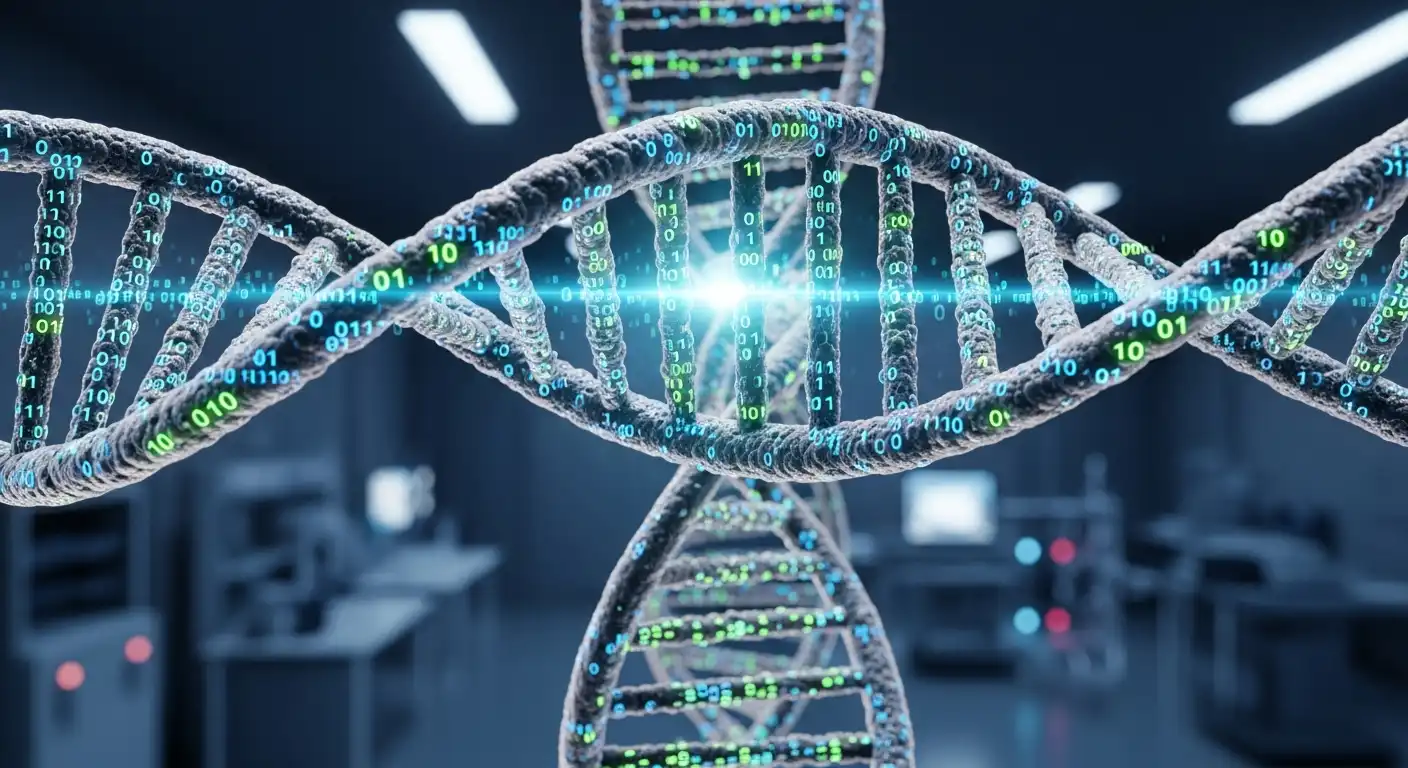
Nature has been storing the blueprints of life in this microscopic molecule for nearly 4 billion years. It is incredibly dense, stable, and energy-efficient. Scientists are now mastering the art of translating binary digital code (0s and 1s) into the genetic code (A, C, T, G). This article explores the revolutionary field of DNA data storage, its mechanisms, its potential to archive the sum of human knowledge in a teaspoon, and the challenges that remain before it becomes a commercial reality.
The Limits of Silicon and the Promise of Biology
To understand why we need DNA storage, we must first examine the limitations of current infrastructure. Data centers today consume nearly 2% of the world’s electricity. They require massive cooling systems and constant hardware replacement. If we try to store the projected 2040 data using today’s flash memory, we would need 10 to 100 times the expected supply of microchip-grade silicon.
The Density Advantage
DNA offers a storage density that makes silicon look primitive. A single gram of DNA can theoretically store 215 petabytes (215 million gigabytes) of data. To put that in perspective, all the data currently in the world could fit into a shoebox full of DNA. While a modern hard drive stores information on a 2D surface, DNA stores it in a 3D molecular volume, achieving densities orders of magnitude higher.
The Durability Factor
Digital media is notoriously ephemeral. “Bit rot” degrades files over time. CDs scratch, hard drives seize, and flash memory loses its charge. DNA, however, is exceptionally stable. We have successfully sequenced DNA from woolly mammoths that died thousands of years ago. If kept in a cool, dry, and dark environment, DNA can preserve information for hundreds of thousands of years without any power source or maintenance. It is the ultimate “cold storage” medium.
How DNA Data Storage Works
The process of storing a digital photo or a text file in a molecule involves a cycle of translation: Encoding, Synthesis, Storage, Retrieval, and Decoding.
Step 1: Encoding (Binary to Base-4)
Computers speak binary: a stream of 0s and 1s. DNA is composed of four chemical bases: Adenine (A), Cytosine (C), Guanine (G), and Thymine (T).
The first step is to map the binary data to these bases. A simple algorithm might look like this:
- 00 = A
- 01 = C
- 10 = G
- 11 = T
So, the binary string 00110110 would be translated into the DNA sequence ATCG. Advanced algorithms also employ error-correction codes (such as Reed-Solomon codes used in CDs) to ensure that, if a molecule breaks, the data can still be recovered.
Step 2: Synthesis (Writing)
Once the sequence is determined, it must be physically created. This is done using chemical DNA synthesis. Unlike biological replication inside a cell, this is a chemical process that builds the strand letter by letter.
Companies such as Twist Bioscience use silicon chips with thousands of tiny wells to synthesize millions of distinct DNA strands simultaneously. These strands are short fragments, typically 150-200 bases long, called “oligos.” Each oligo contains a chunk of the data file plus a specialized “address” sequence (like a barcode) so the computer knows where that chunk belongs in the final file.
Step 3: Storage
Once synthesized, the DNA is dried out or suspended in a liquid and placed in a small vial. This tiny drop of liquid can contain terabytes of data. It occupies virtually no space and requires no electricity. It remains stable for millennia.
Step 4: Retrieval and Sequencing (Reading)
When you want to read the file back, you need to sequence the DNA. You can select specific files using Polymerase Chain Reaction (PCR). By using primers that match the “address” barcode of the desired file, you can chemically amplify (copy) only the strands you want to read, leaving the rest of the archive untouched.
The amplified DNA is then run on a DNA sequencer (e.g., an Illumina or Oxford Nanopore instrument), which reads the chemical order of A, C, T, and G.
Step 5: Decoding
The sequencer outputs a text file of genetic letters. The computer algorithm takes this sequence, removes the error-correction codes, reassembles the fragments based on their addresses, and translates the A, C, T, G back into 0s and 1s. The result is the original digital file, bit-perfect.
The Current State of the Art
This is not science fiction; it is working technology.
- 2012: Harvard geneticist George Church encoded a 52,000-word book into DNA.
- 2016: Microsoft and the University of Washington stored 200 MB of data, including a music video by the band OK Go and the Universal Declaration of Human Rights.
- 2019: A startup cataloged the entirety of Wikipedia (16 GB) into DNA.
- 2020: Netflix collaborated with Twist Bioscience to store an episode of the series Biohackers in DNA.
The technology works. The barrier is no longer a possibility; it is cost and speed.
The Challenges: Why Isn’t It in Your Laptop?
Despite the immense potential, do not expect a DNA drive in your next laptop. Several significant hurdles remain before this technology becomes mainstream.
The Cost Barrier
Currently, DNA synthesis (writing) is prohibitively expensive. Storing just a few megabytes can cost thousands of dollars. While the cost of sequencing (reading) has declined faster than Moore’s Law—from $100 million per human genome in 2001 to under $600 today—synthesis costs have lagged. For DNA storage to compete with magnetic tape, the cost of DNA synthesis must drop by several orders of magnitude.
The Speed Limit
DNA synthesis is a chemical reaction. It is slow. Writing data to DNA currently happens at a rate of a few kilobits per second. Hard drives write at gigabits per second. Reading is faster, but still involves hours of chemical preparation and sequencing.
This makes DNA unsuitable for “hot data” (data that must be accessed immediately, such as your operating system or a streaming video). DNA is destined for “cold data” or archival storage—information that must be kept forever but is rarely accessed, such as government records, scientific raw data, legal archives, and cultural heritage.
The Random Access Problem
In a hard drive, the read head can jump to any sector instantly. In a test tube of DNA, you have a soup of billions of molecules. Finding the specific file you want is like finding a needle in a haystack. While PCR tagging enables file selection, it remains a chemical search process that is far slower than electronic random access.
The Future: Enzymatic Synthesis and Automation
The industry is not standing still. Massive innovation is underway to solve the cost and speed bottlenecks.
Enzymatic Synthesis: The Game Changer
Traditional DNA synthesis uses harsh chemicals and generates toxic waste. It is limited in length and speed. The future lies in Enzymatic DNA Synthesis (EDS). This method mimics nature, using an enzyme (Terminal Deoxynucleotidyl Transferase or TdT) to build DNA in an aqueous solution.
Startups like DNA Script and Molecular Assemblies are developing “DNA printers” that use enzymes. This process is faster, cleaner, and potentially much cheaper, promising to bring synthesis costs down to a level where commercial data storage becomes viable.
The “DNA Hard Drive”
Currently, the process requires human pipetting between machines. Microsoft is researching a fully automated end-to-end system. Imagine a box the size of a photocopier. You send a file to it; inside, microfluidic chips synthesize the DNA and store it. When you request the file, the machine automatically retrieves the sample, sequences it, and sends the data back to your screen. No pipettes, no humans.
Integration with Silicon
Researchers are also exploring hybrid chips. The Semiconductor Synthetic Biology (SSB) roadmap envisions chips that combine electronic circuits with biological pores. These chips could write data directly into DNA molecules tethered to the silicon surface, thereby bridging the gap between the electronic and biological worlds.
Beyond Archiving: Computing with Molecules
DNA storage might just be the beginning. Once data is in DNA form, we can theoretically perform computations on it. Biological enzymes can perform operations such as search-and-replace on massive datasets in parallel without ever converting the data back to electronic bits.
This concept, known as DNA Computing, leverages the massive parallelism of chemistry. In a single test tube, trillions of DNA molecules can interact simultaneously. This could revolutionize fields such as cryptography and complex optimization problems that currently burden supercomputers.
Why This Matters: The Preservation of Civilization
The drive for DNA storage is not merely about reducing data center costs; it is about preserving human history. Digital dark ages are a real threat. File formats become obsolete (try opening a WordPerfect file from 1990). Magnetic tapes degrade. If civilization were to collapse or if we simply lost the ability to read 20th-century magnetic media, vast swathes of our history would vanish.
DNA is the one medium that will never become obsolete. As long as humans exist, we will have a biological imperative to read and understand DNA because it is the code of our own bodies. We will always have DNA sequencers. By storing our knowledge in the language of life, we ensure that it remains readable for thousands of generations.
Conclusion
DNA data storage represents the ultimate convergence of biology and computer science. It turns the problem of the “data explosion” on its head, transforming the massive, energy-sucking data centers of today into compact, eternal archives that fit in the palm of a hand.
While we are likely a decade away from widespread commercial use of this technology, the trajectory is clear. The silicon age has physical limits; the biological age does not. By mimicking nature’s own hard drive, humanity is building an infinite archive, ensuring that the digital footprint of our civilization will outlast the machines that created it.