In the heart of our hyper-connected digital world lies an invisible, power-hungry giant: the data center. These facilities are the humming, blinking backbones of modern society, housing the servers, storage, and networking equipment that power everything from our social media feeds and streaming services to global finance and life-saving medical research. As our reliance on data grows exponentially, so does the energy footprint of these critical infrastructures. For years, this growth came at a steep environmental cost, making data centers among the fastest-growing consumers of global electricity.
However, a profound transformation is underway. The industry is awakening to its environmental responsibilities, leading to the emergence of the “green data center.” This is not merely a buzzword but a fundamental redesign of how we build, power, and operate the digital engines of our world. A green data center is a facility designed, built, and operated to minimize energy consumption and environmental impact. Their development is no longer a niche concern but a critical imperative for achieving sustainable technology growth, ensuring that our digital future doesn’t come at the expense of our planet’s health.
The Hidden Environmental Cost of Our Digital World
To understand the importance of green data centers, we must first confront the immense environmental challenges posed by their traditional counterparts. The sheer scale of global data processing requires staggering resources, creating significant environmental strains that extend far beyond a high electricity bill.
These challenges form a complex web of energy consumption, water usage, and electronic waste, each demanding innovative solutions. Let’s break down the key environmental costs associated with conventional data centers.
The Voracious Appetite for Energy
At its core, a data center is a massive consumer of electricity. This energy is not just for running the servers; a large portion is dedicated to the infrastructure needed to keep them operational around the clock.
The power consumption in a typical data center is distributed across several key components, creating a compounding energy problem.
- IT Equipment: The servers, storage arrays, and networking switches that process and manage data are the primary energy consumers.
- Power Infrastructure: Uninterruptible Power Supplies (UPS), switchgear, and power distribution units (PDUs) dissipate a portion of the energy as heat during power conversion, contributing to overall inefficiency.
- Cooling Systems: This is often the largest non-IT energy consumer. All the electricity used by the IT equipment is ultimately converted into heat, which must be constantly removed to prevent hardware failure.
Collectively, data centers are estimated to consume 1-2% of the world’s electricity, a figure projected to grow significantly as AI and Big Data expand.
The Cooling Conundrum: A Battle Against Heat
The second law of thermodynamics is the data center operator’s greatest foe. Every watt of electricity consumed by a server is converted into a watt of heat. With racks packed densely with powerful processors, a data center can generate heat equivalent to thousands of household ovens running simultaneously.
Removing this heat is a non-negotiable, energy-intensive process that has traditionally been a major source of inefficiency.
- Computer Room Air Conditioning (CRAC): For decades, the standard approach was to use massive CRAC units, which function like oversized home air conditioners. They blast cold air into the data hall, often inefficiently, to cool the entire room rather than just the servers.
- Inefficient Airflow: Poorly designed data halls often suffer from “hot spots,” where hot exhaust air mixes with cold intake air, forcing cooling systems to work much harder than necessary.
The Water Footprint: A Thirst for Cooling
Many large data centers, particularly in warmer climates, rely on evaporative cooling towers to dissipate heat. These towers operate by evaporating vast quantities of water to cool a separate loop of water, which then chills the air inside the facility.
This reliance on water creates a significant and often overlooked environmental impact, especially in water-scarce regions.
- Massive Water Consumption: A medium-sized data center can consume hundreds of thousands of gallons of water per day, equivalent to the water usage of a small town.
- Competition for Resources: In drought-prone areas, this puts data centers in direct competition with agricultural and residential needs for a precious resource.
The Lifecycle Challenge: E-Waste Generation
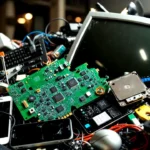
The relentless pace of technological advancement means that servers and networking equipment have a relatively short lifespan, typically 3-5 years. This rapid refresh cycle generates a massive amount of electronic waste (e-waste).
This e-waste is laden with hazardous materials and poses a significant environmental challenge at the end of its life.
- Hazardous Materials: Components contain lead, mercury, and cadmium, which can contaminate soil and water if not disposed of properly.
- Lost Resources: Discarded servers also contain valuable materials, such as gold, silver, and copper. Failing to recycle them properly represents a significant loss of finite resources.
The Anatomy of a Green Data Center: A Blueprint for Sustainability
A green data center addresses these environmental challenges directly through a comprehensive approach that combines intelligent design, renewable energy sources, and operational excellence. The goal is to maximize efficiency and minimize environmental impact across the facility’s entire lifecycle.
The key efficiency metric is Power Usage Effectiveness (PUE). This ratio compares the total power entering the data center to the power actually used by the IT equipment. A perfect PUE is 1.0. While traditional data centers might have a PUE of 2.0 or higher (meaning for every watt used by IT, another watt is used for cooling and overhead), modern green data centers aim for a PUE of 1.2 or lower.
Energy Efficiency by Design: Beyond the Server Rack
The foundation of a green data center is a relentless focus on energy efficiency. This starts with the facility’s physical layout and extends to the selection of every component.
These design principles work together to drastically reduce the energy required for cooling and power distribution.
- Hot/Cold Aisle Containment: This simple but incredibly effective strategy involves arranging server racks in rows to create alternating “cold” aisles for air intake and “hot” aisles for exhaust. Physical barriers prevent hot and cold air from mixing, allowing cooling systems to operate much more efficiently.
- Optimized Airflow Management: Instead of overcooling an entire room, sensors and variable-speed fans deliver the precise amount of cool air directly to the server inlets, minimizing wasted energy.
- High-Efficiency Power Infrastructure: Using modern, high-efficiency UPS systems and power supplies rated “Platinum” or “Titanium” can significantly reduce energy loss during power conversion.
- Server Virtualization and Consolidation: Virtualization allows multiple “virtual” servers to run on a single physical machine. This drastically reduces the number of underutilized physical servers, saving energy and space.
The Renewable Energy Revolution
True sustainability requires moving beyond simply using less energy to using cleaner energy. The world’s leading technology companies are now among the largest corporate buyers of renewable energy, powering their data centers with clean energy sources.
This transition to renewables is accomplished through several key strategies that ensure a reliable supply of clean power.
- On-Site Generation: Building solar farms or wind turbines directly on or adjacent to the data center property provides a clean-energy source.
- Power Purchase Agreements (PPAs): These are long-term contracts where a company agrees to purchase energy directly from a renewable energy developer, such as a large-scale wind or solar farm. This guarantees a stable price for clean energy and helps finance new renewable projects.
- 24/7 Carbon-Free Energy: The new frontier, pioneered by companies like Google, is to match energy consumption with carbon-free energy sources on an hourly basis, using a mix of renewables and battery storage to ensure the data center is truly running on clean power around the clock.
Reinventing Cooling: From Air to Water and Beyond
The most innovative green data centers are moving away from traditional, energy-intensive air conditioning. They are leveraging natural resources and advanced engineering to cool their servers more efficiently.
These next-generation cooling techniques dramatically reduce the energy and water required to maintain optimal operating temperatures.
- Free Air Cooling (Economization): In cooler climates, this method involves simply drawing in filtered outside air to cool the data center for a significant portion of the year, bypassing the need for mechanical refrigeration.
- Liquid Cooling: As processors become more powerful and generate more heat (especially with the rise of AI), air cooling is reaching its limits. Liquid cooling is far more efficient at heat transfer. This includes direct-to-chip cooling, where liquid is piped directly to a cold plate on the processor, and immersion cooling, where entire servers are submerged in a non-conductive dielectric fluid.
- Geothermal and Seawater Cooling: Some of the most ambitious projects locate data centers near natural cold sources. For example, some facilities use naturally cold underground water or deep seawater to run their cooling systems with minimal energy input.
Building with Purpose: Sustainable Design and Waste Heat Reuse
A truly green data center considers its environmental impact from the moment ground is broken. This includes the materials used in its construction and its role within the local ecosystem.
One of the most exciting innovations is turning the data center’s primary waste product—heat—into a valuable resource for the surrounding community.
- Sustainable Building Materials: Utilizing recycled steel, low-carbon concrete, and other environmentally friendly materials helps reduce the facility’s embodied carbon.
- Waste Heat Reuse: Instead of simply venting waste heat into the atmosphere, advanced data centers capture it. This captured heat can be used to warm nearby office buildings and residential homes through a district heating system, or even greenhouses, turning a waste product into a community asset.
The Circular Economy: Extending the Life of IT Hardware
Addressing the e-waste problem requires a fundamental shift from a linear “take-make-dispose” model to a circular one. Green data centers are at the forefront of implementing a circular economy for IT hardware.
This approach focuses on maximizing the value and lifespan of every component within the data center.
- Hardware Refurbishment and Reuse: Instead of discarding old servers, companies are increasingly refurbishing them for less demanding workloads or selling them on a secondary market, extending their useful life.
- Component-Level Upgrades: Rather than replacing an entire server, operators can upgrade individual components, such as memory, storage, or network cards, thereby saving resources and reducing e-waste.
- Responsible Recycling and Materials Recovery: When hardware reaches the end of its life, green data centers partner with certified recyclers who can safely extract and recover valuable materials, ensuring they are reintroduced into the supply chain.
The Road Ahead: Challenges and Future Trends
The journey toward fully sustainable data centers is an ongoing process. The explosion of AI, the Internet of Things (IoT), and other data-intensive technologies presents both challenges and opportunities for the industry.
As technology evolves, so too will the strategies needed to manage its environmental impact.
The AI and HPC Paradox
Artificial Intelligence and High-Performance Computing (HPC) workloads require incredibly dense racks of powerful GPUs that consume enormous amounts of power and generate intense heat. This trend threatens to reverse some of the efficiency gains made over the last decade. However, it is also a powerful catalyst for innovation, driving the rapid adoption of highly efficient liquid cooling and demanding smarter, AI-driven energy management within the data center itself.
The Rise of Edge Computing
To reduce latency for applications such as IoT and autonomous vehicles, data processing is being moved closer to end users in smaller “edge” data centers. While this reduces the energy needed for data transmission, managing the efficiency of thousands of distributed sites is a new challenge. Ensuring these edge locations are built to green standards will be crucial.
Water Usage Effectiveness (WUE)
Alongside PUE, Water Usage Effectiveness (WUE) is emerging as a critical sustainability metric. It measures the amount of water a data center uses for cooling and other operations. This will drive the adoption of closed-loop cooling systems and other technologies that use little to no water.
Conclusion
Green data centers are far more than an environmental initiative; they are a business and technological imperative. They represent a mature, responsible approach to building the infrastructure that will support the next wave of innovation. By prioritizing energy efficiency, embracing renewable power, and adopting a circular economic model, these facilities reduce operational costs, enhance brand reputation, and ensure long-term resilience in a resource-constrained world.
As our digital universe continues to expand, the choices we make about how to power it have never been more important. Green data centers are the critical foundation for a truly sustainable technology ecosystem. They are proof that we can drive progress and innovation not despite our environmental responsibilities, but because of them, powering our shared digital future cleanly, efficiently, and responsibly.