

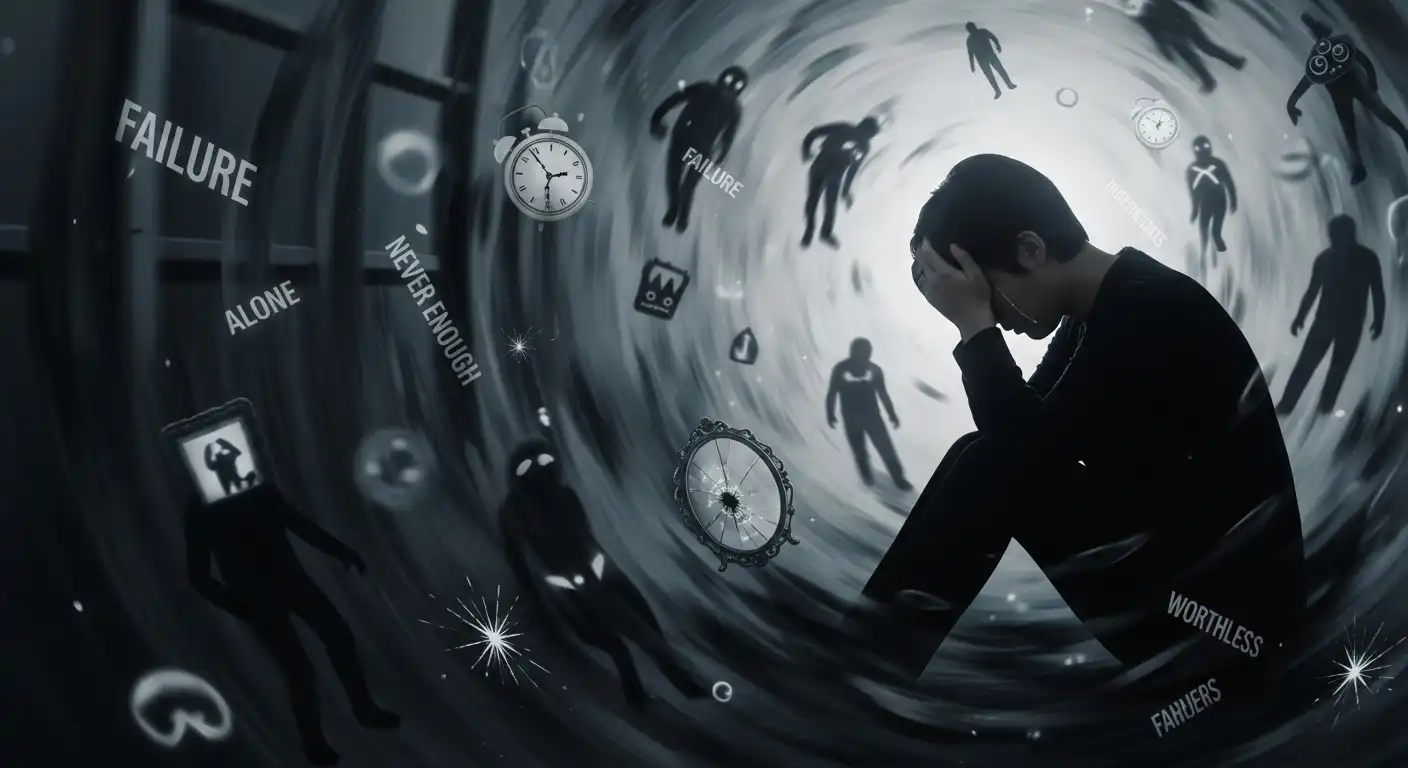
It begins as a whisper. A subtle doubt about a presentation you just gave, a flicker of insecurity about a comment your partner made, or a looming sense of dread about the future. Within minutes, the whisper becomes a shout. Your mind begins to race, constructing elaborate worst-case scenarios, cataloging your past failures, and convincing you that you are not good enough, smart enough, or capable enough.
We have all been held hostage by our own minds. This internal dialogue, often referred to as the “inner critic,” can be relentless. It paralyzes us, turning manageable challenges into insurmountable walls.
But here is the truth that psychology and neuroscience have uncovered: You are not your thoughts. You are the observer of your thoughts. As the observer, you have the power to edit the script.
This process is known as Cognitive Reframing. It is not about “thinking happy thoughts” or ignoring reality—that is toxic positivity. Reframing is a psychological tool used to shift your perspective on a situation toward a more realistic, positive, and constructive view. It is the art of turning a mental roadblock into a stepping stone.
This comprehensive guide will walk you through the science of negativity, the mechanics of reframing, and, most importantly, how to turn those reframed thoughts into tangible, positive action.
The Science of the Shadow: Why We Lean Negative
To conquer negative thinking, we must first understand why it exists. It is easy to blame ourselves for being “pessimistic,” but the truth is that our brains are hardwired for negativity.
The Evolutionary Negativity Bias
Anthropologists and evolutionary biologists call this the Negativity Bias. Tens of thousands of years ago, your ancestors’ survival depended on their ability to identify threats. The human who sat around admiring the sunset might have missed the tiger in the bushes. The human who was anxious, hypervigilant, and constantly scanning for danger was the one who survived and passed on their genes.
Today, we rarely face tigers. However, our brains still possess this ancient software. We treat an awkward email from a boss with the same physiological stress response as a predator attack. Our brains are like Velcro for negative experiences and Teflon for positive ones. Understanding this is the first step to freedom: Your negative thoughts are not a character flaw; they are an evolutionary survival mechanism that is outdated for the modern world.
Neuroplasticity: The Path to Change
The good news is that the brain is not fixed. Through neuroplasticity, the brain can reorganize itself by forming new neural connections. Every time you indulge a negative thought, you strengthen that neural pathway, making it easier to think negatively next time. Conversely, every time you interrupt a negative thought and reframe it, you are physically hacking a new path through the mental jungle. With repetition, the positive path becomes the highway, and the negative path becomes an overgrown trail.
The Anatomy of a Negative Thought
Before we can reframe, we must identify. Negative thoughts rarely appear as calm, rational observations. They usually manifest as Cognitive Distortions—irrational thought patterns that perpetuate anxiety and depression. Recognizing these is like turning on the light in a monster-filled room; suddenly, they look much less daunting.
All-or-Nothing Thinking
This is the world of binaries. You are either a total success or a complete failure. If you eat one cookie while on a diet, you tell yourself, “I’ve ruined everything,” and proceed to eat the whole box. There is no middle ground.
Catastrophizing
This is the “snowball effect.” You make a small mistake at work, and your brain instantly jumps to: “My boss hates me, I’m going to get fired, I’ll lose my house, and I’ll die alone.” You amplify the negative outcome to the extreme.
Mind Reading
You assume you know what others are thinking, and it’s always bad. “She didn’t text back immediately; she must be annoyed with me.” You are projecting your own insecurities onto others without evidence.
Filtering
You filter out all the positive aspects of a situation and dwell exclusively on the negative. You could receive ten compliments and one critique, and you will obsess over the critique for days while forgetting the compliments entirely.
The 4-Step Framework for Reframing
Reframing is a skill, like playing the piano or learning a language. It requires a system. Here is a four-step framework to take a thought from negative to neutral, and finally to positive action.
Step 1: The “Stop” Signal (Awareness)
Most negative thinking happens on autopilot. We spiral for twenty minutes before we even realize we are doing it. The first step is to catch the thought.
- The Technique: Create a somatic (physical) interrupter. When you feel the physical symptoms of anxiety—tight chest, shallow breathing, clenched jaw—say the word “STOP” out loud (or in your head).
- The Label: Name the emotion. “I am feeling anxious right now.” “I am engaging in catastrophizing.” Naming the monster shrinks it.
Step 2: The Tribunal of Truth (Analysis)
Once you have stopped the thought, put it on trial. Do not accept it as fact. Act like a lawyer cross-examining a witness.
Ask these questions:
- Is this thought 100% true?
- Do I have concrete evidence for this thought?
- What is the evidence against this thought?
- Would I say this to a best friend who was in my position?
Example:
Negative Thought: “I am going to fail this project and get fired.”
Evidence: “I am behind schedule.”
Counter-Evidence: “I have successfully managed projects before. My boss has given me good performance reviews. I have time to ask for help.”
Step 3: The Pivot (The Reframe)
Now, we rewrite the script. The goal isn’t to lie to yourself (“Everything is perfect!”). The goal is to find a more constructive perspective.
- The “Yet” Technique: Add the word “yet” to the end of negative sentences. “I don’t understand this” becomes “I don’t understand this yet.”
- The Challenge Reframe: Turn threats into challenges. “This is a disaster” becomes “This is a problem to be solved.”
- The Learning Reframe: Turn failure into data. “I messed up” becomes “I learned one way that doesn’t work.”
Step 4: The Bridge to Action
This is the most critical step. A reframed thought is useless if it stays in your head. You must bridge the gap between “thinking differently” and “acting differently.”
- The Question: Ask yourself, “Given this new, positive perspective, what is the smallest step I can take right now?”
Turning Thoughts into Action: Practical Scenarios
Let’s look at how to apply this framework to three common areas of life where negativity often takes root.
Scenario A: Career Imposter Syndrome
The Trigger: You are assigned a new responsibility or promoted
The Negative Thought: “They are going to find out I’m a fraud. I’m not sure what I’m doing. I’m going to humiliate myself.”
The Distortion: Mind Reading and Catastrophizing.
The Process:
- Stop: Recognize the racing heart. Label it: “This is Imposter Syndrome.”
- Analyze: Is it true you know nothing? No. You were hired for a reason. Everyone learns on the job.
- Reframe: “I am not a fraud; I am a learner. Feeling out of my depth just means I am growing. It is okay not to know the answer immediately.”
- Positive Action: Instead of hiding or overworking to compensate, ask a specific question. “Hey [Colleague], I’d love your insight on this specific part of the project.” This turns fear into collaboration.
Scenario B: Rejection in Dating or Relationships
The Trigger: You get rejected after a few dates or a long-term relationship ends.
The Negative Thought: “I am unlovable. There is something wrong with me. I will be alone forever.”
The Distortion: All-or-Nothing Thinking and Personalization.
The Process:
- Stop: Catch the spiral of self-pity.
- Analyze: Does one person’s opinion define your worth? No. Are there people who love you (friends/family)? Yes.
- Reframe: “This rejection is not a reflection of my worth; it is a reflection of compatibility. By this ending, I am free to find someone who is actually right for me.”
- Positive Action: Do not isolate. Schedule a non-romantic social activity with a friend who makes you feel good. Reconnect with a hobby you neglected. Signal to your brain that you are whole on your own.
Scenario C: Procrastination and Overwhelm
The Trigger: A messy house or a massive to-do list.
The Negative Thought: “It’s too much. I’m so lazy. I’ll never get this done. I might as well just watch TV.”
The Distortion: Labeling (“I’m lazy”) and Emotional Reasoning (I feel overwhelmed, so it must be impossible).
The Process:
- Stop: Acknowledge the paralysis.
- Analyze: Are you lazy, or are you just overwhelmed by the size of the task?
- Reframe: “I don’t have to finish everything today. I just need to start. Action creates motivation, not the other way around.”
- Positive Action: The 5-Minute Rule. Commit to doing the task for just five minutes. Tell yourself you can stop after five minutes. Usually, once you overcome static friction, you will continue.
Advanced Strategies: Building a Resilient Mindset
Reframing is a reactive tool—something you use when a negative thought appears. But how do we build a proactive, positive? Mindset, we need preventative maintenance.
Gratitude as a Cognitive Anchor
Gratitude is often dismissed as “fluff,” but neurologically, it is a powerhouse. It trains your Reticular Activating System (RAS). The RAS is the filter in your brain that decides what information to let through. If you focus on problems, your RAS will scan the world for problems. If you focus on gratitude, your RAS scans for opportunities.
- The Action: Every morning, write down three specific things you are grateful for. Not just “my family,” but “the way the coffee tasted this morning” or “the sunshine on my drive.” Specificity breeds emotion, and emotion changes the brain.
The “Best Case Scenario” Game
Anxiety is essentially using your imagination to create a future you don’t want. Flip the script.
When you catch yourself worrying, “What if it goes wrong?”, force yourself to ask, “What if it goes right?”
Visualize the success. Athletes use this visualization technique to prime their bodies for performance. By visualizing a positive outcome, you reduce the fear response associated with the event.
Curate Your Environment
Negative thoughts are contagious. If you are surrounded by cynical friends, doom-scrolling news feeds, and toxic workplace gossip, reframing becomes 10 times harder.
- The Digital Detox: Unfollow accounts that make you feel inadequate or angry.
- The Circle of Influence: Spend more time with “radiators” (people who radiate warmth and optimism) and less time with “drains.”
Separate “Fact” from “Story”
This is a technique popularized by Brené Brown, a researcher. When something bad happens, we immediately create a story to explain it.
- Fact: My partner is quiet tonight.
- Story: They are bored with me and considering leaving. The suffering comes from the story, not the fact.
- The Action: When you feel a negative emotion rising, say aloud: “The story I am telling myself is…” This phrase acknowledges that your interpretation might not be reality.
The Role of Self-Compassion
In our quest for self-improvement, we often turn reframing into another weapon to beat ourselves up with. “Why am I thinking negatively again? I should be better at reframing!”
This is the “meta-negative thought”—feeling bad about feeling bad.
You must practice Self-Compassion. You cannot hate yourself into a better version of yourself. When you have a negative thought, treat yourself with the same kindness you would offer a scared child.
- Instead of: “Stop being such an idiot and worrying.”
- Try: “I see you are scared right now. That’s okay. It’s a scary situation. But we can handle this.”
Research shows that self-compassion is more effective than self-criticism for motivation. Self-criticism activates the threat response (cortisol), while self-compassion activates the caregiving response (oxytocin), which helps you feel safe enough to try again.
Moving From “Thinking” to “Doing”: The Behavior-First Approach
Sometimes, the mind is too loud. No amount of mental gymnastics or reframing seems to work. In these moments, you must flip the equation.
Traditional psychology suggests: Think -> Feel -> Act. (Change your thoughts to change your feelings, then act).
Behavioral psychology suggests: Act -> Feel -> Think. (Change your actions to change your feelings and thoughts).
This is often referred to as “Behavioral Activation.” If you feel depressed and think, “I don’t want to go for a walk,” and you stay on the couch, you reinforce the depression. If you force yourself to go for the walk despite the thought, your body starts moving, endorphins are released, and the thought “I can’t do anything” is disproven by your actions.
Action is the ultimate reframe.
When you are stuck in a loop of negativity, do something—anything—that contradicts the thought.
- Thought: “I am helpless.”
- Action: Clean one drawer. (Proof of agency).
- Thought: “I am alone.”
- Action: Smile at a barista. (Proof of connection).
Conclusion
Reframing negative thoughts into positive action is not a magic pill. It is not something you do once, and then you are “cured” of negativity forever. It is a daily hygiene practice, like brushing your teeth or showering.
Some days, the negative thoughts will win. Some days, you will spiral. That is part of the human experience. The goal is not to have a mind that never produces a negative thought; the goal is to have a mind that doesn’t get stuck in them.
By cultivating awareness, challenging your internal narrative, and taking small, consistent actions, you reclaim your power. You stop being a victim of your biology and start being the architect of your reality.
Remember: Your thoughts are just suggestions. You decide which ones to accept and which to discard. Choose the ones that help you build the life you want.






