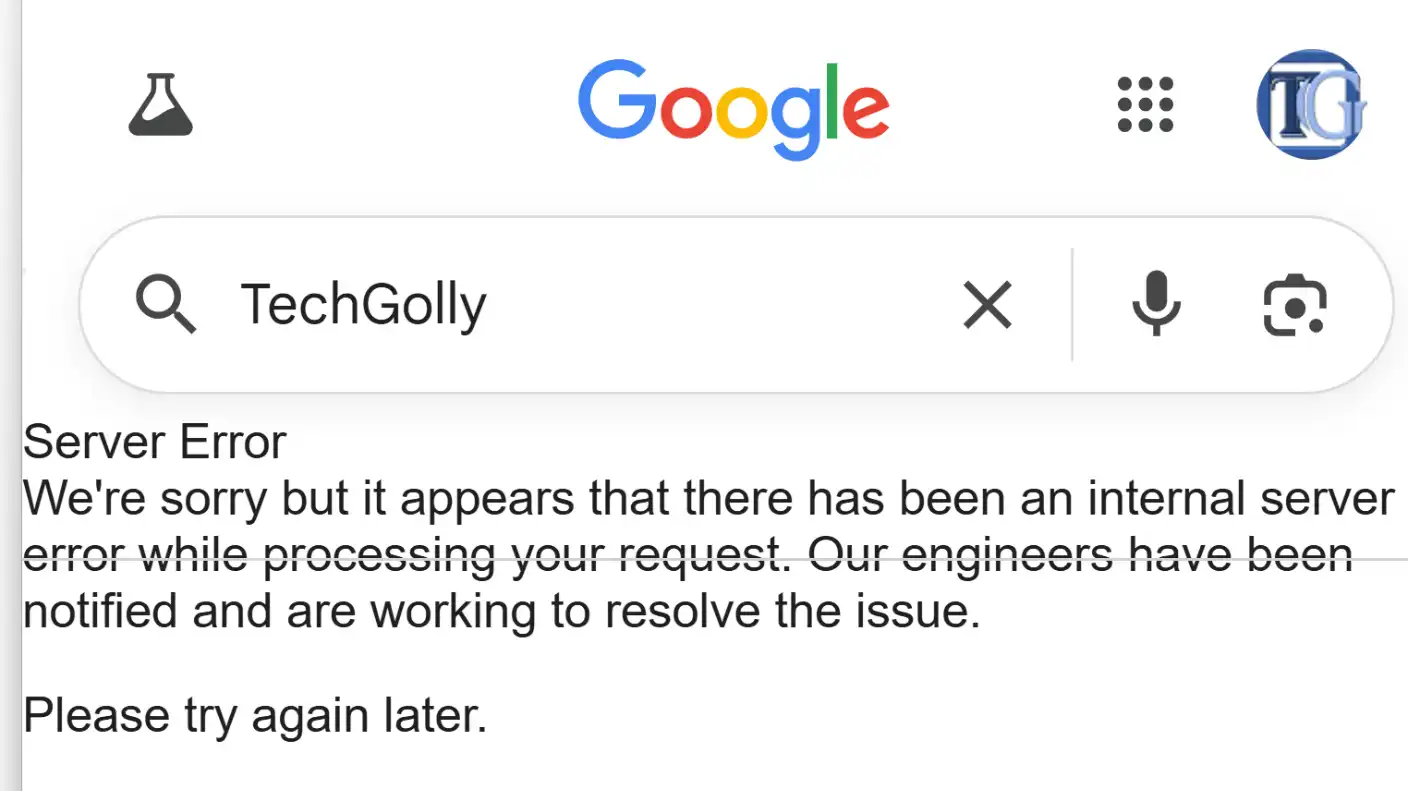
Key Points:
- The TechGolly team discovered a massive Google Search server failure at exactly 01:05 AM Eastern Time.
- Users trying to look up information received a stark white page displaying a standard internal server error message.
- Google processes an incredible 8.5 billion searches daily, making even a short 15-minute global outage a massive event.
- Financial analysts estimate a total search blackout could cost the technology giant up to $1.5 million in lost advertising revenue.
At exactly 01:05 AM Eastern Time, the internet practically stopped working for millions of night owls. The TechGolly team noticed something completely unusual while running routine website checks. Google Search, the most visited website on the planet, completely crashed. Users who tried to look up basic information saw a stark white screen instead of the familiar colorful logo and search bar.
The screen displayed a very specific warning to frustrated users. It read, “Server Error. We’re sorry, but it appears that there has been an internal server error while processing your request.” The message then assured visitors that engineers were aware of the problem and advised them to try again later. This generic 500 error code rarely appears on the search giant’s main page.
TechGolly researchers immediately documented the sudden outage. The team actively monitors website traffic and server health across the globe. Finding a Google server that’s completely down feels like finding a needle in a haystack, especially given the company’s 99.9% uptime guarantee. The researchers quickly grabbed screenshots of the error message to confirm the massive blackout.
Google controls roughly 92% of the global search engine market. People rely on the site for everything from homework help to emergency medical advice. The company processes an incredible 8.5 billion searches every single day. If you break that math down, roughly 98,000 searches happen every single second.
When Google goes completely dark, the financial losses stack up instantly. The company generates massive profits through targeted search advertisements. Financial experts suggest that a total global blackout could cost the company around $1.5 million in lost revenue for every 10 minutes the system stays offline. Advertisers also lose money when their sponsored links stop appearing to potential buyers.
The error message stated that company engineers received alerts about the crash. Google employs thousands of top-tier software developers and network experts who work in shifts around the clock. When a primary server cluster fails, these tech teams scramble to reroute traffic to backup data centers located in different states and countries.
Social media platforms exploded with activity almost immediately after the crash. Users started trending new hashtags about the outage within just 5 minutes of the initial server failure. People shared jokes and asked if their local internet service providers had completely broken down. Most folks simply assume their own Wi-Fi stopped working before they ever suspect a Google server has crashed.
Massive server failures at this scale simply do not happen often. The tech giant spends over $25 billion a year building and maintaining physical data centers around the world. They install custom cooling systems and heavy backup power generators to keep the machines humming. A total internal server error suggests a complex software bug rather than a broken physical wire.
Small businesses feel the pain immediately when search traffic stops. Millions of local shops rely on maps and search queries to drive foot traffic to their physical storefronts. If a hungry customer searches for late-night pizza and the server fails, that local pizzeria loses a guaranteed 100% of that immediate sale. This ripple effect hurts local economies even during late-night hours.
Industry experts believe a bad code update likely caused the sudden crash. Technology companies regularly push software updates during late-night hours, when user traffic is at its lowest. If a developer accidentally types a bad line of code into a massive system update, it can break the entire network in a matter of seconds. Fixing the issue usually requires the team to roll back the system to an older, stable version.
TechGolly continues to monitor the situation as the company works to stabilize its main search grid. Google usually publishes a detailed report after major outages to explain exactly what went wrong behind the scenes. For now, internet users have to remember what life was like before they had the entire world’s knowledge right at their fingertips.
The internet community fully expects the engineering team to resolve the internal server error swiftly. The TechGolly team will keep testing the search bar until the familiar blue links finally return to the screen. Until the engineers officially fix the problem, web surfers will have to type exact website addresses into their browsers or try out alternative search engines.