

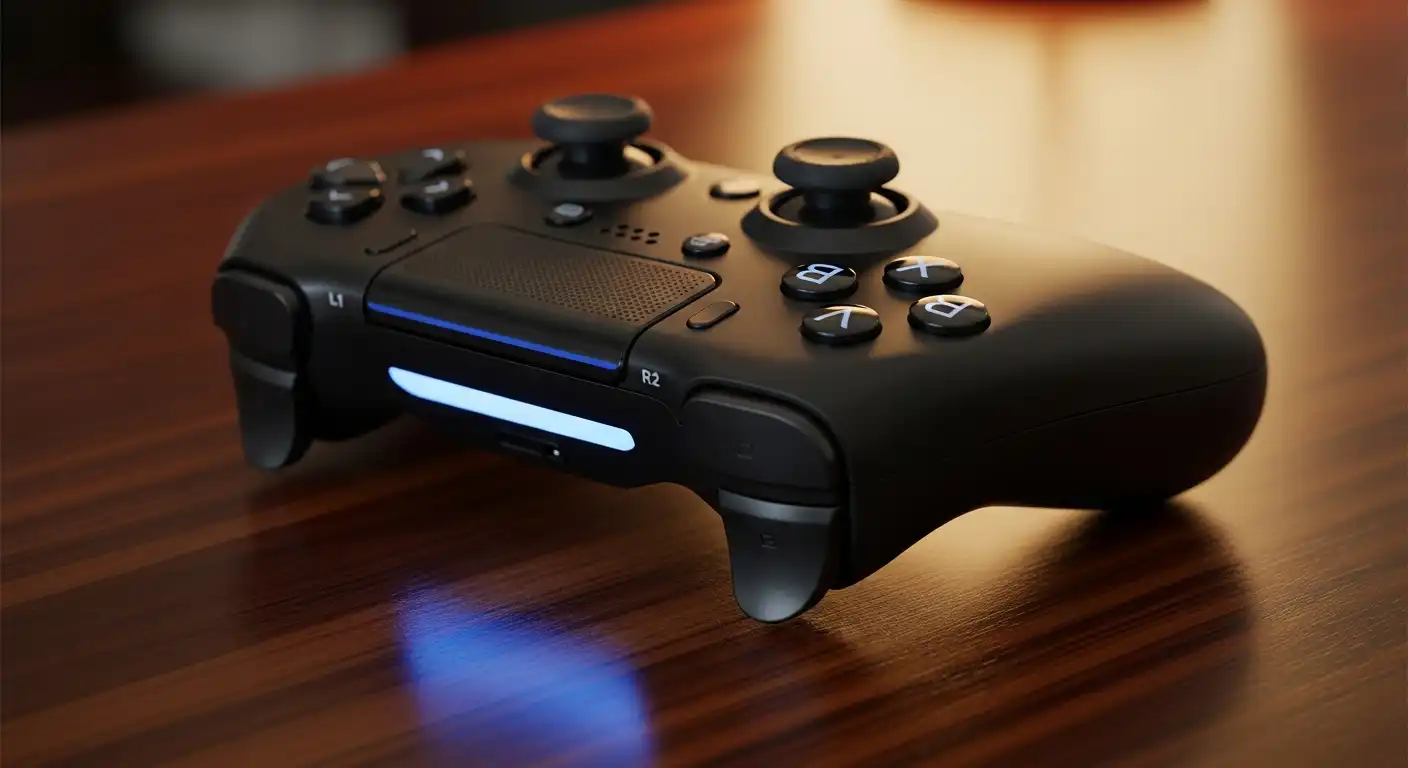
The video game controller is the most important, and most overlooked, piece of gaming hardware. It is the handshake between you and the digital world, the physical object that translates your thoughts and reflexes into action on the screen. It started as a clunky box with a single joystick and one red button. Today, it’s a hyper-sensitive, wirelessly connected, ergonomically perfected extension of our own hands. This evolution is a fascinating story of how we learned to talk to our games.
The Age of the D-Pad
The first great leap came when Nintendo replaced the imprecise, wobbly joystick of the Atari era with the “Directional Pad,” or D-Pad. This simple, cross-shaped button was a revelation. It was precise. It was tactile. It gave you a level of control over your 2D character that was impossible before. The D-Pad, combined with the A and B buttons, became the blueprint for game controllers for an entire generation. This was the design that taught us how to run and jump, to navigate a maze, and to master the simple, satisfying language of 2D games.
Entering the Third Dimension
When games made the leap from 2D sprites to 3D worlds, the controller had to evolve with them. The old D-Pad was great for moving left, right, up, and down, but it was terrible for moving forward. This was the moment the analog stick was reborn. The Nintendo 64 controller, with its revolutionary thumbstick, was the first to solve the problem of 3D movement truly. It gave us nuance. We could now walk, run, or sneak, all depending on how far we pushed the stick. This was the birth of the modern controller layout.
The Language Becomes Standardized
For a while, every company had a different idea of what a controller should be. They had different shapes, different button layouts, and different philosophies. But over time, a standard, unspoken language emerged. This was the “dual analog” layout perfected by Sony’s PlayStation. Two thumbsticks—one for movement, one for the camera—a D-Pad on the left, four face buttons on the right, and shoulder buttons. This design was so effective and intuitive that it has become the universal standard that almost every controller has followed for the last 20 years. We had finally found the perfect grammar for talking to our games.
Feeling the Game, Not Just Playing It
The next evolution wasn’t about adding new buttons; it was about what we could feel. This started with the simple “rumble” feature, which would shake the controller when you got hit or when an explosion occurred. But modern controllers have taken this to a whole new level. Features like the “HD Rumble” in the Nintendo Switch or the “haptic feedback” in the PlayStation 5 controller can produce incredibly subtle, advanced vibrations. You can now feel the difference between walking on sand and walking on metal, the tension of a bowstring being pulled, or the pitter-patter of rain. The controller is no longer just an input device; it’s an output device, sending information from the game world back to your hands.
A Perfected Tool
The modern video game controller is a masterpiece of ergonomic design and engineering. It is the result of 40 years of trial, error, and refinement. We have gone from a simple stick and a button to a device that is packed with sensors, motors, and a perfectly honed layout that has become second nature to millions of people. It is the invisible hero of the gaming world, a tool so well-designed that we often forget it’s even there, allowing us to become completely immersed in the digital worlds it helps us explore.






