

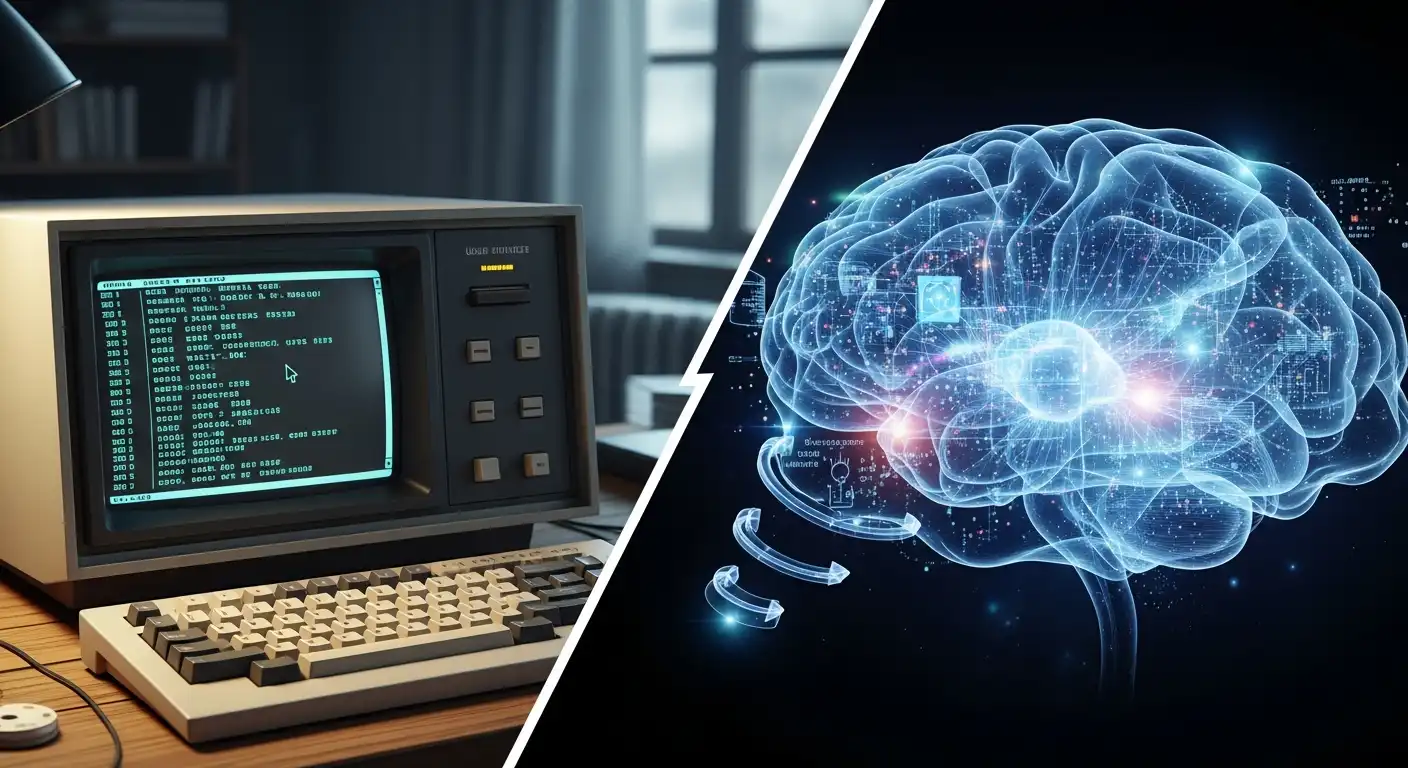
A user interface is the handshake between a human and a machine. It’s the language we use to tell a computer what we want it to do. For a long time, that language was a brutal, unforgiving one that only a handful of experts could speak. The story of the user interface is a story of a relentless quest to make that handshake simpler, more natural, and more intuitive. It is a journey from the cryptic blinking cursor to a future where the interface might disappear entirely.
The Age of the Command Line
The first handshake was a harsh one. The “Command-Line Interface” (CLI) was a black screen with a blinking cursor. There were no icons, no windows, no mouse. You had to learn a secret, cryptic language of commands to get the computer to do anything. If you typed a single letter wrong, the computer would simply reply with “command not found.” It was powerful and efficient in the hands of an expert, but it was a brick wall for everyone else. The computer was a fortress, and the CLI was the tiny, heavily guarded gate.
The Great Visual Revolution
The revolution that brought computing to the masses was the “Graphical User Interface” (GUI). Pioneered by Xerox and made famous by Apple and Microsoft, the GUI was a brilliant metaphor. It turned the abstract world of the computer into a familiar physical space: a “desktop” with “files,” “folders,” and a “trash can.” You no longer had to learn a secret language; you could just point and click with a mouse. This was the moment the fortress walls came down. The GUI invited the entire world in, and it has been the dominant way we interact with our machines for the last 40 years.
The Age of Touch
The next great leap was to remove the mouse, the middleman between our hand and the screen. The “Touch Interface,” brought to the mainstream by the iPhone, was the most intuitive leap forward yet. It was a return to our most primal way of interacting with the world: direct manipulation. We no longer had to move a plastic mouse to move a cursor to click a button; we could just touch the button. This was a revolution in simplicity that made computing accessible to toddlers and grandparents alike. The interface was no longer a metaphor for the real world; it was a direct extension of our own fingers.
The Rise of the Voice
The most recent step in this evolution has been the quest to get rid of the screen entirely. The “Voice User Interface” (VUI) of our smart speakers is the first truly “invisible” interface. There is no screen to look at, no buttons to press. The handshake is a conversation. While still in its early days, the VUI represents a profound shift. It is the first interface that doesn’t require our hands or our eyes, allowing us to interact with our technology while we are doing other things, like cooking or driving.
The Final Frontier: The Brain
Where is this journey heading? The logical endpoint is the “Brain-Computer Interface” (BCI), a technology that is already being developed in labs around the world. This is the ultimate handshake, a direct connection between our thoughts and the machine. It is a future where the interface disappears completely, where the act of telling the computer what to do is indistinguishable from the act of simply thinking it. This is a future that is both thrilling and terrifying, but it is the final step in a 50-year quest to make the language between human and machine as natural and as seamless as a conscious thought.






