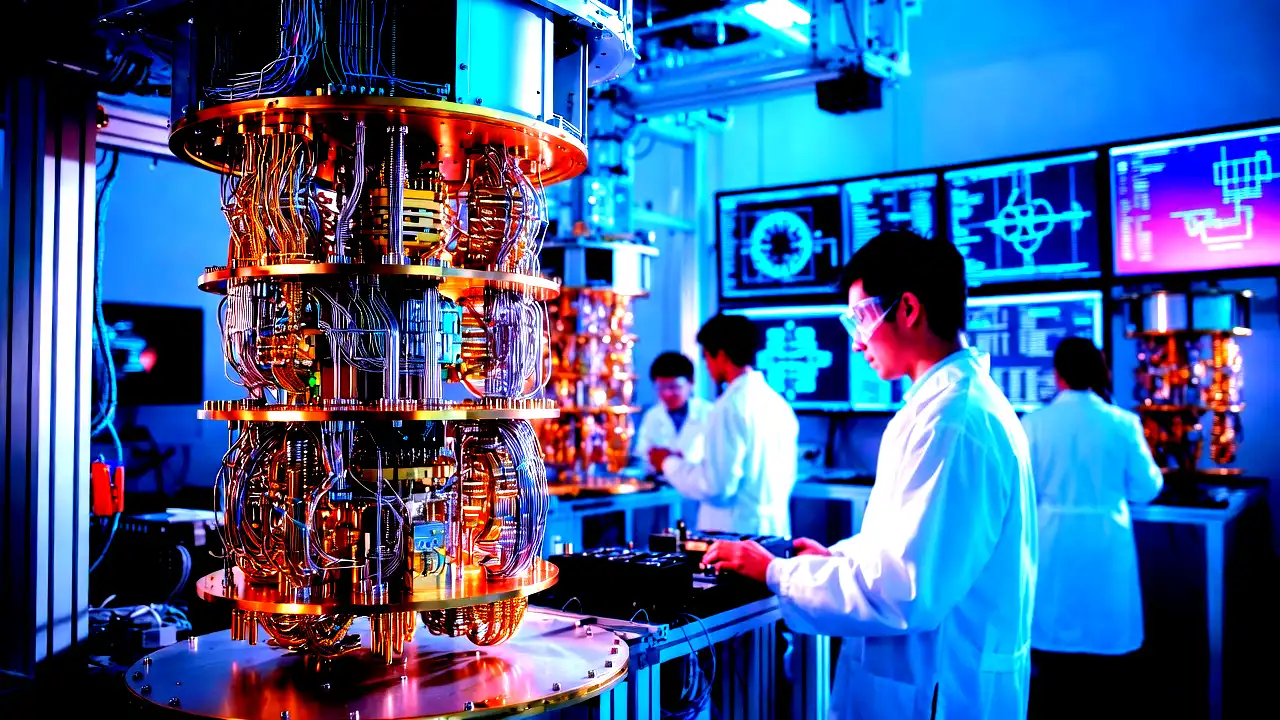
We live our lives online, trusting that our secrets are safe. Every password, bank transfer, and private message is protected by a layer of encryption—a digital lock. For today’s computers, breaking these locks is like trying to guess a password that is trillions of characters long. It is practically impossible. But a new type of machine, the quantum computer, is on the horizon. It thinks in a completely different way, and it is learning how to pick every digital lock we use.
Why Today’s Locks Won’t Work Tomorrow
Our current security standards are built on mathematical problems that are easy to create but incredibly hard to solve. Think of it like mixing two specific colors of paint to get a third. It’s easy to mix them, but very difficult to look at the final color and figure out the exact original shades. A normal computer has to guess and check over and over, a process that would take centuries. A quantum computer, however, can use its unique power to see through the mathematical trick, breaking down the problem and revealing the answer in minutes or hours. Once these machines are powerful enough, the encryption protecting everything from government intelligence to your email will become useless.
The Data Heist Is Happening Now
This is not just a problem for the future. Adversaries and spy agencies are acting today. They are actively stealing and copying huge amounts of encrypted data from governments and corporations around the world. They cannot read this information yet, but they are storing it on massive servers. This strategy is known as “Harvest Now, Decrypt Later.” They are betting that in a few years, they will have a quantum computer capable of unlocking this stolen data. This means that any secret that needs to stay secret for the next decade is already in danger.
Building a Quantum-Resistant Future
Fortunately, the world’s brightest minds are already building new locks. A new generation of protection, known as post-quantum cryptography (PQC), is being developed. These new encryption methods are based on different kinds of math problems—ones that are hard for both normal and quantum computers to solve. It’s like retiring the old key-and-lock system and replacing it with complex puzzles that no machine can easily game. Governments and tech companies are in a race to standardize and roll out these new protections before the quantum threat becomes a reality.
Using Quantum to Fight Quantum
Interestingly, the strange physics that make quantum computers a threat can also be used to build a stronger defense. A technique called Quantum Key Distribution (QKD) allows two people to share an encryption key with total security. It uses the principles of quantum mechanics to send information. If a third party tries to eavesdrop on the transmission, the very act of observing it changes the information, immediately alerting the original users to the security breach. This technology promises to create communication channels that are, by the laws of physics, impossible to spy on.
Conclusion
The age of quantum computing will bring about the single greatest challenge to our digital security that we have ever seen. It will force a worldwide overhaul of the systems that protect our most sensitive information. The threat is real, and the timeline is shrinking. However, we have the tools and the talent to prepare our defenses. By moving quickly to adopt post-quantum cryptography and exploring new quantum security methods, we can build a future where our digital armor is stronger than ever.