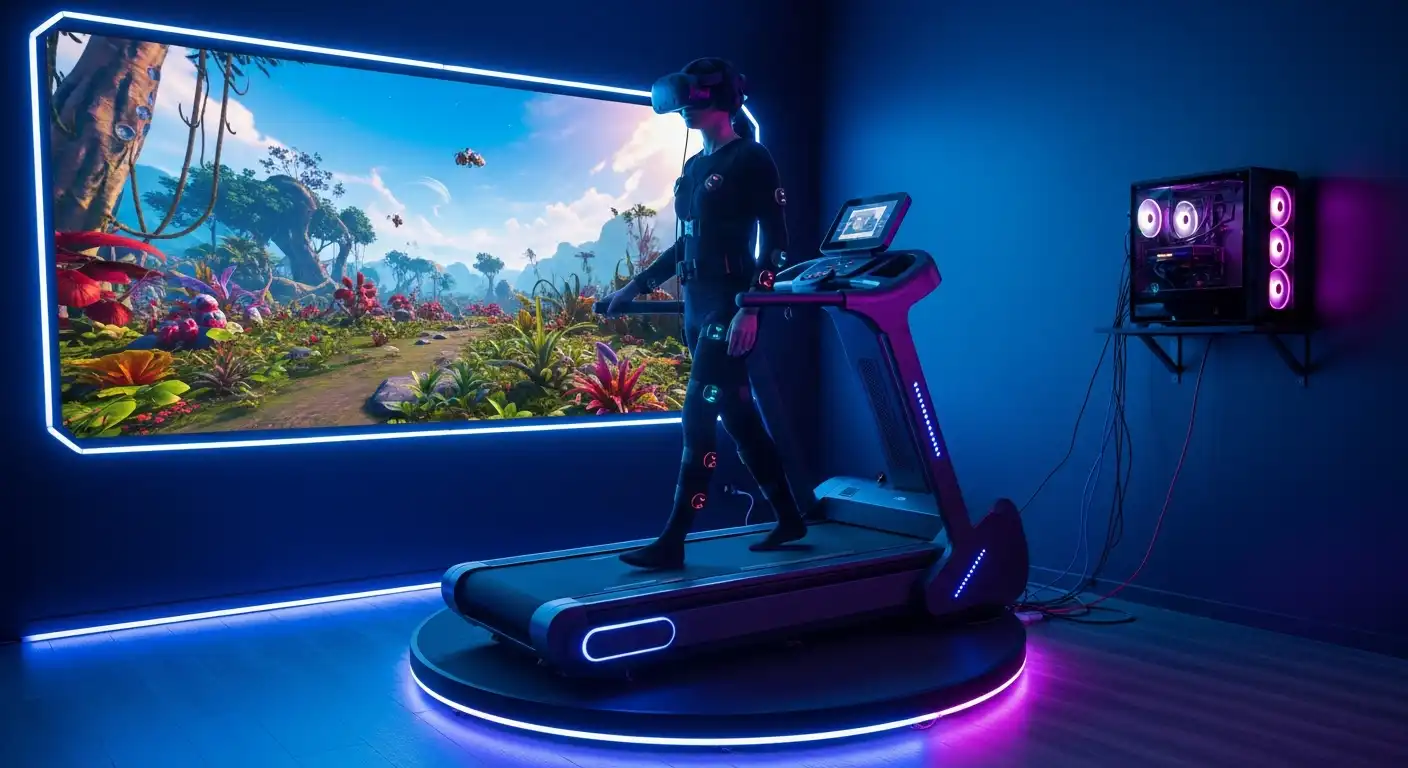
The ultimate dream of virtual reality is total immersion. We dream of the Holodeck from Star Trek—a world we can walk into, where the digital and physical are indistinguishable, and our bodies are the controllers. To solve the problem of walking around a virtual world while stuck in a small physical room, a new kind of hardware has emerged: the VR treadmill. It’s a massive, omnidirectional platform that lets you “walk” in any direction. And it is, without a doubt, one of the most absurd, over-engineered, and misguided pieces of technology I have ever seen.
Solving a Problem That Shouldn’t Exist
The very premise of the VR treadmill is based on a failure of imagination. It tries to solve the problem of VR locomotion with a brute-force, physical solution. But the magic of VR is that it isn’t the real world. We don’t need to be bound by its limitations. Game developers have already come up with dozens of clever, elegant software solutions for movement, from simple joystick control to “teleportation” mechanics. These solutions are free, they take up no space, and they work. The VR treadmill is a multi-thousand-dollar answer to a question that the software has already solved.
The Clunky, Expensive Reality
Let’s be honest about what these things are. They are not sleek, futuristic platforms. They are monstrously large, incredibly heavy, and ridiculously expensive contraptions. They are giant, noisy, low-friction bowls that you have to strap yourself into with a harness. This is not a consumer product that will ever be in a normal living room. It’s a niche, enthusiast toy for people with a spare garage and a lot of disposable income. It’s the opposite of the accessible, user-friendly future that VR promises. It’s a step backward into the era of giant, room-sized computers.
The Awkward Shuffle of Broken Immersion
The worst part is that it doesn’t even feel like walking. You don’t stride; you slide. You have to wear special low-friction shoes and perform an awkward, gliding shuffle to move. All while being tethered to a giant ring above your head. Every part of the experience, from the unnatural foot movement to the physical harness, is a constant, nagging reminder that you are not in a virtual world. You are in your basement, strapped into a giant hamster wheel. Instead of enhancing immersion, it shatters it at every turn. It’s a solution that is worse than the problem it’s trying to solve.
A Technological Dead End
The VR treadmill feels like a technological dead end, a bulky placeholder for a future, more elegant solution. It’s the Segway of VR—a fascinating but ultimately impractical piece of engineering that will be remembered as a quirky footnote. The real future of VR locomotion will not be found in bigger, more complex hardware. It will be found in smarter software, better body tracking, or perhaps, one day, in a technology that interacts more directly with our brains. Building a giant mechanical contraption is the least imaginative path forward.
Let’s Dream a Better Dream
The dream of VR is to escape the limitations of our physical rooms, not to build a more elaborate cage inside them. The VR treadmill is an impressive piece of engineering, but it’s engineering pointed in the wrong direction. It’s a solution that is too big, too expensive, too awkward, and ultimately, too focused on recreating a physical experience that VR is supposed to help us transcend. We need to stop trying to build a better hamster wheel and start focusing on building better worlds.