Key Points
- Scientists have discovered a “hidden state” in a key family of proteins called kinases.
- This hidden state allows the kinase to modify its target protein multiple times, very quickly.
- It acts as a “quick-release” mechanism for waste products, turbocharging the process.
- This is vital for biological functions such as T-cell activation and cell migration.
Scientists have discovered a secret “hidden state” in a vital family of proteins, revealing how they can work so quickly and efficiently inside our cells. This breakthrough, from researchers at St. Jude Children’s Research Hospital, could open new avenues for designing drugs for a wide range of diseases, including cancer.
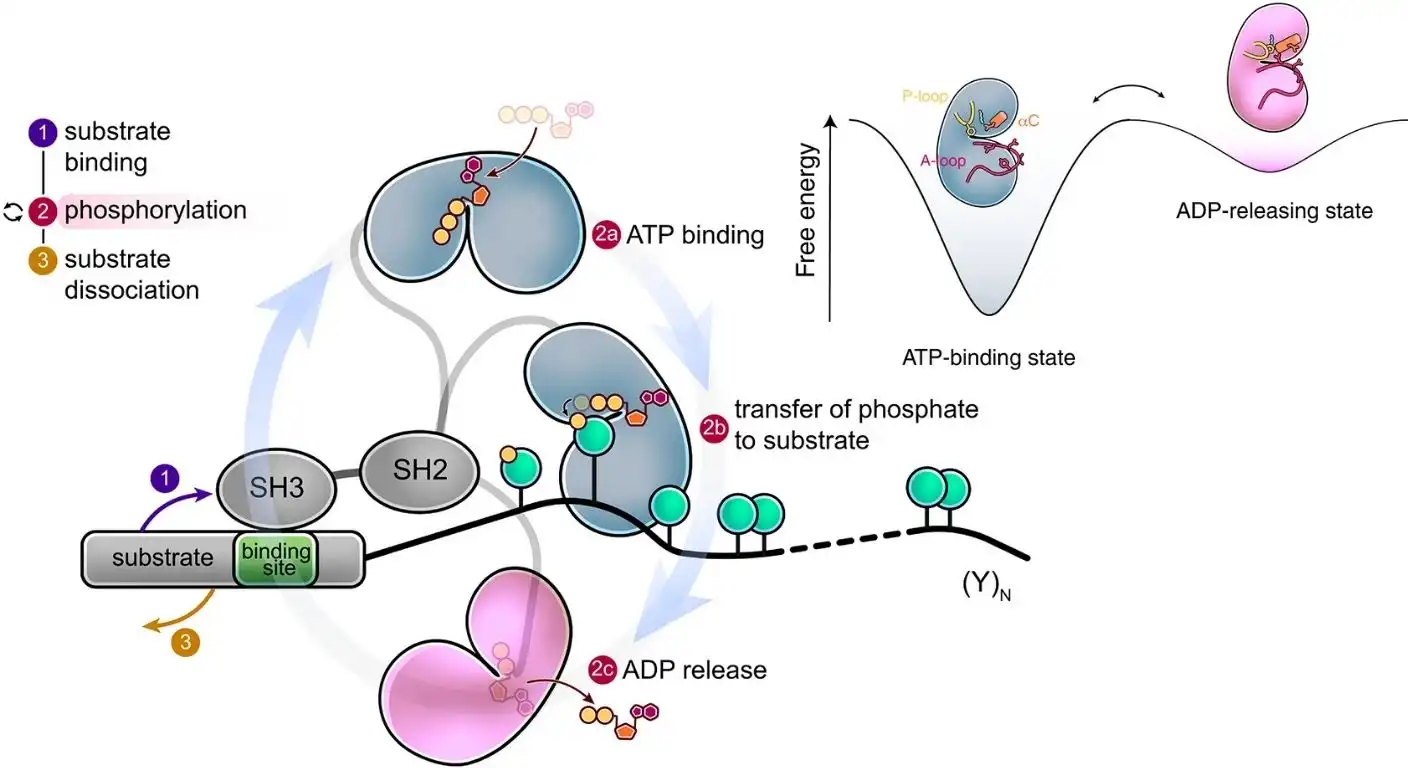
The research focuses on proteins called kinases, which act as master switches for many of our body’s most important functions. They work by attaching a phosphate group to other proteins in a process called phosphorylation. For some processes, such as promoting cell movement, a kinase must attach multiple phosphate groups to the same target protein rapidly, one after another.
Until now, scientists have not fully understood how the kinase acts rapidly without releasing its target.
The new study, published in the journal Science, has found the answer. Using advanced imaging techniques, the researchers identified a short-lived, “hidden state” that functions as a quick-release mechanism. This allows the kinase to rapidly discard the waste product from one reaction and immediately initiate the next, while still maintaining its target.
“These kinases have to work in a processive manner, so that once they dock onto their target, they can phosphorylate it at multiple sites in one go before they disassociate,” explained Charalampos Babis Kalodimos, the study’s lead author.
When the researchers blocked this hidden state with targeted mutations, key cellular functions such as cell migration and T-cell activation were severely disrupted, demonstrating the vital role of this fleeting state.