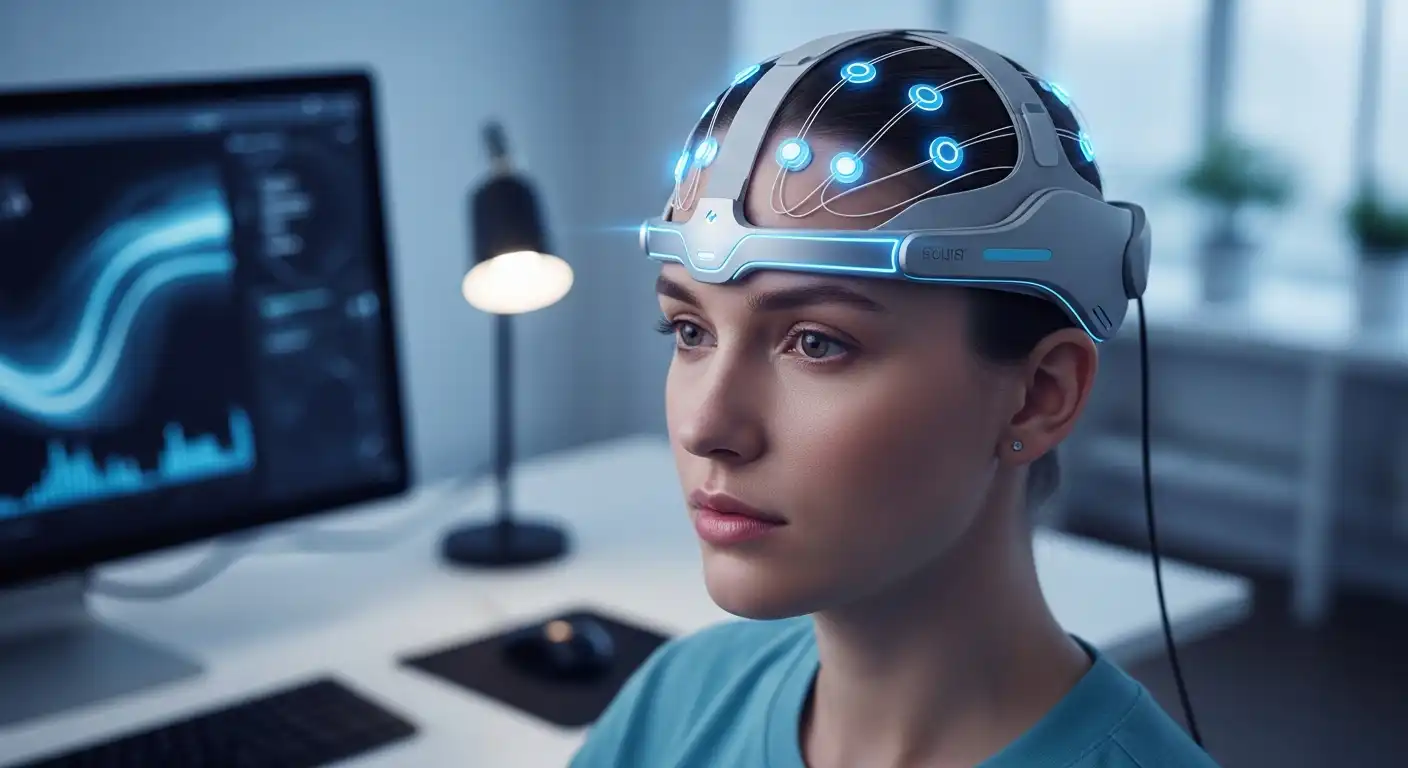
The line between human thought and digital interaction is blurring faster than ever before. Brain-Computer Interfaces (BCIs), once the domain of science fiction and advanced medical research, are rapidly entering the consumer space. These non-invasive devices are not about reading minds, but about understanding neural signals to create a new, frictionless way to interact with technology.
As we look toward 2026, the market is buzzing with groundbreaking prototypes designed to enhance everything from wellness and focus to augmented reality and gaming. These pioneers are moving beyond simple brainwave tracking to offer intuitive control and deep personalization. Here are the top 5 consumer BCI prototypes that are defining the next frontier of personal technology.
Kernel Flow C (Consumer Edition)
Kernel has made a significant leap from complex, helmet-sized research devices to sleek, consumer-focused prototypes. Their technology is unique in this list as it primarily uses fNIRS (functional near-infrared spectroscopy) to measure brain activity by tracking blood oxygenation.
By 2026, the “Flow C” prototype will represent the most advanced “quantified mind” device, offering deep insights into brain health and cognitive performance.
- fNIRS Technology: Provides a different and potentially richer data stream than traditional EEG, measuring the metabolic activity of the brain, which is closely linked to cognitive effort and focus.
- Focus on Brain Wellness: Designed to provide users with a detailed picture of their cognitive state, helping them track the effects of meditation, learning, or even diet on their brain’s performance.
- AI-Powered Insights: The platform uses sophisticated AI to translate complex hemodynamic data into clear, actionable insights about your focus, attention, and mental workload throughout the day.
- Sleek, Headphone-Like Design: Moving towards a form factor that is comfortable and stylish enough for everyday use, making brain activity tracking as normal as tracking your heart rate.
Best For: Biohackers, wellness enthusiasts, and anyone interested in the “quantified self” who wants the deepest possible insights into their brain’s health and performance.
Meta Reality Labs Wristband (CTRL-labs technology)
Meta’s vision for the metaverse and augmented reality hinges on a new form of input that is faster and more intuitive than a controller or hand tracking. The answer lies in the technology from its acquisition of CTRL-labs: a wristband that interprets neural signals sent from the brain to the hand.
By 2026, this wristband will be the most advanced prototype for seamless, intuitive control of AR glasses and virtual environments.
- EMG (Electromyography) Sensing: The wristband doesn’t read your brain directly, but rather the electrical signals of your motor neurons as they travel down your arm. This allows it to detect the intention of a finger movement before it even happens.
- Intuitive, Thought-Speed Control: Enables subtle, micro-gestures to be used for clicking, scrolling, and interacting with AR interfaces, creating a control scheme that feels as fast as thought.
- AI-Powered Haptic Feedback: The system provides intelligent haptic feedback, allowing you to “feel” virtual objects and buttons, creating a more tangible and immersive AR experience.
- Deep Integration with AR Glasses: Designed from the ground up to be the primary input device for Meta’s next-generation AR glasses, aiming to make them truly hands-free.
Best For: AR/VR early adopters, tech enthusiasts, and anyone excited by the future of human-computer interaction in the metaverse.
NextMind V2 (by Snap)
After being acquired by Snap, the technology from NextMind is being integrated into the future of social augmented reality. NextMind’s unique BCI reads signals from the brain’s visual cortex, allowing a device to know what you are focusing on in your field of view.
The 2026 prototype is a small, discreet module designed to work with AR eyewear, enabling a new form of hands-free, attention-based interaction.
- Visual Cortex Interface: A non-invasive sensor array on the back of the head detects brain activity related to your visual attention, effectively turning your focus into a cursor.
- Attention-Based Selection: Allows you to interact with AR objects simply by looking at them and focusing your attention, enabling a “look and think” method of control.
- Seamless Integration with AR Eyewear: Designed to be a small, low-power component of future Snap Spectacles or similar AR devices.
- Contextual, Hands-Free Experiences: Opens up new possibilities for AR experiences, such as changing a song on a virtual display or interacting with a game, all without using your hands.
Best For: Social media users, AR enthusiasts, and those interested in a new, passive, and hands-free method of digital interaction.
Muse (Next-Generation Neurofeedback)
Muse has been a leader in the consumer EEG space for years, known for its meditation and sleep-tracking headbands. By 2026, their next-generation prototypes have evolved into powerful, AI-driven personal focus trainers.
These devices use advanced neurofeedback and AI coaching to help users actively train their brains for improved concentration and mental performance.
- Real-Time Neurofeedback: Provides real-time audio feedback that responds to your brain activity, helping you understand when you are in a state of calm focus and when your mind is wandering.
- AI-Powered Focus Coaching: The accompanying app uses AI to analyze your brainwave patterns and provide personalized coaching programs and challenges designed to improve your ability to concentrate for longer periods.
- Integration with Productivity Apps: Prototypes are exploring integrations with productivity software, potentially dimming notifications or activating “focus mode” on your devices when your brain is in a state of deep work.
- Advanced Sleep and Recovery Tracking: Uses its multi-sensor array to provide even more detailed sleep stage analysis and recovery insights, linking your nightly rest directly to your next day’s cognitive performance.
Best For: Professionals, students, and anyone looking to improve their focus, manage stress, and optimize their mental performance through active training.
OpenBCI Galea V2
OpenBCI has long been the champion of the open-source BCI community, and its Galea project represents the pinnacle of multi-modal neurotechnology for immersive VR and AR. It integrates a huge array of sensors into a single head-mounted device.
The 2026 Galea V2 prototype is the ultimate “prosumer” BCI, offering a research-grade level of data for developers and serious enthusiasts building the next generation of immersive experiences.
- Multi-Modal Sensor Fusion: Combines high-density EEG (brainwaves) with EMG (muscle), EOG (eye movement), EDA (sweat), and PPG (heart rate) sensors to create a complete picture of a user’s physiological state.
- Designed for Immersive VR/AR: Built to integrate directly with VR headsets like the Varjo Aero, allowing developers to create experiences that respond in real-time to a user’s cognitive and emotional state.
- Open-Source and Extensible: As an open-source platform, it gives developers unparalleled access to the raw data and the ability to customize the hardware and software for their specific needs.
- Biometric-Responsive Experiences: Enables the creation of games that can adjust their difficulty based on your focus level, or wellness apps that guide you through biofeedback exercises with incredible precision.
Best For: VR/AR developers, academic researchers, and “prosumer” enthusiasts who want the most comprehensive, research-grade BCI data for building deeply immersive and responsive experiences.
Conclusion
The world of consumer BCI in 2026 is a thrilling glimpse into the future of human-computer interaction. We are moving beyond the hype and into the realm of practical, tangible prototypes. Kernel is quantifying the mind, Meta is revolutionizing control, Snap is leveraging attention, Muse is training our focus, and OpenBCI is deepening immersion.
While the “iPhone moment” for BCI may still be a few years away, these pioneering devices are the critical stepping stones. They are teaching us how this powerful technology can be integrated into our lives safely and ethically, paving the way for a future where our technology understands us on a fundamentally deeper level.