Key Points:
- Researchers successfully generated milliwatt-level ultraviolet light directly on a tiny photonic chip.
- The team used a clever process to combine two red photons into one single UV photon.
- The researchers built a complex nanoscale waveguide using thin-film lithium niobate.
- This breakthrough paves the way for smaller, cheaper quantum computers and optical atomic clocks.
Researchers from the University of Twente and Harvard University have just achieved a breakthrough in optics. They developed a brand new way to generate powerful ultraviolet light directly on a tiny photonic chip. For the very first time, this new technique produces UV light at milliwatt power levels. This level of power is critical for real-world applications. The scientists recently published their exciting findings in the journal Nature Communications.
Integrated light sources play a massive role in modern technology. For example, massive amounts of data travel across the globe every second via glass fiber-optic cables using infrared light. However, next-generation applications, like highly sensitive environmental sensors and complex quantum computing, require visible or ultraviolet light to function properly. Until this recent breakthrough, scientists struggled to generate high-quality short-wavelength light on tiny computer chips.
Kees Franken, one of the study’s authors, explained the core problem facing the industry. He noted that each application requires a specific color of light to work correctly. He admitted that at short wavelengths, like ultraviolet, the overall quality of integrated light sources has simply not been good enough for commercial use. The industry desperately needed a new approach to solve the power problem.
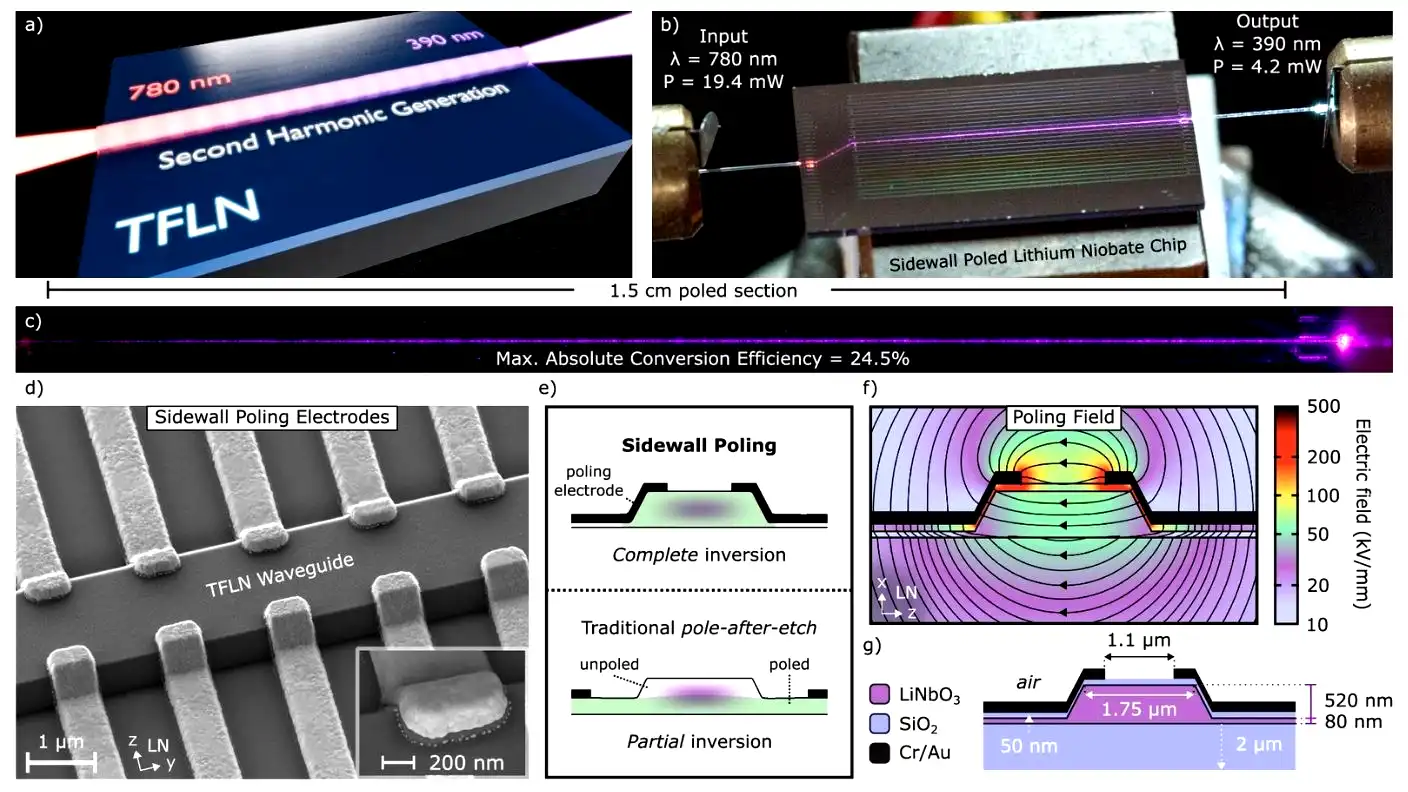
The research team solved the issue using a very clever conversion process. They started the experiment with standard red light. Scientists already know how to generate red light on a chip very easily and reliably. The team figured out a way to efficiently convert that abundant red light directly into ultraviolet light. During this complex physical process, two individual red photons combine to form a single, powerful UV photon.
Scientists have tried this conversion approach before, but previous attempts produced only a very small amount of light output. The tiny amount of light generated was basically useless for real-world technology. This new study is the first to generate a truly useful amount of UV light successfully. The team produced several milliwatts of power, roughly a hundred times more than any previous work in this field.
To achieve this massive leap in power, the team had to use a highly specialized material called thin-film lithium niobate. A group of scientists at Harvard University originally pioneered the chip-scale version of this exact material. In recent years, thin-film lithium niobate has drawn considerable attention from the scientific community for its unusual physical properties.
Using this unusual material, the researchers built a highly distinctive waveguide directly on the chip. A waveguide is simply a tiny, nanometer-scale structure that channels and confines light as it travels across the chip. The team carefully manipulated the waveguide along its entire length, which measured nearly two centimeters. To do this correctly, they first had to measure its exact shape with an incredible precision of just a few dozen atomic diameters.
Next, the team ran thousands of tiny electrical electrodes right along the sides of the waveguide. Using these electrodes, the team periodically reversed the orientation of the material’s internal crystal structure, flipping it up to a thousand times every single millimeter. By alternating the voltage on and off along the waveguide, they created a specific pattern that enables the red-to-UV conversion. Each of the roughly 10,000 electrodes on the waveguide is unique, perfectly tailored to the waveguide’s exact shape at that specific microscopic point on the chip.
Franken explained how this new design differs from previous failures. In earlier experiments, scientists placed the electrodes some distance from the waveguide itself. Franken noted that in his team’s new design, the electrodes sit directly on top of it. He admitted that this design required a highly complex fabrication process accurate to just fifty nanometers across a chip several centimeters long. However, the direct contact gives the scientists far more control, making the conversion from red to UV much more efficient.
This massive leap in technology will change how scientists build complex machines. Right now, advanced technologies like quantum computers and optical atomic clocks are incredibly bulky, highly expensive, and very hard to scale up. Franken stated clearly that if the industry wants to scale those massive systems down to a manageable size, engineers absolutely need powerful on-chip light sources.
Putting an optical atomic clock directly onto a tiny chip makes the technology compact and practical enough to launch into space on a small satellite. These incredibly precise clocks can even detect tiny differences in gravity. The technology is already moving out of the laboratory and into the real world. A university spin-off startup company named Sabratha has secured the study’s underlying knowledge. The startup will now focus heavily on scaling up these powerful photonic chips for the global telecom and wireless communication industries.
Source: Nature Communications (2026).