Key Points:
- Unidentified drones frequently survey the 100 offshore wind farms currently operating across the North Sea.
- Confusing legal boundaries leave private energy companies and national governments unsure of who must defend these maritime energy sites.
- Nine European nations signed an agreement to add 15 gigawatts of offshore wind capacity annually starting in 2031.
- Germany wants to multiply its 9.7 gigawatts of offshore wind capacity sevenfold by 2045 to avoid relying on Middle Eastern oil.
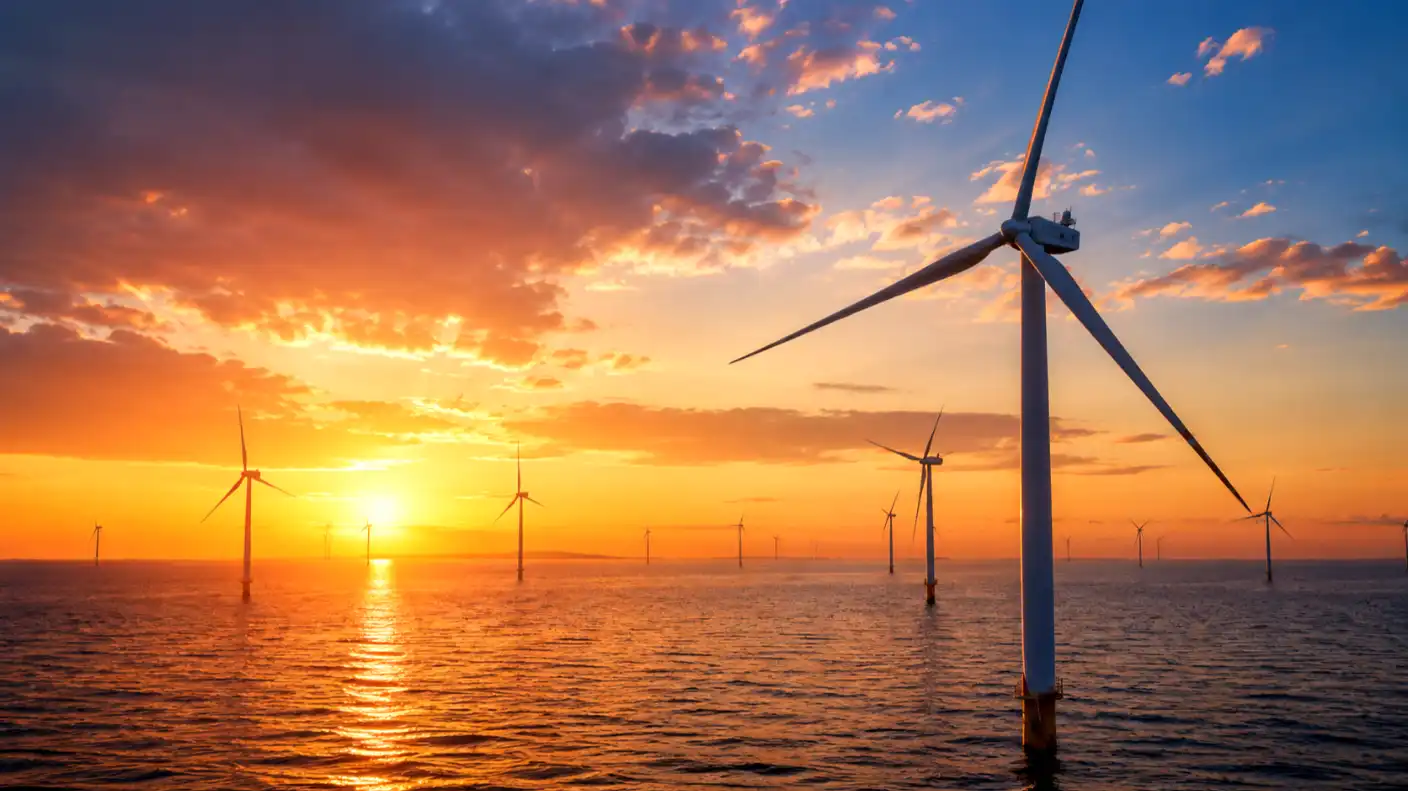
Unidentified drones, potential sabotage, and submarines currently threaten one of Europe’s most vital sources of renewable energy. As of early 2026, energy companies operate more than 100 offshore wind farms in the North Sea. These massive energy hubs span the exclusive economic zones of Germany, the United Kingdom, the Netherlands, Denmark, and Belgium. However, blurry reporting chains and confusing legal boundaries create a massive security blind spot over the water.
When an incident happens on land, the rules dictate a clear response. If a drone flies near a power plant in Germany, local police handle the situation. If a device breaches a military base, the armed forces shoot it down. Offshore wind farms sit in a legal gray area. When workers spot a drone photographing ocean infrastructure, they rarely report the incident. Private operators do not know which government agency holds the authority to intervene.
Dan Marks, a researcher at the Royal United Services Institute in London, points out a severe lack of data sharing among the affected nations. He notes that companies have very little incentive to report these encounters. Workers watch a drone hover over their equipment for a few minutes, wonder why it flew out there, and simply go back to work when it disappears. Mark doubts these devices belong to hobbyists. Regular consumer drones do not accidentally fly several nautical miles out into the harsh ocean. Instead, he suspects smugglers launch some of these drones from shadow fleet tankers to move sanctioned goods like oil.
Albéric Mongrenier, Executive Director at the European Initiative for Energy Security, warns that threats against energy infrastructure are changing rapidly. Attackers target these wind parks specifically because their remote locations make them incredibly difficult to defend. Mongrenier highlights the underwater cables that connect the turbines to the mainland as the most vulnerable targets for hostile actors.
Governments struggle to build a unified defense against these hybrid threats. European nations use entirely different legal and military structures. Mongrenier suggests governments need to establish a simple framework for the private sector. Energy companies must know exactly which public agency to call before, during, and after an attack. While Nordic countries like Norway handle these maritime threats effectively, Germany faces a much harder challenge.
Germany operates under a complex federal system that divides power among many different agencies. Sabrina Schulz, the German Director for the European Initiative for Energy Security, explains that the water police, the navy, and federal cybersecurity offices all hold overlapping responsibilities. The German constitution prevents the Ministry of Defense from simply taking control of a civilian incident. While the Maritime Safety and Security Center tries to coordinate responses, surveillance remains extremely difficult because most wind farms lie outside Germany’s territorial waters.
Europe desperately needs these wind farms to protect its energy grid. When Russia invaded Ukraine in 2022, European leaders scrambled to find alternative energy supplies. Many countries bought liquefied natural gas from the United States and Qatar. Today, escalating military conflicts in the Middle East disrupt those alternative supply lines. The ongoing war involving the United States, Israel, and Iran severely chokes commercial shipping traffic through the Strait of Hormuz.
Daniel Greve, a spokesperson for the German federal government, states that offshore wind is a strategic cornerstone of the European industrial base. Wind turbines generate stable electricity and drastically reduce European reliance on imported fuels from volatile regions.
To secure their energy independence, nine North Sea states signed the Hamburg Declaration this past January. The agreement requires governments to add 15 gigawatts of offshore wind capacity each year starting in 2031. Reaching this massive target will supply electricity to roughly 10.5 million average households. Politicians expect this wind boom to create 91,000 new jobs and generate 1 trillion euros in economic activity.
Countries in the region currently coordinate their construction timelines and material auctions. They want to avoid sudden spikes in building activity to ease the pressure on local supply chains. Germany already leads the way in this rapid expansion. At the end of 2025, Germany boasted 9.7 gigawatts of offshore wind capacity. The government plans to increase this output sevenfold by 2045.
While protecting thousands of new turbines poses a major headache, experts remain optimistic about the technology. Schulz argues that wind farms actually resist attacks better than traditional oil and gas facilities. A wind farm lacks a single point of failure, houses no volatile chemicals, and operates without on-site workers. Hostile nations previously focused their hybrid attacks on the Baltic Sea, but European navies must now prepare for those threats spilling over into the North Sea.