Key Points:
- A Vega-C rocket successfully carried the SMILE satellite into space from French Guiana on Tuesday.
- The Chinese Academy of Sciences and the European Space Agency jointly run this massive science project.
- The satellite features 4 advanced instruments to study how the solar wind collides with Earth’s magnetic shield.
- Scientists expect the spacecraft to orbit at an altitude of 121,000 kilometers above the planet during its 3-year primary mission.
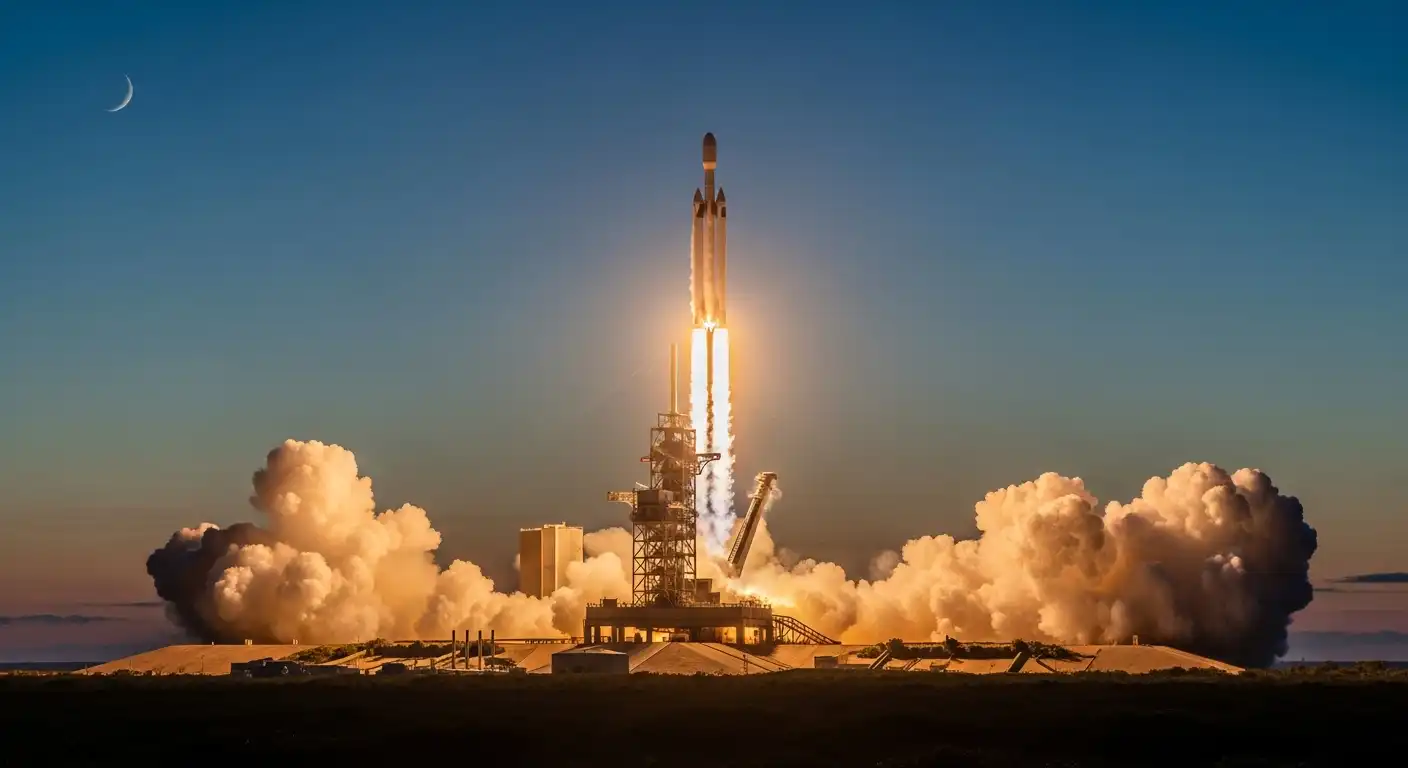
A powerful rocket lit up the sky over South America on Tuesday morning. The Vega-C rocket roared off the launch pad at the European Spaceport in French Guiana. It carried a highly anticipated science satellite straight into orbit. This successful launch marks a massive victory for international space research. Teams from the Chinese Academy of Sciences and the European Space Agency hugged and cheered as the rocket reached space.
The newly launched satellite is called SMILE. The name stands for the Solar Wind Magnetosphere Ionosphere Link Explorer. The Chinese and European space agencies built this machine together to solve a major space mystery. They want to understand exactly what happens when violent solar weather collides with our planet.
Our sun constantly throws out a massive stream of tiny particles. Scientists call this invisible storm the solar wind. These particles race through space at speeds reaching 1.5 million kilometers per hour. When this high-speed wind hits our world, it slams into the magnetic field that surrounds the Earth. This magnetic shield protects human life from deadly radiation, but the constant crashing creates intense space weather.
To study these invisible crashes, the SMILE satellite carries 4 highly specialized cameras and sensors. Engineers designed these tools to take pictures of things human eyes cannot normally see. The satellite features a special X-ray camera that will record the exact moments the solar wind smashes into the magnetic shield. At the same time, an ultraviolet camera will record the glowing auroras near the North and South poles.
Getting the perfect picture requires a very specific flight path. The Vega-C rocket dropped the satellite into a highly elliptical orbit. At its farthest point, the SMILE satellite will fly exactly 121,000 kilometers away from Earth. This massive distance equals roughly one-third of the trip to the moon. Flying this high gives the cameras a perfect, wide view of the entire magnetic shield. The satellite will take about 40 hours to complete 1 full lap around the planet.
This mission proves that global superpowers can still work together for the sake of science. China and Europe shared the heavy financial and technical burdens of the project. Experts estimate the combined mission costs are around $ 150 million. Chinese engineers built the main spacecraft body and the power systems. Meanwhile, European scientists provided the crucial launch vehicle and several of the main scientific instruments.
Reaching the launch pad required an enormous amount of patience. Scientists first proposed the SMILE mission back in 2015. Over the last 11 years, researchers from both continents have held countless meetings to design the hardware. They pushed through massive delays, including a global pandemic that completely halted factory production. Putting a heavy 2,200-kilogram satellite together across two different continents takes serious dedication.
The launch also served as a major test for the European space program. The European Space Agency desperately needed the Vega-C rocket to perform perfectly on Tuesday. The agency wants to secure its own reliable ride to space without depending on other countries. The smooth launch proved the Vega-C can safely carry expensive, heavy payloads into deep orbits.
Researchers back on Earth eagerly await the first batch of data. They hope this information will help them predict dangerous space weather. Severe solar storms can easily destroy expensive communication satellites orbiting Earth. A strong enough solar storm can even knock out power grids and ground-based internet cables. By learning how the magnetic shield responds to the solar wind, scientists can warn power companies before a massive storm hits.
The SMILE satellite now faces a busy schedule. The spacecraft will spend the next 3 years gathering data and sending it back to control centers in Europe and China. Engineers will spend the next few weeks turning on the cameras and testing the sensors. If everything goes according to plan, the public will see the first X-ray images of the magnetic shield in about 2 months.