Key Points:
- Researchers found a way to control a rare quantum effect.
- The nonlinear Hall effect turns alternating current into direct current.
- This process works without needing magnets or traditional diodes.
- Temperature changes cause the electrical signal to flip direction.
A new study reveals how we can use tiny defects inside materials to harvest energy more efficiently. An international team of scientists led by Professor Dongchen Qi from QUT and Professor Xiao Renshaw Wang from Singapore discovered a method to control a strange quantum behavior called the nonlinear Hall effect. Their findings, published in the journal Newton, could change how we power small electronics.
This specific effect differs from the standard Hall effect students learn in physics class. It allows a material to take alternating electrical signals—like the energy floating around us from wireless sources—and turn them directly into usable direct current. Crucially, the material does this without needing magnets or bulky electronic parts like diodes.
Professor Qi explains that this phenomenon generates voltage perpendicular to the current flow. He notes that this allows the conversion of alternating signals straight into the direct current that electronic devices need to run. Theoretically, this means engineers could build chips and sensors that never require a battery because they pull power right out of the environment.
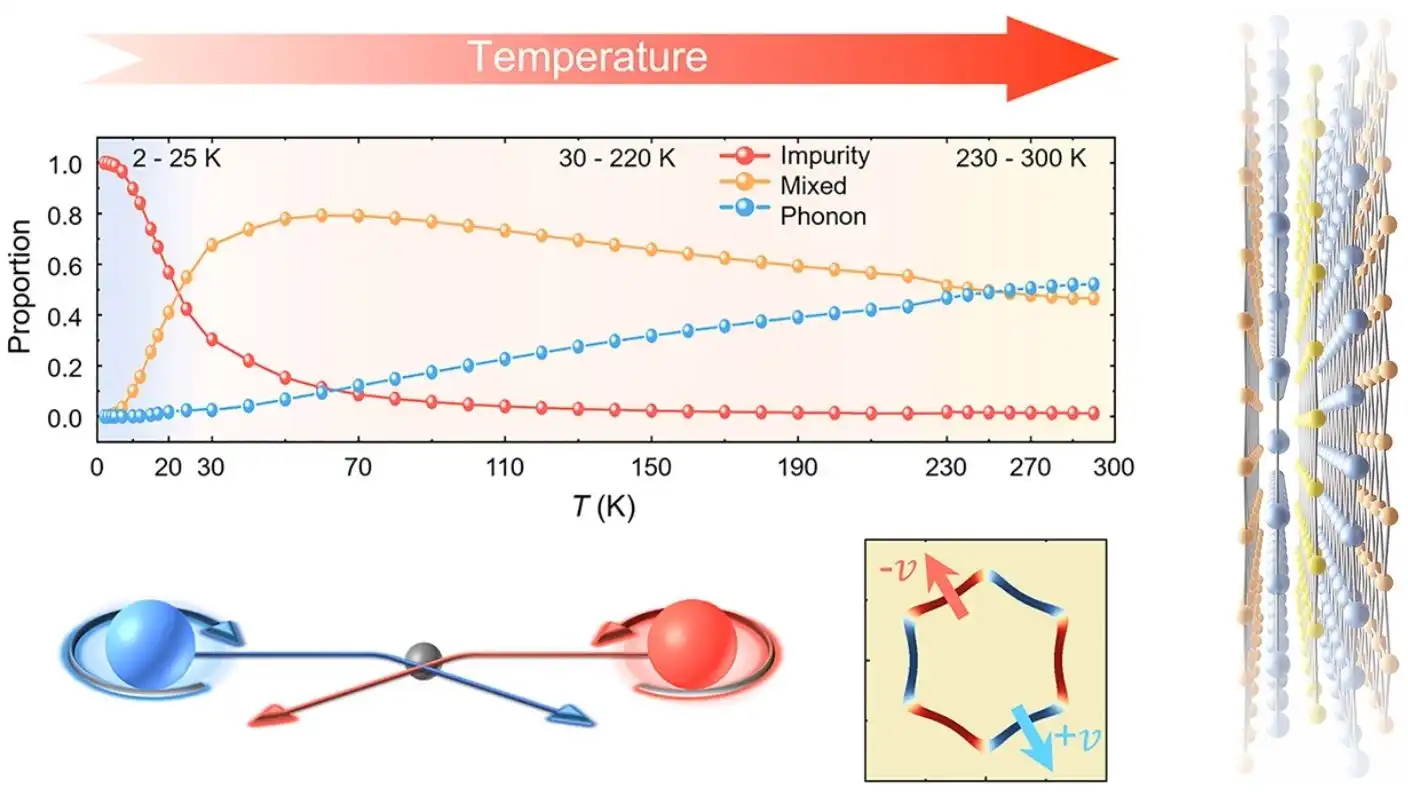
The team examined a high-quality topological material to see how it behaved. They found that the effect stays stable even at room temperature, which is vital for real-world use. They also discovered that temperature acts as a switch. It controls how strong the voltage is and which way it flows.
At very low temperatures, tiny imperfections in the material dictate the behavior. However, as the material warms up, the natural vibrations of its crystal structure take over. This shift causes the electrical signal to flip directions.
Understanding this switch allows for better design. Qi believes this is the moment quantum physics moves from abstract theory to practical tools. This research could lead to self-powered wearable technology, faster components for wireless networks, and smart sensors that operate indefinitely without maintenance. By mastering these invisible forces, the team hopes to make future electronics smaller and more efficient.
Source: Newton (2026).