In the grand tapestry of human history, few ambitions have captured our collective imagination as powerfully as the quest to explore the cosmos. For decades, this monumental endeavor was the exclusive domain of world superpowers, a geopolitical chess match played out in the vacuum of space. But in the early 21st century, a new player emerged, not from a government agency, but from the audacious vision of a single entrepreneur. Space Exploration Technologies Corp., universally known as SpaceX, has not just entered the aerospace industry; it has fundamentally redefined it, shattering long-held paradigms and accelerating our journey to the stars at a pace once thought impossible.
This is the story of SpaceX, a company born from the belief that humanity’s future lies beyond Earth. It is a tale of explosive failures and triumphant successes, of relentless innovation, and of a mission to make life multi-planetary. From its near-bankrupt beginnings to its current status as the world’s leading launch provider, SpaceX has charted a course that is as ambitious as it is inspiring. This deep dive will explore every facet of the company: its visionary founder, revolutionary technology, groundbreaking missions, and audacious plans for the future. We will journey through the history of the Falcon rockets, the development of the Dragon capsule, the creation of the globe-spanning Starlink constellation, and the colossal ambition of Starship—the vehicle designed to carry humanity to Mars and beyond.
The Visionary Behind the Venture: Elon Musk
To understand SpaceX, one must first understand its driving force: Elon Musk. A figure of immense ambition, controversy, and genius, Musk’s journey is inextricably linked to the company’s DNA. His personal philosophy of tackling humanity’s greatest challenges has shaped SpaceX’s mission from day one.
Born in South Africa, Musk displayed an early aptitude for computers and business. After moving to North America, he co-founded Zip2, a web software company, which he sold to Compaq for over $300 million in 1999. He then co-founded X.com, an online financial services and e-mail payment company that would soon merge with a competitor to become PayPal. In 2002, eBay acquired PayPal for $1.5 billion, and Musk, as the largest shareholder, walked away with approximately $180 million.
For many, this would have been the pinnacle of a career. For Musk, it was merely the seed capital for his true ambitions. He identified three critical areas he believed would most affect humanity’s future: the internet, sustainable energy, and space exploration. Having already conquered the first with PayPal, he founded SpaceX in 2002 to tackle space, and later co-founded Tesla, Inc. to address sustainable energy.
Musk’s motivation for founding SpaceX stemmed from a frustration with the stagnation of the space industry and a profound fear for humanity’s long-term survival. He believed that staying on a single planet left humanity vulnerable to extinction-level events, from asteroid impacts to self-inflicted catastrophes. The logical solution, in his view, was to establish a self-sustaining human presence on another planet, with Mars being the most viable candidate.
When he first investigated the cost of launching a small greenhouse to Mars—a mission he called “Mars Oasis”—he was shocked by the exorbitant price of existing rockets. He even traveled to Russia to try to purchase refurbished intercontinental ballistic missiles (ICBMs) for the task. The Russians, however, did not take the young internet millionaire seriously. It was on the flight back from Moscow that Musk had his epiphany: the problem wasn’t a lack of will, but the prohibitive cost of launch. He realized that if he could drastically reduce that cost by applying modern manufacturing principles and, most importantly, by making rockets reusable, he could change the economics of spaceflight entirely. He decided to build the rockets himself, and SpaceX was born.
The Genesis of a Revolution: The Founding and Early Years of SpaceX
Space Exploration Technologies Corp. was founded in May 2002 with a mission statement as simple as it is audacious: to revolutionize space technology and, ultimately, enable people to live on other planets. Musk invested $100 million of his own fortune to get the company off the ground. He assembled a small, dedicated team of engineers in a warehouse in El Segundo, California, guided by a philosophy of first-principles thinking—breaking down a problem to its fundamental truths and reasoning up from there.
The initial years were a crucible of hardship and near-constant failure. The aerospace industry was dominated by legacy giants like Boeing and Lockheed Martin, who had decades of experience and deep-rooted government contracts. SpaceX was an upstart, viewed with skepticism and derision by many in the establishment.
The Falcon 1: A Lesson in Perseverance
The company’s first orbital rocket was the Falcon 1, a small, two-stage launch vehicle designed to deliver small satellites to low Earth orbit. The goal was to prove that a private company could develop and launch a rocket for a fraction of the cost of government-led efforts.
The development was fraught with challenges, and the launch campaign, conducted from Omelek Island in the Kwajalein Atoll of the Marshall Islands, was a trial by fire.
Here is a summary of the first three harrowing launch attempts of the Falcon 1. These early failures tested the company’s resolve to its absolute limit.
- Flight 1 (March 24, 2006): The maiden flight of the Falcon 1 ended in disaster just 25 seconds after liftoff. A fuel line leak caused a fire that led to the main engine’s failure. The rocket fell back into the ocean near the launch pad.
- Flight 2 (March 21, 2007): The second attempt went farther. The first stage burn was successful, and stage separation occurred. However, a harmonic oscillation issue caused the second-stage engine’s nozzle to strike the interstage, resulting in a loss of control and the mission’s eventual failure.
- Flight 3 (August 3, 2008): This attempt was perhaps the most heartbreaking. Both the first and second stages performed well. However, a timing issue during the first-stage separation caused it to collide with the second-stage engine nozzle. The mission, which carried payloads for the Department of Defense and NASA, was another failure.
By this point, SpaceX was on the brink of collapse. Musk had poured almost all of his personal fortune into the company. He later admitted that he had enough money for only one more launch attempt. Both SpaceX and Tesla were teetering on the edge of bankruptcy. The pressure was immense. The fourth flight of the Falcon 1 was not just another mission; it was for the company’s survival.
The Fourth Flight: Success at Last
On September 28, 2008, the fourth Falcon 1 rocket lifted off from Omelek Island. The team watched with bated breath as the rocket ascended, the first stage separated cleanly, and the second-stage engine ignited, carrying a dummy payload into orbit. When the confirmation came through that the rocket had successfully reached orbit, the SpaceX control room erupted in pure, unadulterated joy and relief.
SpaceX had done it. It had become the first privately funded company to put a liquid-fueled rocket into orbit. This single success was the turning point. It proved that their design philosophy worked and that their team could deliver. Just a few months later, in December 2008, NASA awarded SpaceX a $1.6 billion Commercial Resupply Services (CRS) contract to fly 12 cargo missions to the International Space Station (ISS), effectively saving the company and paving the way for its future.
The Workhorses of Modern Spaceflight: The Falcon Rocket Family
With the Falcon 1 success and the NASA contract secured, SpaceX shifted its focus to developing a more powerful and capable rocket family. The Falcon 9 and its derivative, the Falcon Heavy, would go on to dominate the global launch market, primarily due to their revolutionary reusability-focused design.
Falcon 9: The World’s First Orbital-Class Reusable Rocket
The Falcon 9 is the cornerstone of SpaceX’s operations. Named for its nine first-stage Merlin engines, it is a two-stage, medium-lift launch vehicle designed to reliably and cost-effectively transport satellites and spacecraft into orbit. Since its debut in 2010, the Falcon 9 has undergone several major upgrades, culminating in the highly reliable and reusable Block 5 version currently in service.
The Falcon 9 is defined by a series of key innovations and specifications that have made it a dominant force in the launch market. Its design focuses on reliability, performance, and, most importantly, reusability.
- Two-Stage Design: The first stage contains nine sea-level Merlin 1D engines, providing over 1.7 million pounds of thrust at liftoff. The second stage is powered by a single Merlin Vacuum (MVac) engine, optimized for space vacuum, which propels the payload to its final orbit.
- Performance: The Falcon 9 can lift over 22,800 kg (50,265 lbs) to Low Earth Orbit (LEO) and over 8,300 kg (18,300 lbs) to a more demanding Geostationary Transfer Orbit (GTO), making it suitable for a wide range of missions.
- Engine-Out Capability: The nine-engine configuration of the first stage provides crucial redundancy. The rocket can lose one engine during ascent and still complete its mission by burning the remaining engines for longer.
- Autonomous Flight Termination System: The Falcon 9 utilizes an autonomous system that can terminate the flight if it deviates from its planned trajectory, a more modern and efficient approach than traditional ground-based systems.
- Block 5 Evolution: The final major iteration of the Falcon 9, the Block 5, was introduced in 2018. It was designed specifically for high reusability, to fly the same first-stage booster at least 10 times with minimal refurbishment. This has since been far surpassed, with some boosters flying over 20 times.
The Falcon 9’s legacy is defined by its role in pioneering operational reusability, a feat that has slashed the cost of access to space and dramatically increased launch frequency.
Falcon Heavy: The World’s Most Powerful Operational Rocket
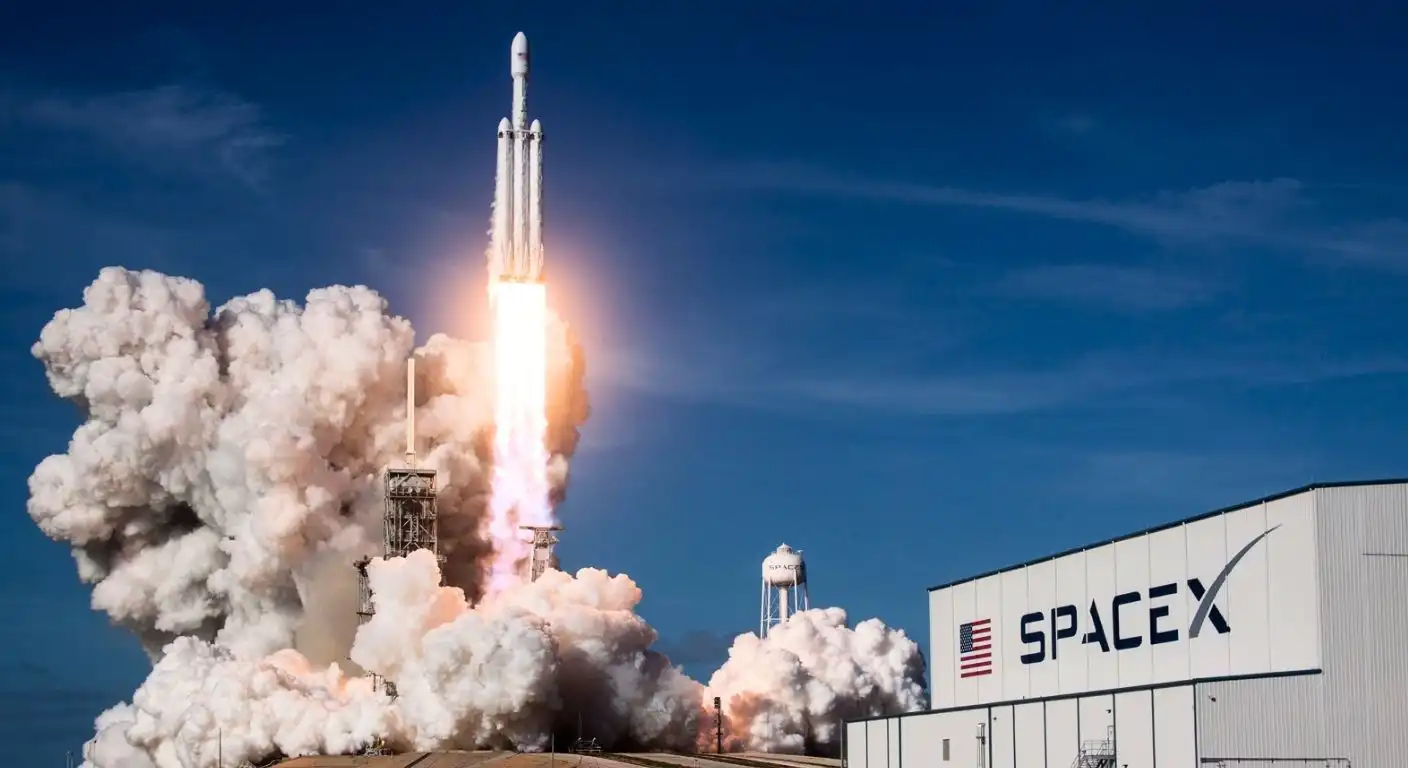
For missions requiring even greater lift capacity, SpaceX developed the Falcon Heavy. Essentially, it consists of a strengthened Falcon 9 central core with two additional Falcon 9 first stages strapped on as side boosters. This configuration triples the first-stage thrust, creating a super-heavy-lift launch vehicle.
The Falcon Heavy is a marvel of engineering, combining immense power with the same reusability ethos as the Falcon 9. Its capabilities and unique flight profile make it a spectacle to behold.
- Immense Power: With its 27 Merlin 1D engines (nine on each of the three cores) firing at liftoff, the Falcon Heavy generates over 5 million pounds of thrust, equivalent to approximately eighteen 747 aircraft at full power.
- Payload Capacity: It can lift nearly 64,000 kg (141,000 lbs) to LEO—more than twice the payload of the next closest operational vehicle, the Delta IV Heavy. It can also send heavy payloads directly to GTO or on interplanetary trajectories to Mars and beyond.
- Synchronized Booster Landing: The most iconic aspect of a Falcon Heavy launch is the simultaneous landing of its two side boosters. Shortly after liftoff, the two side boosters separate from the center core and perform a synchronized boostback burn, returning to land at SpaceX’s landing zones near the launch site in a breathtaking display of precision engineering. The center core, having traveled further and faster, typically lands on a droneship far out in the Atlantic Ocean.
- Notable Missions: The Falcon Heavy’s inaugural flight in February 2018 became a cultural phenomenon. Its payload was Elon Musk’s personal cherry-red Tesla Roadster, with a spacesuit-clad mannequin named “Starman” in the driver’s seat, listening to David Bowie’s “Space Oddity.” This masterclass in marketing captured the world’s attention and demonstrated the rocket’s capabilities in a uniquely memorable way. Since then, it has launched critical national security payloads for the U.S. Space Force and large communications satellites.
The Magic of Reusability: How SpaceX Lands Rockets
The single greatest innovation SpaceX has brought to the aerospace industry is propulsive landing and rocket reusability. Before SpaceX, rockets were single-use machines. The first stages—the most expensive part of the rocket—would simply fall into the ocean after use. Musk likened this to throwing away an airplane after a single flight.
Here is a breakdown of the complex sequence of events that allows a Falcon 9 first stage to fly to space and return for a gentle touchdown.
- Stage Separation: After propelling the second stage and payload to high altitude and velocity, the first-stage booster separates.
- Flip Maneuver: Small cold gas thrusters at the top of the booster fire to flip the stage around, orienting it with its engines facing the direction of travel.
- Boostback Burn (for land landings): For missions where the booster returns to the launch site, three of its Merlin engines reignite for a “boostback burn.” This burn cancels out the rocket’s horizontal velocity and sets it on a trajectory back toward the landing zone.
- Re-entry Burn: As the booster plummets back through the Earth’s atmosphere at hypersonic speeds, it reignites three engines for a “re-entry burn.” This burn dramatically slows the booster down, protecting it from the intense heat and aerodynamic forces of re-entry.
- Atmospheric Steering: During its descent, the booster uses four large, steerable “grid fins” at the top. These fins, made of titanium, provide aerodynamic control, allowing the booster to steer itself with precision toward its landing target.
- Landing Burn and Touchdown: In the final seconds of its descent, the booster reignites its center Merlin engine for the “landing burn.” This final burn acts as a brake, slowing the booster to a near-hover. Four landing legs deploy from the base of the rocket, and it touches down softly on either a concrete landing pad or an autonomous droneship at sea.
This entire process is autonomous, controlled by sophisticated flight computers. The successful landing of the first Falcon 9 booster in December 2015 was a watershed moment, proving that what was once science fiction was now engineering fact.
Dragon: Ferrying Cargo and Crew to the Cosmos
While the Falcon rockets provide the ride to orbit, the Dragon spacecraft is what carries the precious cargo—and now, crew. Developed in parallel with the Falcon 9, the Dragon program was essential for fulfilling SpaceX’s contracts with NASA and realizing the goal of human spaceflight.
Dragon 1: Resupplying the International Space Station
The original Dragon capsule, now retired, was a cargo workhorse. Developed under NASA’s Commercial Orbital Transportation Services (COTS) program, it became the first commercial spacecraft to deliver cargo to and from the ISS.
The Dragon 1 played a pivotal role in the ISS logistics chain for nearly a decade. Its unique capabilities made it an indispensable asset for NASA and its international partners.
- First Commercial Docking: In May 2012, the Dragon capsule made history by becoming the first commercial vehicle to successfully dock with the International Space Station, a feat previously achieved only by government space agencies.
- Pressurized and Unpressurized Cargo: Dragon could carry supplies inside its pressurized capsule and larger external payloads in its unpressurized “trunk.” This flexibility enabled it to transport everything from food and science experiments to large exterior replacement parts for the station.
- Return Capability: Crucially, unlike most other cargo vehicles, which burn up on re-entry, the Dragon capsule was designed to survive its fiery descent through the atmosphere. This allowed it to return valuable scientific experiments and hardware to Earth, a capability largely lost since the retirement of the Space Shuttle.
From 2012 to 2020, Dragon 1 flew 20 successful resupply missions, ferrying tens of thousands of pounds of critical supplies to the orbiting laboratory and returning invaluable scientific data to researchers on the ground.
Crew Dragon (Dragon 2): Returning Human Spaceflight to American Soil
The ultimate evolution of the Dragon capsule is the Crew Dragon, also known as Dragon 2. Developed under NASA’s Commercial Crew Program, its primary mission was to end America’s reliance on the Russian Soyuz spacecraft for transporting astronauts to the ISS, a capability the U.S. had lost with the retirement of the Space Shuttle in 2011.
Crew Dragon represents a generational leap in spacecraft design, focusing on automation, safety, and a 21st-century astronaut experience.
- Launch Abort System: Its most critical safety feature is an integrated launch abort system. Eight powerful SuperDraco engines are built into the sides of the capsule. In the event of a rocket failure, these engines can ignite in a fraction of a second, pulling the capsule and its crew safely away from the malfunctioning booster. This system was successfully tested in a dramatic in-flight abort test in January 2020.
- Autonomous Docking: Unlike its predecessor, which required capture by the station’s robotic arm, Crew Dragon is designed to dock with the ISS completely autonomously, using a sophisticated suite of sensors and navigation software.
- Modern Interior: The interior is a stark contrast to the button-and-switch-laden capsules of the past. It features a sleek, minimalist design with large touchscreen displays, providing astronauts with intuitive control over the spacecraft.
- The Demo-2 Mission: On May 30, 2020, history was made. A Falcon 9 rocket launched the Crew Dragon “Endeavour” carrying NASA astronauts Bob Behnken and Doug Hurley to the ISS. This mission, known as Demo-2, marked the first time a private company had launched humans into orbit and successfully returned human spaceflight capability to the United States after a nine-year gap.
Since Demo-2, Crew Dragon has been flying regular operational missions for NASA and pioneering a new market in private commercial spaceflight, including Inspiration4, the world’s first all-civilian orbital spaceflight.
Starlink: Weaving a Web of Global Internet
While SpaceX is most famous for its rockets, its most ambitious project in terms of scale and potential global impact may be Starlink. It is a satellite internet constellation designed to provide high-speed, low-latency broadband internet to locations where access has been unreliable, expensive, or completely unavailable.
The Mission: Connecting the Unconnected
The fundamental goal of Starlink is to bridge the digital divide. Billions of people worldwide, particularly in rural and remote areas, lack access to reliable internet. Starlink aims to solve this by creating a massive network of satellites in low Earth orbit (LEO).
Here is an overview of the core objectives and advantages of the Starlink system. This initiative seeks to solve one of the world’s most persistent connectivity challenges.
- Global Coverage: The constellation is designed to provide near-global coverage, reaching areas that are difficult to serve with traditional terrestrial infrastructure such as fiber-optic cables or cell towers.
- Low Latency: Because Starlink satellites orbit at an altitude of only about 550 km, much closer to Earth than traditional geostationary satellites (which orbit at 36,000 km), the time it takes for a signal to travel from a user to the satellite and back is significantly shorter. This results in low “latency,” which is critical for real-time applications like video calls, online gaming, and remote work.
- High Speed: Starlink offers download speeds comparable to or exceeding many ground-based broadband services, making it a viable alternative for users in underserved markets.
The Technology: A Constellation of Satellites
Achieving this global coverage requires a truly staggering number of satellites. SpaceX is leveraging its unique launch capabilities to deploy the constellation at an unprecedented rate, often launching batches of 50-60 satellites at a time.
The technology behind Starlink involves a complex interplay of hardware in space and on the ground. Its design is a testament to SpaceX’s vertical integration and rapid development approach.
- Satellite Design: Starlink satellites are compact, flat-panel designs mass-produced at SpaceX’s facility in Redmond, Washington. Each satellite weighs around 260-300 kg and is equipped with a powerful phased-array antenna, a single solar array for power, and ion thrusters for maneuvering and de-orbiting at the end of its life.
- Laser Links: Newer generations of Starlink satellites are equipped with inter-satellite laser links. These lasers enable satellites to communicate with each other in space, forming a mesh network in orbit. This reduces the need for ground stations, allowing data to be routed through space at nearly the speed of light—faster than it can travel over fiber-optic cables on the ground.
- User Terminals: Customers on the ground receive the signal using a small, self-orienting satellite dish, colloquially known as “Dishy McFlatface.” This terminal automatically connects to the optimal satellite passing overhead.
Impact and Controversies
Starlink has already had a profound impact. It has provided critical communications infrastructure in disaster zones and has famously kept Ukraine connected to the internet during its conflict with Russia. It is also transforming the lives of people in remote communities around the world.
However, the project is not without its critics. Here are some of the primary concerns raised by the scientific community and other stakeholders.
- Light Pollution: Astronomers are deeply concerned that the thousands of bright, reflective satellites are interfering with ground-based astronomical observations, leaving bright streaks in long-exposure images and potentially obscuring faint, distant objects. SpaceX is working on mitigation measures, such as painting satellites with anti-reflective coatings and adding sunshades.
- Space Debris: The sheer number of satellites in the Starlink constellation raises concerns about collision risk and the growing problem of space debris in LEO. SpaceX maintains that its satellites have autonomous collision-avoidance capabilities and are designed to de-orbit and burn up in the atmosphere at the end of their service life.
- Orbital Congestion: The rapid deployment of Starlink is creating a more crowded orbital environment, potentially complicating future space missions for all operators.
Despite these challenges, Starlink is on track to become a major global ISP and a significant source of revenue for SpaceX, which the company intends to use to fund its ultimate goal: developing Starship and colonizing Mars.
Starship: The Holy Grail of Interplanetary Travel
If the Falcon and Dragon programs represent SpaceX’s present, Starship is its future. It is a fully reusable, super-heavy-lift transportation system designed to carry both crew and cargo to Earth orbit, the Moon, Mars, and beyond. In terms of ambition and scale, it is arguably the most complex and powerful rocket ever conceived.
The Audacious Vision: A Fully Reusable Transportation System
The core principle behind Starship is complete and rapid reusability. While the Falcon 9’s first stage is reusable, its second stage is still expended on each flight. Starship is designed for both of its stages to be fully and rapidly reusable, much like a commercial airliner. This, in theory, could reduce the cost of launching a kilogram to orbit by several orders of magnitude, making interplanetary travel economically feasible.
The Starship system consists of two primary components, each a marvel of engineering. The combination of these two elements creates a vehicle of unprecedented capability.
- Super Heavy (First Stage): This is the massive booster that will launch Starship from Earth. It stands approximately 70 meters (230 feet) tall and is powered by over 30 Raptor engines, generating more than twice the thrust of the Saturn V rocket that took astronauts to the Moon. Like the Falcon 9, it is designed to return to Earth and land propulsively back at the launch site, ready to be refueled and launched again.
- Starship (Second Stage/Spacecraft): This is the upper stage that also serves as the crew and cargo spacecraft. It is 50 meters (164 feet) tall and is powered by six Raptor engines (three optimized for sea-level and three for vacuum). It is designed to carry up to 100 people on long-duration interplanetary flights. For its return to Earth, it will perform a unique “belly-flop” maneuver, using its large body flaps for aerodynamic control before reorienting itself for a vertical, propulsive landing.
The Engine of the Future: The Raptor Engine
At the heart of Starship’s revolutionary design is the Raptor engine. It is a completely new type of rocket engine, more efficient and powerful than the Merlin engines used on the Falcon 9.
The Raptor engine represents a significant leap forward in rocket propulsion technology. Its development was a critical prerequisite for realizing the Starship vision.
- Methane Fuel: Unlike Merlin, which uses rocket-grade kerosene (RP-1), Raptor engines use liquid methane (CH4) and liquid oxygen (LOX). Methane was chosen because it is highly efficient, burns cleanly (reducing engine soot and making reuse easier), and, crucially, can be produced on Mars through in-situ resource utilization (ISRU) by combining atmospheric carbon dioxide with water ice. This is the key to creating a self-sustaining outpost on Mars.
- Full-Flow Staged Combustion: Raptor is the first operational full-flow staged combustion engine ever flown. This is a highly complex but extremely efficient engine cycle where 100% of the propellants are used to drive the engine’s turbines before being injected into the main combustion chamber. This results in higher performance and allows the engine to run at lower temperatures, increasing its lifespan and reusability.
An Iterative Development Process: “Build, Fly, Fail, Repeat”
SpaceX’s development of Starship has been as unconventional as the vehicle itself. Instead of spending years on design and simulation, the company has adopted a rapid, hardware-rich, iterative approach at its sprawling “Starbase” facility in Boca Chica, Texas.
This philosophy involves building and testing numerous prototypes in quick succession. Many of these tests have resulted in spectacular, fiery explosions, which SpaceX treats not as failures, but as valuable data-gathering opportunities. This cycle of “build, fly, fail, repeat” has allowed them to learn and iterate at an astonishing pace. From the early, short hops of the “Starhopper” test vehicle to the high-altitude flights and belly-flop maneuvers of the full-scale Starship prototypes, each test has pushed the program forward. The first integrated flight test of the full Starship stack in April 2023, though it ended in an explosion, was a crucial first step in testing the entire system. Subsequent tests have demonstrated increasing success, including successful stage separation and a controlled descent of the Starship vehicle.
The Future of Starship: Moon, Mars, and Point-to-Point Earth Travel
Once operational, Starship is intended to be a jack-of-all-trades transportation system with a wide range of applications that could transform our relationship with space and even travel on Earth.
The versatility of the Starship platform is one of its most compelling features. It is designed to be a single system capable of performing a wide range of tasks.
- Lunar Lander for Artemis: NASA has selected a modified version of Starship to serve as the Human Landing System (HLS) for its Artemis program, which aims to return astronauts to the lunar surface. Starship HLS will be the vehicle that carries the next man and the first woman to the Moon.
- Mars Colonization: This is the primary, long-term goal. SpaceX envisions a fleet of Starships carrying people and supplies to build a self-sustaining city on Mars, ensuring the long-term survival of the human species.
- Starlink V2 Deployment: The massive payload capacity and fairing volume of Starship will allow SpaceX to deploy a new, larger, and more capable generation of Starlink satellites, dramatically increasing the constellation’s bandwidth and capabilities.
- Point-to-Point Earth Travel: Musk has proposed using Starship for ultra-fast, long-distance travel. A trip from New York to Shanghai, for example, could be completed in under 40 minutes. This would involve launching from a sea-based platform, flying through space, and landing at another platform near the destination city.
The SpaceX Ecosystem: Infrastructure and Innovation
SpaceX’s success is not just due to its rockets and spacecraft; it is a result of a comprehensive ecosystem of manufacturing, infrastructure, and a unique corporate culture that enables rapid innovation.
Manufacturing and Vertical Integration
From the very beginning, SpaceX has pursued a strategy of vertical integration—designing and manufacturing the vast majority of its components in-house. While traditional aerospace companies often rely on a complex web of subcontractors, SpaceX builds its own engines, rocket stages, avionics, and software.
This approach gives the company several key advantages. It provides granular control over the design and production process, reduces costs by eliminating supplier markups, and enables incredibly fast iteration and design changes. This philosophy is most evident at their main factory in Hawthorne, California, where raw materials enter one end of the building and finished rocket stages emerge from the other.
Launch and Landing Facilities
SpaceX operates a network of world-class launch and recovery facilities to support its high-tempo launch cadence. Each site is strategically chosen to serve different orbital inclinations.
These locations form the backbone of SpaceX’s operational capabilities, enabling a launch rate that no other entity in the world can match.
- Cape Canaveral Space Force Station & Kennedy Space Center (Florida): These neighboring sites on Florida’s “Space Coast” are SpaceX’s primary launch pads for missions to the ISS, geostationary orbit, and interplanetary trajectories. Kennedy Space Center’s historic Launch Complex 39A, previously used for the Apollo and Space Shuttle programs, has been repurposed for Falcon 9 and Falcon Heavy launches.
- Vandenberg Space Force Base (California): Located on the west coast, Vandenberg is used for launches that require a polar orbit, which is ideal for many Earth-observation and Starlink satellites.
- Starbase (Boca Chica, Texas): This is SpaceX’s private development, manufacturing, and launch site dedicated exclusively to the Starship program. It is a bustling hub of round-the-clock activity, more akin to a high-tech shipyard than a traditional rocket factory.
- Autonomous Spaceport Droneships (ASDS): For missions where the booster does not have enough fuel to return to the launch site, it lands on one of SpaceX’s autonomous droneships stationed hundreds of miles out at sea. These vessels, named “Of Course I Still Love You,” “Just Read the Instructions,” and “A Shortfall of Gravitas” (a nod to the author Iain M. Banks), are a critical piece of the reusability puzzle.
Company Culture and Philosophy
The culture at SpaceX is famously intense, demanding, and mission-driven. The company attracts top engineering talent who are passionate about advancing space exploration. The work environment is characterized by long hours, immense pressure, and a flat organizational structure where engineers have a high degree of responsibility and direct access to senior leadership, including Elon Musk himself. The guiding philosophy is one of first-principles thinking, constantly questioning assumptions and looking for more efficient and effective ways to solve problems, rather than simply following industry tradition.
The Broader Impact: How SpaceX Changed an Industry
In just two decades, SpaceX has gone from a quixotic startup to the undisputed leader of the global space industry. Its impact extends far beyond its own missions, having fundamentally altered the landscape for governments, competitors, and scientists alike.
Driving Down the Cost of Launch
The most direct and quantifiable impact of SpaceX has been the dramatic reduction in the cost of accessing space. By successfully implementing booster reusability, SpaceX has been able to offer launch prices significantly lower than those of competitors using expendable rockets. This has made space more accessible for a wider range of customers, including universities, small satellite startups, and developing nations.
Fostering a New Space Race
SpaceX’s success has ignited a new, commercially driven space race. Legacy aerospace giants like United Launch Alliance (ULA) have been forced to develop their own next-generation, partially reusable rockets (like the Vulcan Centaur) to remain competitive. A new wave of launch startups, such as Rocket Lab and Relativity Space, has emerged, inspired by SpaceX’s model and seeking to capture a share of the growing market. This increased competition is driving further innovation and cost reduction across the entire industry.
Enabling New Possibilities in Space
The lower launch costs and higher launch frequency enabled by SpaceX have opened the door to new business models and scientific endeavors that were previously economically unfeasible. The rise of satellite mega-constellations like Starlink and its competitors (such as Amazon’s Project Kuiper) is a direct result of this new reality. Scientists can also propose more ambitious missions, knowing that the cost of getting their instruments to space is no longer the primary budgetary constraint.
Challenges and Criticisms on the Path to the Stars
SpaceX’s meteoric rise has not been without controversy and challenges. As a disruptor, it has faced scrutiny from regulators, competitors, and the public on several fronts.
The Human Cost of Rapid Innovation
The relentless pace and high-stakes environment at SpaceX have led to criticisms regarding its work culture. Reports have surfaced over the years detailing employee burnout due to long hours and intense pressure. The company’s focus on speed has also, at times, raised safety concerns and led to investigations into workplace accidents at its facilities.
Environmental and Astronomical Concerns
The environmental impact of an ever-increasing number of rocket launches is a growing concern. While individual rocket launches have a relatively small carbon footprint compared to other industries, the cumulative impact of thousands of launches per year remains under study. As mentioned earlier, the Starlink constellation has also drawn significant criticism from the astronomical community for its impact on the night sky.
The Monopolization of Space
There is a growing concern in the industry that SpaceX is becoming too dominant. It currently accounts for the vast majority of mass launched to orbit globally. While this dominance is a product of its own innovation, some worry that a lack of viable competition could eventually lead to a monopoly, giving SpaceX undue influence over access to space for both commercial and government entities.
The Future: What’s Next for SpaceX?
The story of SpaceX is still in its early chapters. The company’s focus for the coming decade is clear and more ambitious than ever. The primary objective is to get Starship fully operational. This involves successfully launching and landing both the Super Heavy booster and the Starship spacecraft, and mastering the complex in-orbit refueling process, which is necessary for journeys to the Moon and Mars.
In parallel, SpaceX will continue to expand the Starlink constellation, transitioning to the larger V2 satellites launched by Starship to increase capacity and speed. The company will continue to be the primary transportation provider for NASA astronauts to the ISS. It will play a central role in the Artemis program with its Starship lunar lander.
But the ultimate goal remains unchanged since the company was founded: Mars. Every success with Falcon 9, every astronaut delivered by Dragon, and every Starlink satellite deployed is a step toward funding and developing the technology needed to build a self-sustaining city on another planet. Elon Musk’s vision is to begin sending the first crewed missions to Mars within the next decade.
Charting Humanity’s Future Among the Stars
SpaceX began as a seemingly impossible dream, an audacious bet by a Silicon Valley entrepreneur against an entrenched, century-old industry. Through a combination of visionary leadership, relentless engineering, a high tolerance for risk, and an unwavering focus on a long-term goal, it has fundamentally transformed humanity’s access to space.
The company has made rockets land themselves, returned human spaceflight to American soil, and is in the process of connecting the entire globe to the internet from space. It has inspired a new generation to dream of the stars and has forced an entire industry to reinvent itself. The journey has been fraught with explosive failures and spectacular triumphs, but the trajectory has been consistently, unstoppably upward.
The story of Space Exploration Technologies Corp. is more than just the story of a company. It is a story about the power of first-principles thinking, the importance of long-term vision, and the indomitable nature of human ambition. As the steel towers of Starbase rise in Texas and the thunder of Raptor engines echoes across the landscape, we are witnessing not just the construction of a new rocket, but the forging of a multi-planetary future for humanity.