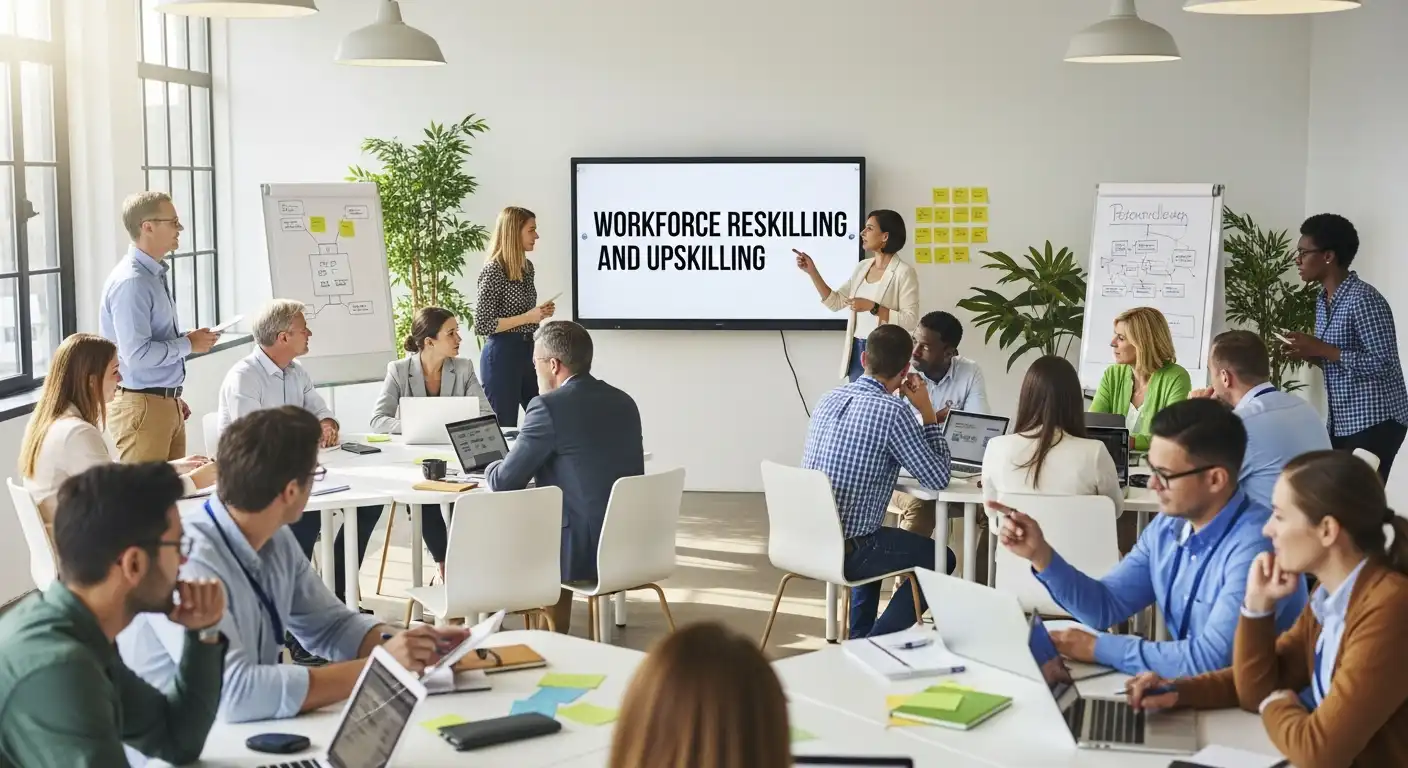
The technology industry is built on a paradox: its greatest strength is also its most profound challenge. The relentless, blistering pace of innovation that brings us self-driving cars, generative AI, and quantum computing also creates a constant state of creative destruction within its own workforce. The programming language that was cutting-edge five years ago is now considered legacy. The cloud certification that was a golden ticket three years ago is now a baseline expectation. In this environment, skills are not static assets acquired once in college; they are perishable resources with an ever-shrinking half-life. The concept of a “job for life” has been replaced by the reality of a “life of learning.”
This is the new normal, a world where the only constant is change, and the only sustainable competitive advantage—for both individuals and the companies that employ them—is the ability to learn, unlearn, and relearn at the speed of technology itself. This is the world that has made “reskilling” and “upskilling” two of the most critical verbs in the corporate lexicon. They are no longer optional professional development perks but have become the core, strategic imperatives for survival and growth. This is not about simply keeping up; it is about building a workforce that is perpetually ready for a future that has yet to be invented. This deep dive will explore the powerful forces driving this learning revolution, the strategies being deployed by forward-thinking organizations, and the roadmap for building a truly future-ready tech workforce.
The Unrelenting Engine of Change: Why Continuous Learning is the New Normal
The urgent, industry-wide focus on reskilling and upskilling is not a passing trend. It is a rational and necessary response to a series of powerful, interconnected forces that are fundamentally reshaping the nature of work, the structure of teams, and the very definition of a valuable technical skill.
Understanding these foundational drivers is key to appreciating why a static workforce is a liability and a dynamic, learning workforce is the ultimate asset.
The Accelerating Pace of Technological Obsolescence
The half-life of a technical skill has been in freefall for years. A study by the World Economic Forum has suggested that the half-life of a learned skill is now estimated to be as little as five years, and for a specific technical skill, it can be less than two and a half years. This means that nearly half of what an engineer or IT professional knows today could be outdated or irrelevant in a remarkably short period.
A constant churn of new technologies, frameworks, and methodologies drives this rapid obsolescence.
- Programming Languages and Frameworks: A decade ago, expertise in Objective-C for iOS development was paramount. Today, Swift and cross-platform frameworks such as React Native and Flutter are in high demand. In the world of web development, the “framework of the month” is a running joke, but it reflects the real-world churn from Angular.js to React to Vue.js and beyond.
- Software Architectures: The industry has transitioned from monolithic applications to service-oriented architectures (SOA) and is now moving toward microservices and serverless computing. Each shift requires a completely different approach to building, deploying, and managing software.
- Development Methodologies: The slow, sequential Waterfall model has been almost entirely supplanted by Agile, which is constantly evolving with practices like Scrum, Kanban, and deeper integration with DevOps principles.
The Rise of AI and Automation: A Paradigm Shift in Job Roles
Artificial intelligence is not just another tool; it is a transformative force on par with the invention of electricity or the internet. It is not simply automating repetitive, manual tasks; it is beginning to augment and automate complex cognitive tasks that were once the exclusive domain of highly skilled professionals.
This is not a story of “robots taking jobs” but of a profound redefinition of what human jobs entail.
- From Coder to Architect: AI-powered coding assistants, such as GitHub Copilot, can now write entire blocks of boilerplate code, freeing developers from mundane tasks. The value of a developer is shifting from their ability to write perfect syntax to their ability to architect complex systems, solve novel problems, and effectively prompt and guide AI tools.
- The Automation of IT Operations (AIOps): In IT operations, AI is being utilized to automate tasks such as anomaly detection, root cause analysis, and predictive maintenance. This is transforming the role of an IT operations professional from a reactive “firefighter” to a proactive strategist who designs and manages these automated systems.
- New Roles Emerge: The AI revolution is creating entirely new job categories that did not exist five years ago, such as Prompt Engineer, AI Ethicist, and Machine Learning Operations (MLOps) Engineer. There is no traditional educational path for these roles; they must be filled by reskilling people from adjacent fields.
The Cloud Revolution and the Demand for New Infrastructure Skills
The wholesale migration of computing infrastructure from on-premises data centers to public cloud platforms (such as Amazon Web Services, Microsoft Azure, and Google Cloud Platform) has been one of the most significant shifts in IT history. This has rendered a vast swath of traditional IT skills obsolete while creating a massive demand for new cloud-native capabilities.
Operating in the cloud requires a fundamentally different skill set and mindset than managing physical servers in a data center.
- Infrastructure as Code (IaC): Instead of manually configuring servers, cloud professionals now define and manage infrastructure using code with tools like Terraform and CloudFormation. This requires systems administrators to learn software development principles.
- Cloud Security: Securing a dynamic, ephemeral cloud environment is vastly different from securing a static on-premise network. It requires expertise in Identity and Access Management (IAM), cloud-native security tools, and a “zero trust” security posture.
- FinOps (Cloud Financial Operations): A new discipline has emerged around managing and optimizing cloud spending. This requires a hybrid skill set that blends finance, technology, and business analytics.
The Widening Skills Gap: A Chasm Between Demand and Supply
The cumulative effect of these trends is a massive and growing “skills gap”—a mismatch between the skills employers need and the skills available in the workforce. Companies are finding it increasingly difficult, time-consuming, and expensive to hire for high-demand roles. The traditional pipeline of university graduates is not producing talent fast enough or with the specific, up-to-the-minute skills required. This leaves companies with only one viable, long-term solution: to build the talent they need from within.
Defining the Terms: Reskilling vs. Upskilling – Two Sides of the Same Coin
While often used interchangeably, “reskilling” and “upskilling” describe two distinct, though related, strategies for talent development. A successful workforce transformation program must incorporate both, as they solve different but equally important business challenges.
Understanding this distinction is the first step in building a coherent and effective learning and development strategy.
Upskilling: Deepening Expertise for Current Roles
Upskilling is the process of acquiring new skills to enhance performance in one’s current role. It is about adding to an existing skill set to keep pace with the evolution of a job function. It is a vertical movement that makes an individual better, faster, and more effective at what they already do.
Upskilling is a continuous process focused on achieving mastery and adapting to a specific career path.
- Example 1 (Software Developer): A front-end developer who currently uses the React framework (upskills) by learning about new features in the latest version of React, mastering advanced state management libraries, and learning new performance optimization techniques.
- Example 2 (IT Administrator): A systems administrator who manages on-premise servers (upskills) by getting certified in the latest version of their virtualization software and learning new automation scripts to manage their existing infrastructure more efficiently.
- Business Goal: To improve productivity, quality, and efficiency in existing roles, and to ensure that the current workforce can leverage the latest tools and techniques within their domain.
Reskilling: Building New Capabilities for New Roles
Reskilling is the process of learning an entirely new set of skills to transition into a completely different job role. It is a lateral or horizontal movement that prepares an individual for a new career trajectory, often in response to their old role becoming obsolete or redundant.
Reskilling is a transformative process that redeploys human capital to meet new and emerging business needs.
- Example 1 (QA Tester to Developer): A manual quality assurance (QA) tester whose role is being automated (reskilled) by attending a coding bootcamp to become a junior software developer or a software development engineer in test (SDET).
- Example 2 (IT Administrator to Cloud Engineer): An IT administrator whose company is migrating to the cloud (reskills) by undertaking an intensive training program to learn AWS or Azure, earning a cloud architect certification, and transitioning into a new role as a cloud engineer.
- Business Goal: To fill emerging skills gaps internally, to retain valuable institutional knowledge by redeploying talent, and to provide career pathways for employees in roles that are being phased out by technology.
The Strategic Symbiosis: Why Companies Need Both
Upskilling and reskilling are not mutually exclusive; they are two essential components of a holistic talent strategy. Upskilling ensures that your current teams remain at the cutting edge of their fields, driving incremental innovation and efficiency. Reskilling ensures that you have a pipeline of talent ready to fill the entirely new roles that disruptive technologies will create. A company that only upskills will eventually find itself with highly optimized teams working on outdated problems. A company that only reskills will struggle with the day-to-day execution and quality of its current operations. A truly resilient organization does both, continuously and at scale.
The New Landscape of Learning: Key Areas Demanding Reskilling and Upskilling
The demand for new skills is not uniform across the technology landscape. Several key domains are experiencing explosive growth and a particularly acute talent shortage. These are the “hot zones” where corporate reskilling and upskilling programs are being focused with the greatest intensity.
These domains represent the foundational pillars of the next wave of technological innovation and business transformation.
Artificial Intelligence and Machine Learning: From User to Creator
AI is the most significant technology shift of our generation, and the demand for AI talent has skyrocketed. The challenge is that AI is not a single skill but a complex ecosystem of capabilities.
Organizations are developing learning pathways to advance their workforce along the AI value chain.
- AI Literacy (Upskilling for All): The foundational layer is providing basic AI literacy for the entire workforce. This involves teaching non-technical employees about AI, its capabilities and limitations, and how to use generative AI tools like ChatGPT or Midjourney responsibly and effectively in their daily work.
- Applied AI (Upskilling for Developers): For the existing developer population, upskilling involves learning how to integrate AI into applications. This means learning to utilize AI APIs from services like OpenAI, Google’s Vertex AI, or Amazon Bedrock to incorporate features such as natural language processing, computer vision, or recommendation engines into their products.
- Deep AI/ML Expertise (Reskilling): The most intensive track involves reskilling individuals with strong quantitative backgrounds (like data analysts or software engineers) to become Machine Learning Engineers or Data Scientists. This requires in-depth training in statistics, linear algebra, Python programming with libraries such as TensorFlow or PyTorch, and the principles of building, training, and deploying machine learning models.
Cloud Computing: The Foundational Skill for Modern Infrastructure
As “the cloud” has become the default platform for building and running applications, cloud fluency has shifted from a niche specialty to a core competency for a large portion of the tech workforce.
The demand spans a wide range of roles, from infrastructure management to application development.
- Cloud Essentials (Upskilling for All Tech Roles): Every developer, QA engineer, and IT professional now needs a foundational understanding of cloud concepts—what are virtual machines, containers, serverless functions, and object storage? How does cloud pricing work? Major cloud providers offer “Cloud Practitioner” level certifications that are becoming a baseline expectation.
- Cloud Architecture and Engineering (Reskilling): This is a primary path for reskilling traditional IT professionals, such as network administrators and database administrators. It involves intensive, platform-specific training (e.g., AWS, Azure, or GCP), leading to certifications such as Solutions Architect or DevOps Engineer. The focus is on designing and building scalable, secure, and cost-effective cloud-native systems.
- Cloud-Native Development (Upskilling for Developers): For software developers, this means learning to build applications that take full advantage of the cloud. This includes working with container orchestration platforms such as Docker and Kubernetes, building serverless applications with services like AWS Lambda, and using cloud-native databases and messaging queues.
Cybersecurity: The Ever-Evolving Digital Battlefield
The relentless, ever-evolving threat of cyberattacks has created a permanent, severe shortage of skilled cybersecurity professionals. As every company becomes a technology company, every company also becomes a target.
The need for cybersecurity skills is both broad (for all employees) and deep (for specialists).
- Security Awareness (Upskilling for All): The first line of defense is a security-conscious workforce. All employees require regular training on identifying phishing attempts, creating strong passwords, and securely handling sensitive data.
- Secure Software Development (Upskilling for Developers): Integrating security into the development process (“DevSecOps”) is a major focus. Developers are being upskilled in secure coding practices, in using static and dynamic code analysis tools to find vulnerabilities, and in understanding the common threats described by the OWASP Top 10.
- Specialized Cybersecurity Roles (Reskilling): The industry is struggling to fill roles such as Security Analyst, Penetration Tester, and Incident Responder. Reskilling programs often target IT professionals or developers with a strong aptitude for analytical thinking and problem-solving, providing them with intensive training in network security, ethical hacking, digital forensics, and threat intelligence.
Data Science and Analytics: Translating Data into Value
The ability to collect, process, and analyze vast amounts of data is a key source of competitive advantage. This has created massive demand for roles that can turn raw data into actionable business insights.
The data skill spectrum ranges from basic data literacy to advanced predictive modeling.
- Data Literacy (Upskilling for Business Roles): This involves training business and product managers to be more data-driven. It includes learning to use business intelligence (BI) and visualization tools, such as Tableau or Power BI, understanding basic statistical concepts, and learning to ask the right questions of the data.
- Data Engineering (Reskilling/Upskilling): This is a critical but often overlooked field. Data engineers build the “plumbing”—the data pipelines and warehouses that data scientists and analysts rely on. This is a common reskilling path for software engineers or database administrators, involving training in big data technologies such as Spark, data warehousing solutions like Snowflake, and workflow orchestration tools such as Airflow.
- Data Science and Analytics (Reskilling): This track is designed for individuals with strong statistical and programming skills who aim to develop predictive models. Reskilling programs focus on Python, R, machine learning algorithms, and the end-to-end process of developing and deploying data-driven products.
Modern Software Development: Beyond the Code
Even the core role of a software developer is constantly evolving. The skills required today extend far beyond simply writing code in a specific programming language.
Upskilling programs for developers focus on building a more holistic, business-aware engineer.
- DevOps and CI/CD: The wall between “development” and “operations” has crumbled. Developers are now expected to have a deep understanding of the entire software delivery lifecycle. Upskilling involves learning about continuous integration and continuous deployment (CI/CD) pipelines, containerization (using Docker and Kubernetes), and infrastructure automation.
- Full-Stack Development: The demand for “full-stack” developers—those who are comfortable working on both the front-end (user interface) and back-end (server-side logic) of an application—continues to grow. This often requires a front-end specialist to upskill in back-end technologies, or vice versa.
- Product Thinking and Business Acumen: The most valuable engineers are those who understand the “why” behind what they are building. Upskilling now often includes training in product management principles, user experience (UX) design, and understanding key business metrics, enabling developers to contribute more strategically to the product’s success.
The Corporate Playbook: Strategies for Building a Future-Ready Tech Workforce
Recognizing the need for continuous learning is easy; implementing an effective, scalable reskilling and upskilling program is incredibly difficult. Forward-thinking technology companies are treating this not as an HR initiative, but as a core business strategy. They are deploying a multi-faceted playbook to build their workforce of the future.
This playbook combines cultural change, strategic planning, and a diverse ecosystem of learning opportunities.
Fostering a Culture of Continuous Learning
The most important element, and the hardest to achieve, is creating a corporate culture where learning is not an event, but a continuous, expected, and celebrated part of the job.
This cultural foundation is what makes all other initiatives possible and sustainable.
- Leadership Buy-in and Role Modeling: It starts at the top. When executives openly talk about what they are learning, block out time for learning, and champion the company’s skilling initiatives, it sends a powerful message.
- Psychological Safety: Employees must feel safe admitting they don’t know something and taking time away from “productive” work to learn without fear of being perceived as unproductive.
- Rewarding Learning and Growth: Tying career progression, promotions, and even compensation to skill acquisition and demonstrated learning can powerfully reinforce the importance of this culture.
Building a Skills Taxonomy: The Foundation of Strategy
You cannot build what you cannot measure. The first step in any strategic skilling program is to understand both the skills you currently possess and the skills you will need.
A skills taxonomy is a structured classification of the capabilities required across the organization.
- Skills Inventory: The process begins with a comprehensive inventory of the workforce’s current skills. This can be achieved through self-assessments, manager evaluations, and AI tools that analyze project code and performance reviews.
- Future-State Analysis: The next step is to collaborate with business and technology leaders to forecast the skills required over the next 1-5 years to execute the company’s strategic roadmap.
- Gap Analysis: By comparing the current inventory with the future-state needs, the company can identify the most critical skills gaps. This data-driven analysis enables the organization to focus its investment on the reskilling and upskilling programs with the greatest strategic impact.
The Rise of Corporate Academies and Internal Bootcamps
Some of the largest technology companies are taking matters into their own hands by building sophisticated, in-house educational institutions.
These internal academies offer highly contextualized learning that is perfectly aligned with the company’s specific technologies and business goals.
- Amazon’s Upskilling 2025: Amazon has pledged over $1.2 billion to upskill its workforce. A key part of this is the Amazon Technical Academy. This intensive, 9-month internal bootcamp reskills non-technical Amazon employees (from warehouse workers to HR professionals) into entry-level software development engineers.
- Microsoft’s Global Skilling Initiative: Microsoft has launched a massive initiative that includes its own learning platforms, providing free access to content and low-cost certifications in high-demand roles, such as software developer, data analyst, and IT administrator, for both its employees and the public.
Leveraging External Partnerships: MOOCs, Bootcamps, and Universities
No company can build all of its learning content from scratch. Smart organizations build a blended learning ecosystem that leverages the best of the external market.
These partnerships offer access to world-class content and a diverse range of learning modalities.
- Massive Open Online Courses (MOOCs): Companies purchase enterprise licenses for platforms like Coursera, edX, and Udacity. This gives their employees on-demand access to a vast library of courses from top universities and industry experts.
- Third-Party Bootcamps: For intensive, role-based reskilling, companies often partner with established coding and data science boot camps, such as General Assembly or Flatiron School, to run custom cohorts for their employees.
- University Partnerships: Some companies are partnering with universities to co-create custom degree or certificate programs that combine academic rigor with industry-specific application.
Personalized Learning Paths: Moving Beyond One-Size-Fits-All
The most effective learning is not one-size-fits-all. Modern learning experience platforms (LXPs) leverage AI to create personalized learning paths for each employee.
These platforms function like a “Netflix for learning,” recommending content tailored to an individual’s current role, skill gaps, and career aspirations.
- AI-Driven Recommendations: The LXP can analyze an employee’s skills profile and career goals, and automatically recommend the most relevant sequence of courses, articles, and projects to help them achieve their goals.
- Learner Autonomy: While the platform provides guidance, it also empowers employees to explore their interests, fostering curiosity-driven learning that often leads to unexpected innovation.
The Power of Project-Based Learning and Internal Mobility
Learning is most effective when it is immediately applied. The best skilling programs move beyond passive consumption of content and are tightly integrated with real-world work.
This “learning by doing” approach solidifies new skills and demonstrates their business value.
- Apprenticeship and Mentorship Programs: Pairing a learner with an experienced mentor and assigning them to a real project is a powerful way to bridge the gap between theory and practice.
- Internal Gig Platforms: Some companies are creating internal “gig” platforms where employees can take on short-term projects or “stretch assignments” outside of their regular duties to learn and apply new skills in a low-risk environment.
- A Culture of Internal Mobility: The ultimate goal of reskilling is to redeploy talent. This requires HR processes that make it easy for employees to move between roles and for managers to hire from internal talent pools. A strong culture of internal mobility is the clearest signal that the company is serious about investing in its people’s careers.
The Individual’s Roadmap: Taking Ownership of Your Career Trajectory
While companies bear a significant responsibility for enabling learning, the ultimate driver of success is the individual. In the modern tech economy, every professional must think of themselves as a “company of one,” with their skills as their primary product.
This requires a proactive, lifelong commitment to personal and professional development.
Embracing a Growth Mindset: The Psychological Foundation
The most important skill of all is the belief that one’s skills are not fixed. This concept, popularized by Stanford psychologist Carol Dweck, is the psychological bedrock of continuous learning. Individuals with a growth mindset see challenges as opportunities to learn and believe that their abilities can be developed through dedication and hard work.
Navigating the Learning Ecosystem: Choosing the Right Path
The modern learner is spoiled for choice, which can also be overwhelming. The key is to choose a learning path that aligns with one’s goals, learning style, and budget. This could be a structured university program, an intensive bootcamp, a series of on-demand MOOCs, or even a self-directed path using free online resources.
Building a Portfolio: Demonstrating, Not Just Certifying, Skills
In the tech industry, what you can do is far more important than what a certificate says you can do. The most effective way to demonstrate a new skill is to build something with it. A portfolio of personal projects, contributions to open-source software on GitHub, or detailed blog posts about a new technology are tangible proof of capability that will often carry more weight with a hiring manager than a certificate alone.
The Importance of Soft Skills in a Tech-Driven World
As technology automates more technical tasks, the uniquely human “soft skills” become even more valuable. The ability to communicate complex ideas clearly, collaborate effectively in a cross-functional team, think critically, and solve problems creatively are durable skills that will always be in demand. Upskilling should not focus solely on technical capabilities but also on crucial interpersonal and cognitive skills.
Measuring the Unmeasurable? The ROI and Impact of Reskilling Initiatives
To secure ongoing investment, learning and development leaders must demonstrate the return on investment (ROI) of their skilling programs. While some benefits are hard to quantify, a data-driven approach can effectively measure the impact on the business.
This involves tracking a range of Key Performance Indicators (KPIs) that connect learning to business outcomes.
Key Performance Indicators (KPIs) for Success
A well-rounded measurement strategy looks at both learning metrics and their impact on business performance.
These metrics provide a clear picture of the program’s effectiveness and its contribution to the bottom line.
- Learning and Engagement Metrics: Course completion rates, skill proficiency assessments (before and after), and employee engagement with the learning platform.
- Talent and HR Metrics: Time-to-fill for open roles, percentage of roles filled internally, employee retention and attrition rates (especially for program participants), and promotion velocity.
- Business Impact Metrics: For a developer upskilling program, this could be an increase in team velocity or a reduction in bug rates. For a sales team learning a new product, it could mean increased sales of that product.
Beyond the Bottom Line: The Intangible Benefits
Not all benefits can be captured in a spreadsheet. Skilling initiatives have powerful, though less tangible, impacts on corporate culture and innovation. A workforce that is constantly learning is more engaged, more adaptable to change, and more likely to generate new ideas. A strong investment in employee development is also a powerful tool for employer branding, helping to attract and retain top talent in a competitive market.
The Cost of Inaction: The True Price of a Stagnant Workforce
The most important calculation is often the cost of not investing in reskilling and upskilling. This includes the high costs of recruiting and hiring externally to fill skills gaps, the loss of productivity from an under-skilled workforce, the loss of valuable institutional knowledge when employees in obsolete roles are let go, and the inability to seize new market opportunities due to the lack of available talent. In the long run, the cost of inaction is almost always higher than the cost of investment.
Overcoming the Hurdles: Challenges and Pitfalls in Implementation
The path to building a successful skilling program is fraught with challenges. Many well-intentioned initiatives fail due to a lack of strategic alignment, employee resistance, or an inability to scale.
Anticipating and proactively addressing these common pitfalls is crucial for success.
The Investment Dilemma: Cost and Time Commitment
Skilling programs are expensive, requiring investment in platforms, content, and, most importantly, employee time. Getting executive buy-in for a significant, long-term investment can be challenging, especially in a tough economic climate. The biggest challenge is often carving out the time for employees to learn. In a culture that rewards immediate productivity, taking time away for learning can feel like a penalty.
Overcoming Employee Resistance and “Learning Fatigue”
Not all employees will be eager to learn new skills. Some may be resistant to change, while others may feel overwhelmed by their current workload and suffer from “learning fatigue.” A successful program must address the “what’s in it for me?” question for each employee, clearly linking learning to their career growth and job security.
Aligning Learning with Business Strategy
One of the most common failure modes is a learning program that is disconnected from the company’s actual business needs. A program that trains hundreds of employees in a technology that the company has no plans to adopt is a waste of time and money. A tight alignment between the L&D team and senior business and technology leadership is essential to ensure that skilling efforts are focused on the capabilities that will actually drive the business forward.
The Challenge of Scale and Consistency
What works for a pilot program with 50 employees may completely break down when scaled to 50,000. Maintaining a high-quality, consistent learning experience across a large, global organization is a massive operational challenge. It requires a robust technology platform, a strong governance model, and a network of internal champions and mentors to support learners.
The Future of Learning at Work: The Next Wave of Skilling
The field of corporate learning is being transformed by technology itself. The next generation of reskilling and upskilling will be more personalized, more integrated, and more effective than ever before.
These emerging trends will move learning from a destination to a continuous part of the daily workflow.
AI-Powered Learning and Hyper-Personalization
AI will be the engine of the next wave of corporate learning. AI-powered platforms will move beyond simple recommendations to act as a personal learning coach for every employee. They will be able to diagnose skill gaps with incredible precision, generate custom learning paths on the fly, and even create personalized content and quizzes to match an individual’s learning style and pace.
The Rise of Micro-Credentials and Just-in-Time Learning
The future is less about monolithic degree programs and more about assembling a portfolio of “micro-credentials” that verify specific, in-demand skills. Learning will become more modular and “just-in-time.” Instead of taking a six-week course, an employee might access a five-minute micro-learning module to solve an immediate problem they are facing, with the system recording that they have demonstrated that skill.
Immersive Learning with AR/VR
For certain types of skills, immersive learning using augmented reality (AR) and virtual reality (VR) will become a powerful tool. A network engineer could practice configuring a complex piece of hardware in a safe, virtual environment. A team of developers could collaborate on a 3D data visualization in a shared virtual space.
The Integration of Skilling into the Daily Flow of Work
The ultimate goal is to erase the distinction between “working” and “learning.” The next generation of tools will bring learning directly into the workflow. This could be a Slackbot that suggests a relevant micro-learning video based on a conversation, or an AI assistant in a developer’s IDE that not only suggests code but also explains the underlying concept.
Conclusion
In an industry defined by the relentless march of machines, the ultimate strategy for success has turned out to be profoundly human-centered. Workforce reskilling and upskilling are not merely a defensive reaction to technological change; they are an offensive strategy to unlock the single most powerful and adaptable resource any company has: the potential of its people. It is a recognition that the ability to innovate is inextricably linked to the ability to learn.
The companies that will win the future will be the ones that transform themselves into perpetual learning engines. They will be the ones who build a culture where curiosity is valued, learning is integrated into the daily work rhythm, and every employee is empowered to reinvent themselves continually. In the final analysis, the greatest technological challenge of our time is not about building smarter machines but about building a smarter, more adaptable, and more capable human workforce to guide them.