Key Points:
- Cornell physicists calculated how long dynamical freezing protects quantum information.
- Shaking quantum systems at precise frequencies stops them from losing data.
- This frozen state can last for timeframes nearing the age of the universe.
- Extremely rare quantum jumps will eventually break the stable state.
Building useful quantum computers requires keeping fragile data safe. However, interacting quantum systems naturally fall into chaos. They follow the strict laws of thermodynamics, which eventually destroy the stored information. Now, physicists at Cornell University have calculated exactly how long a special technique can hold this chaos back.
Scientists call this protective trick “dynamical freezing.” By shaking a quantum system at very specific frequencies, researchers can stop the normal rules of physics from destroying the setup. Debanjan Chowdhury, an associate professor at Cornell, compared the concept to a hot cup of coffee that stays hot forever without needing a heater.
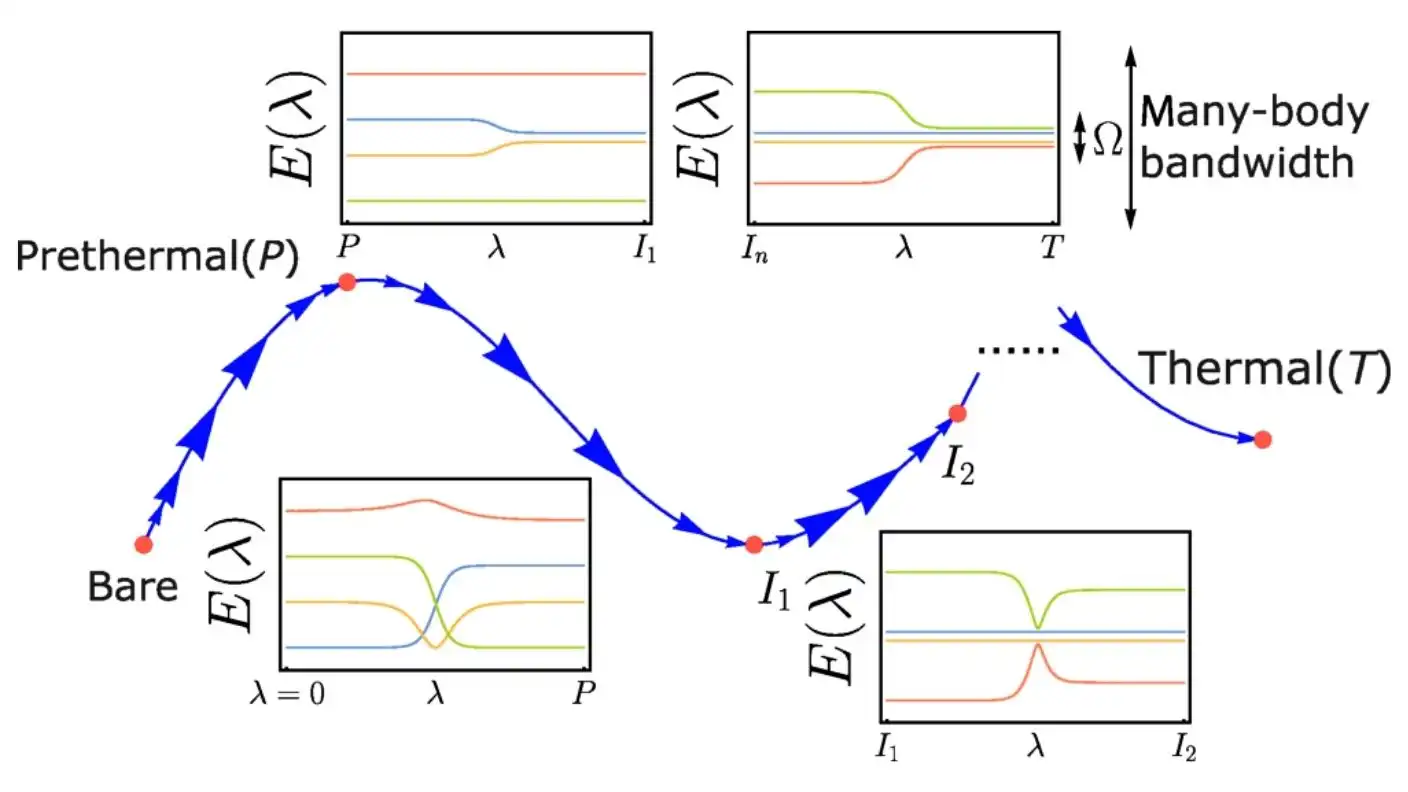
Chowdhury and his research team used a new mathematical framework to figure out the exact lifespan of this frozen state. They discovered that while the protection does not last forever, it persists for an astonishingly long time. Under the right conditions, the system can preserve information for a period approaching the age of the universe.
The system requires a constant driving force to maintain this frozen state. Researcher Rohit Mukherjee likened the process to pushing a child on a playground swing. If you time your pushes perfectly and repeat them over and over, you control the motion completely. This periodic drive acts like noise-canceling headphones for quantum chaos.
Despite this incredible stability, the team found that the system will inevitably break down. Researcher Haoyu Guo explained that the setup remains stable almost all the time, but rare quantum events eventually happen. A particle might suddenly jump through a solid barrier into a completely different state. When this sudden jump occurs, the coherence breaks, and thermodynamics finally takes over.
This theoretical work offers massive practical benefits for the technology industry. Today, engineers struggle to control just a handful of qubits. When future computers scale up to millions of interacting parts, tiny errors will easily snowball into massive failures. Understanding dynamical freezing gives creators a powerful tool to build large, stable quantum machines.
Source: Physical Review X (2026).