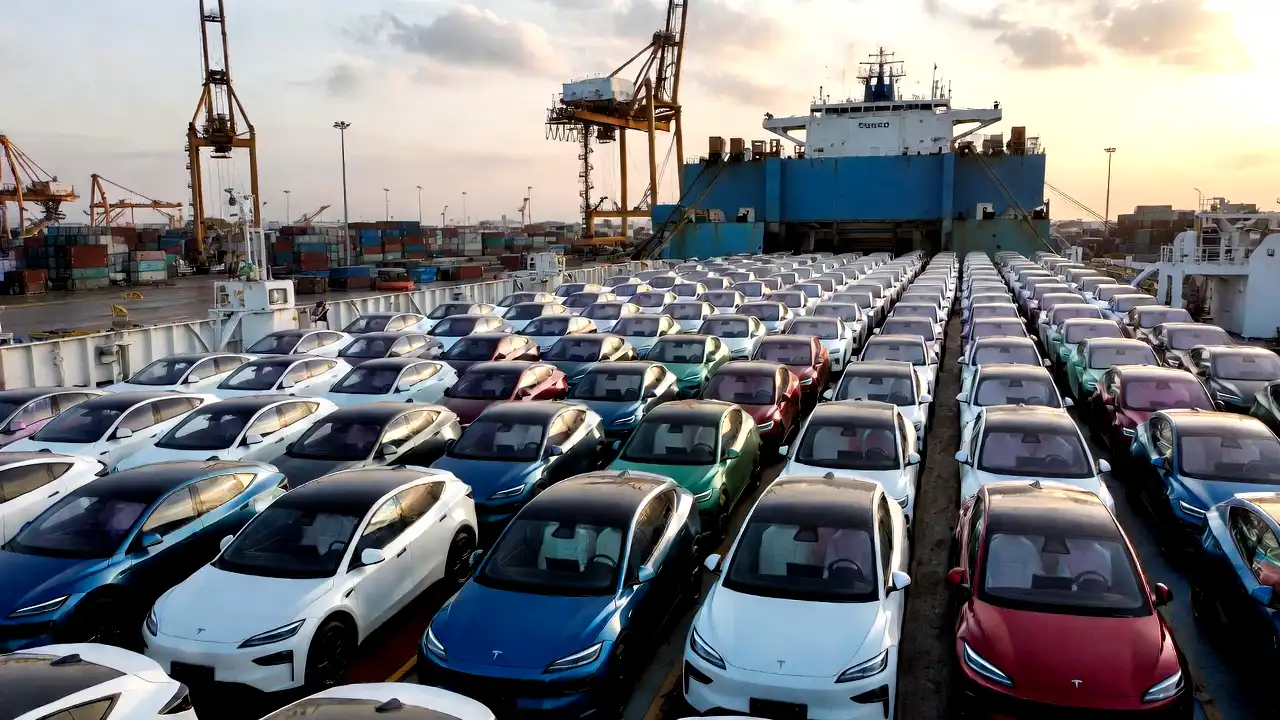
The global automotive industry is undergoing a historic, highly volatile transformation. Across Europe, Australia, Latin America, and Southeast Asia, everyday drivers are walking past the traditional showrooms of famous Western car companies to drive home in brand-new vehicles made by Chinese manufacturers. Brands like BYD, Chery, and Geely have quickly evolved from obscure regional players into global household names, challenging the decades-long dominance of legacy automakers.
However, behind this explosive international expansion lies a highly unexpected economic paradox. In a recent report published by The Wall Street Journal, the stark contrast between the global popularity of these vehicles and their performance at home has come into sharp focus.
While the rest of the world is falling in love with Chinese electric vehicles, the domestic Chinese automotive market is experiencing a severe, profit-killing downturn. Sluggish consumer spending, a brutal price war, and weak domestic demand are forcing local carmakers to export their vehicles aggressively to survive. This comprehensive analysis explores why Chinese cars have captured the global market, examines the economic struggles plaguing the domestic Chinese market, and details the geopolitical tariff battles reshaping the global automotive landscape.
Understanding the Global Obsession with Chinese Cars
To understand why international buyers are snatching up Chinese vehicles at an unprecedented rate, one must look at the value proposition they offer. For decades, Western consumers associated Chinese-manufactured cars with low-quality, derivative designs.
That perception has completely vanished. Today, Chinese automakers produce some of the most advanced, highly reliable, and software-rich vehicles in the world, selling them at prices that legacy Western manufacturers simply cannot match.
A standard electric vehicle or family SUV from a traditional European or American brand can easily cost a consumer $50,000 to $60,000. In contrast, a Chinese alternative with superior battery range, spacious leather interiors, and a massive, highly responsive touch screen can be purchased for a fraction of that amount.
In the United Kingdom, for instance, Chery’s upmarket plug-in hybrid SUV, the Jaecoo 8, has become one of the most highly anticipated car launches of the year, offering luxury features that mimic a Range Rover at a middle-market price point. This combination of low cost and high technology has democratized access to electric mobility worldwide, making Chinese cars highly attractive to everyday families.
Key Components of China’s Automotive Export Success
The rapid global expansion of Chinese automakers relies on several critical technical, financial, and industrial components:
- Highly Integrated Battery Supply Chains: Sourcing battery cells directly from local giant CATL, which keeps manufacturing costs 20% to 30% lower than Western rivals.
- Aggressive Export Pricing: Offering premium utility vehicles and sedans at wholesale prices that legacy brands cannot compete with.
- Advanced Infotainment and Operating Systems: Integrating high-speed software and smartphone ecosystems directly into the dashboard (as demonstrated by Xiaomi’s HyperOS).
- Massive Sovereign Subsidies: Utilizing over $232 billion in direct state subsidies over the past fifteen years to build an unmatched manufacturing infrastructure.
- Flexible Hybrid and EV Powertrains: Offering both battery-electric vehicles (BEVs) and plug-in hybrid electric vehicles (PHEVs) to capture all consumer preferences.
The Domestic Reality: Sluggish Demand and Squeezed Margins
While Chinese automakers are enjoying massive victories on the global stage, their home market has turned into a brutal financial battlefield. The world’s largest automotive market is suffering from severe overcapacity, weak consumer confidence, and a slowing national economy.
The 22.1% Passenger Car Sales Collapse
The latest retail data from the China Passenger Car Association (CPCA) paints a highly alarming picture of the domestic market’s health. In May, retail sales of passenger cars in China fell sharply by 22.1% year-on-year, to just 1.51 million units.
Even new-energy vehicles, which include both full electrics and plug-in hybrids, saw their retail sales slide by 7.5% during the month, dropping to 950,000 units. While EVs and hybrids captured a record 62.9% share of the domestic sales mix, overall car sales continue to shrink.
A Cautious and Deal-Fatigued Consumer Base
The primary cause of this domestic weakness is a highly cautious Chinese consumer. Faced with real estate market volatility, high local fuel prices, and tighter auto financing conditions, middle-class households are holding onto their savings.
Furthermore, the relentless, profit-killing price war waged by local manufacturers has backfired. Because brands like BYD and Geely are cutting prices almost every week, Chinese consumers have developed “deal fatigue.”
Instead of rushing to buy, consumers are delaying their purchases, assuming that if they wait a few more months, the cars will become even cheaper. This cautious behavior has eroded local carmakers’ profit margins, making their domestic operations highly unprofitable.
The Export Escape Hatch: Flooding the Global Market
Because the domestic Chinese market has become a low-margin battlefield, local automakers have been forced to look to international markets as their primary escape hatch. To survive sluggish domestic demand, Chinese carmakers are using their massive, state-subsidized factories to flood global markets with excess inventory.
The export figures from May illustrate the sheer scale of this outward push:
- A Record 784,000 May Exports: Chinese automakers exported a record 784,000 vehicles in May alone, using global demand to offset their domestic sales losses.
- New-Energy Vehicles Dominate: EVs and hybrids accounted for a record 54% of these exports, demonstrating that China is successfully exporting its clean-energy transition to the rest of the world.
- Tesla’s Shanghai Export Hub: Tesla’s Gigafactory Shanghai continues to serve as a primary pillar of this export machine, exporting 38,701 units to international markets in May while selling 85,982 units to domestic Chinese buyers.
This massive export drive has turned China into the world’s top automotive exporter. However, this sudden flood of cheap, high-tech vehicles has triggered intense anxiety in Western capitals, where governments are moving aggressively to protect their own legacy manufacturing industries from being completely wiped out.
The Ford CEO and the Xiaomi SU7: A Wake-Up Call for Detroit
The ultimate proof of how far Chinese automakers have surpassed their Western rivals came from Ford CEO Jim Farley. During a candid public appearance, Farley made a shocking admission about his experience with a Chinese electric vehicle.
Farley managed to import a Xiaomi SU7 Max—a high-performance electric sedan designed by the Chinese smartphone giant—from Shanghai to Chicago. He daily drove the vehicle for over six months, and his verdict was incredibly candid: “I don’t want to give it up.”
The Xiaomi SU7 Max is a formidable demonstration of China’s highly advanced EV supply chain. Priced at an aggressive $30,400 in China, the sedan features a dual-motor setup that accelerates from 0 to 100 km/h in just 2.78 seconds, putting it in direct competition with the Porsche Taycan.
More importantly, the car features a modular interior with a “plug-and-play” dashboard that allows drivers to magnetically attach physical buttons and dials, catering to those who prefer tactile controls over purely digital screens. The car also integrates seamlessly into Xiaomi’s “human-car-home” HyperOS software ecosystem, allowing the driver to control their home appliances directly from the dashboard.
The fact that the head of one of America’s most iconic automakers fell in love with a Chinese EV highlights the immense competitive threat facing Western brands. However, while Farley personally loves the vehicle, he has been highly vocal about keeping these cars out of American consumers’ hands.
Farley recently warned that allowing Chinese EVs to enter the United States would be “devastating” for American manufacturing, calling for strict protectionist measures to keep them out.
The Tariffs and the Tariff-Bypass Battle
To protect their vulnerable domestic car industries, Western governments are building massive tariff walls. The United States and Canada have both imposed a 100% tariff on Chinese-built electric vehicles, effectively making them non-viable for sale in North America.
In Michigan, politicians have even proposed banning Mexican and Canadian citizens from driving Chinese-made cars across the U.S. border for day trips, demonstrating the extreme level of political anxiety surrounding Chinese technology.
However, Chinese automakers are already executing a highly sophisticated strategy to bypass these tariff walls. Instead of exporting finished vehicles from Shanghai, they are investing billions of dollars to build assembly plants in neutral third countries:
- BYD’s European Expansion: BYD is actively seeking to acquire an existing assembly plant in Spain to establish its second major factory on the European continent, thereby bypassing EU tariff penalties.
- Stellantis’s Canadian Leapmotor Project: Stellantis, which owns a 20% stake in Chinese EV startup Leapmotor, is exploring plans to manufacture Leapmotor EVs at its idle assembly facility in Brampton, Canada, allowing the cars to enter the North American market under local trade agreements.
- The “Made by China” Shift: This structural transition means “Made in China” is rapidly becoming “Made by China.” By shifting assembly to developing markets in Latin America and Eastern Europe, Chinese automakers can successfully bypass Western tariffs while continuing to capture global market share.
Conclusion
The global automotive landscape has split into two completely different realities. While the rest of the world is falling in love with the high-tech, low-cost appeal of Chinese electric vehicles, the Chinese domestic market is struggling under the weight of weak consumer demand and a profit-killing price war. This domestic slowdown has forced Chinese automakers to export aggressively, redrawing the global automotive map in the process. As Western nations build massive tariff walls to protect their legacy industries, the sheer economic and technological force of China’s automotive supply chain suggests that the global transition is already unstoppable.