Key Points:
- Engineers from MIT and partner universities created a new soft magnetic hydrogel to build tiny 3D robots.
- The new double-dip process solves the old problem of light scattering during 3D printing.
- Researchers built a tiny gripper that is smaller than 1 grain of sand to grab small objects.
- Doctors could eventually use these micro-robots to deliver medicine or take tissue biopsies inside the human body.
Under a powerful microscope, a group of tiny structures that look like lollipops floats in a small dish of liquid. Each little shape is smaller than 1 grain of sand. Suddenly, a scientist waves a small magnet over the dish. The tiny shapes snap together instantly, acting just like a hungry plant’s jaws. This small trick showcases a brand-new type of soft magnetic hydrogel. Engineers at MIT, the University of Cincinnati, and EPFL worked together to create this amazing new material.
The team recently published their findings in the scientific journal Matter. They explained a completely new way to print and build 3D materials. Their new gel allows scientists to build tiny, complex shapes that move when they feel a magnetic pull. These new materials will soon serve as the foundation for microscopic robots. Doctors could use these tiny robots, often called magno-bots, in hospitals. A doctor could guide the robot through a patient using an external magnet. Once the robot reaches the right spot, it could release medicine or grab a small piece of tissue for testing.
Moving objects with magnets is a very common trick in our everyday lives. For example, anyone can grab a refrigerator magnet and drag a pile of metal paper clips across a desk. At the microscopic level, scientists have already built different types of tiny swimmers. These tiny machines measure less than 1 millimeter across. Scientists guide them through tight spaces using magnets. However, older designs relied on a messy process. Builders mixed small magnetic metal pieces directly into a printable liquid resin. Then, they simply pulled the whole solid block toward a magnet.
The MIT team wanted to do something much more complex. They wanted to build flexible robots that move specific body parts with extreme precision. Carlos Portela, an engineering professor at MIT, explained that the team can now build soft 3D shapes with individual parts that bend and move independently. He believes this new ability will completely change the field of microscopic robotics.
Creating these tiny shapes required a major change in how scientists use 3D printers. Normally, researchers use a high-resolution 3D printing method that shoots a laser into a tiny pool of liquid resin. The laser flashes quickly, turning the liquid into a solid layer by layer. While this method works perfectly for normal plastics, adding magnets caused huge problems.
In the past, researchers tried to mix magnetic metal particles into the liquid resin before turning on the laser. Since magnetic particles are just tiny pieces of metal, they naturally block the light. The metal pieces scattered the laser beams and gathered into messy clumps. The metal blocked the laser from working properly, which ruined the printing process and produced weak structures. Rachel Sun, a lead author of the study, noted that printing tiny structures with magnetic metal inside forces scientists to choose between a strong shape or a strong magnet.
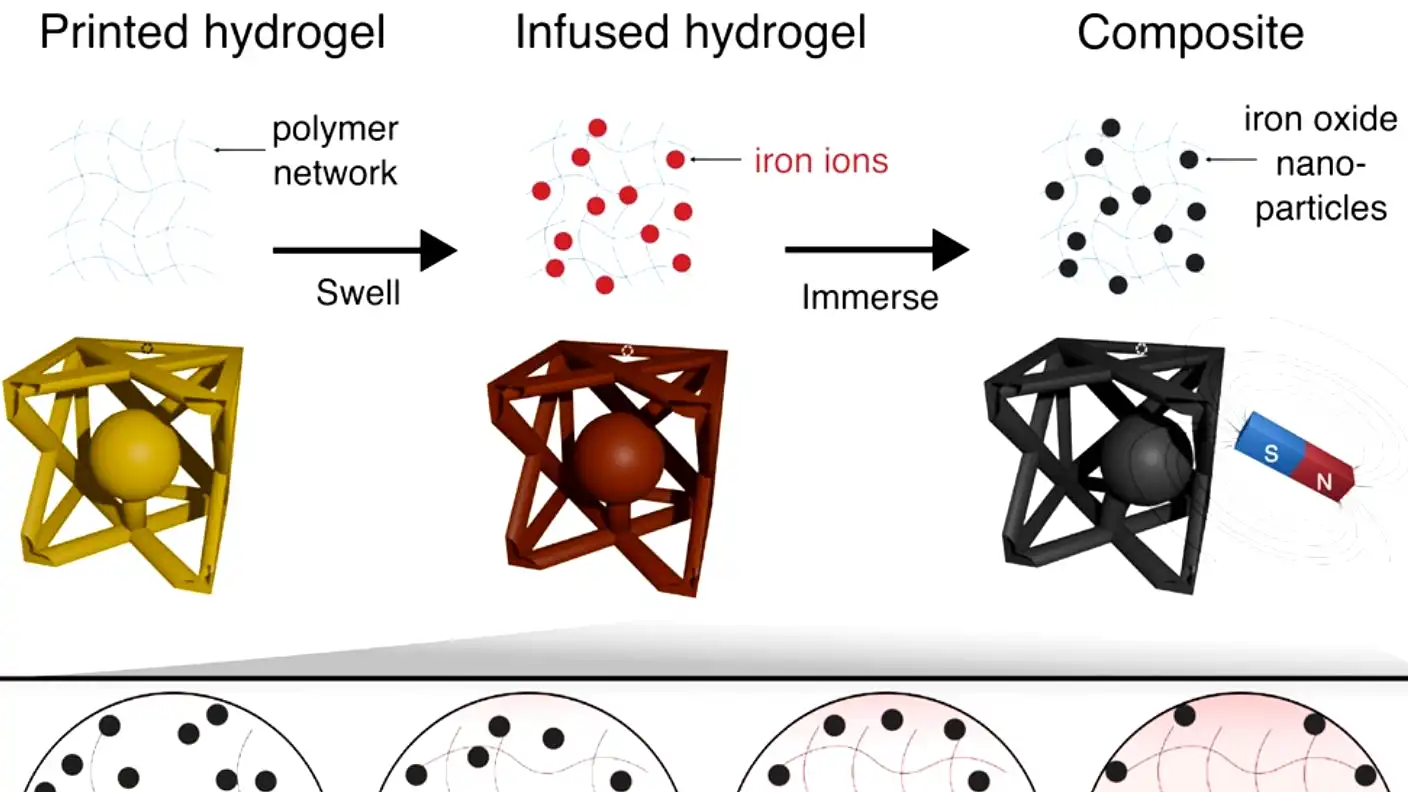
To solve this major problem, the team invented a smart double-dip process. First, the researchers print the tiny shape using a standard polymer gel without any magnets. Next, they take the finished solid shape and dip it into a special liquid filled with iron ions. The soft gel drinks up the iron like a sponge. Finally, the team dips the shape into a second liquid filled with hydroxide ions. The iron and the hydroxide link together inside the gel. This chemical reaction produces iron oxide particles, which are naturally magnetic.
This brilliant new process allows the team to print tiny structures perfectly and add the magnets later. Even better, the engineers can control exactly how magnetic each specific part becomes. During the initial printing phase, the team adjusts the laser power. A stronger laser creates a tighter gel network. A tighter gel absorbs fewer magnetic particles during the dipping phase. This clever trick gives scientists the freedom to decide which parts of the robot strongly pull toward a magnet and which parts remain still.
To test their idea, the team built the tiny lollipop shapes. They printed a base with several sticks holding tiny round balls. The entire robot stood less than 1 millimeter tall. The engineers gave each ball a different level of magnetism. When they brought a standard refrigerator magnet close to the dish, the tiny lollipops bent toward it. Because they had different magnetic strengths, they curled inward perfectly to form a gripping hand.
The team also built a tiny magnetic switch. They printed a small rectangle that measured about 1 millimeter long. They attached 4 tiny magnetic oars to the sides. Each oar measured exactly 8 microns thick, which perfectly matches the size of a single human red blood cell. When the engineers held a magnet to one side, the 4 oars flipped over, locking the rectangle in place. Moving the magnet to the other side flipped the oars back, pulling the rectangle the opposite way.
Portela envisions a bright future for these tiny creations. He says engineers can use these small switches as valves to open and close fluid channels inside tiny medical devices. The team completely solved the problem of building complex magnetic shapes at the microscopic level. Now, scientists around the world can use this exact method to design the next generation of tiny medical robots.
Source: Matter (2026).