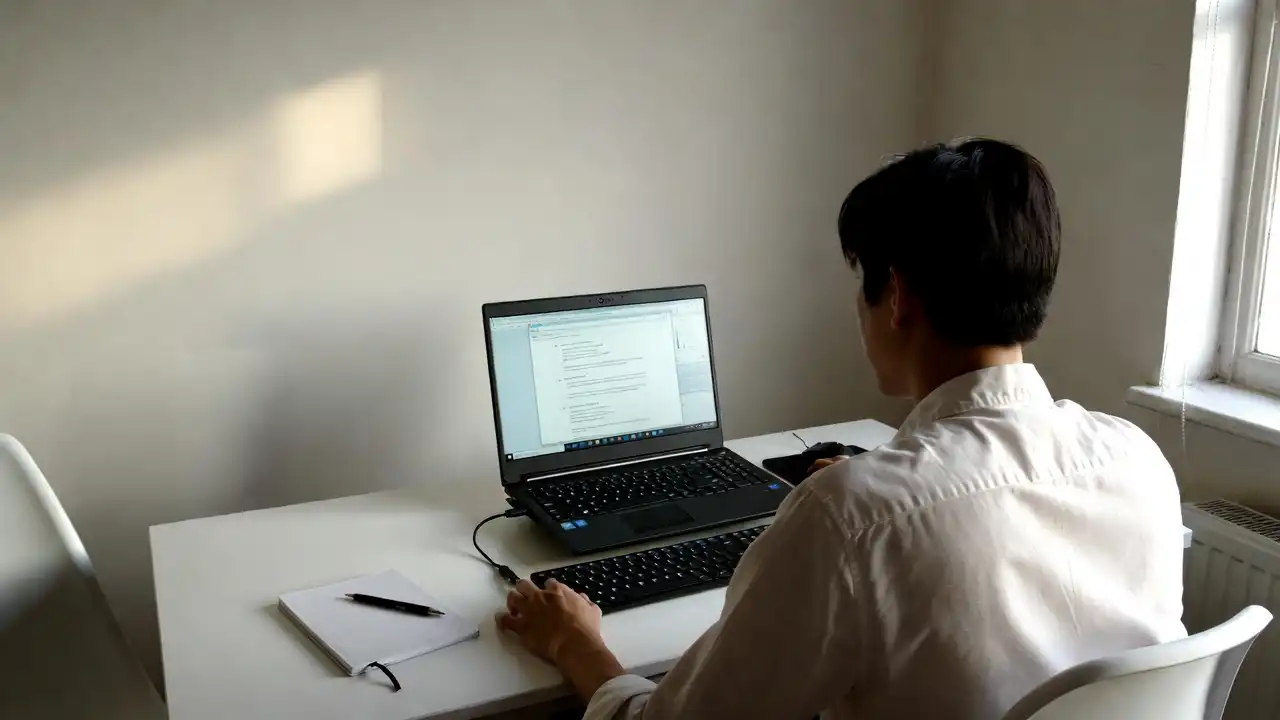
In the modern economy, your ability to focus is your most valuable asset. The capacity to engage in “deep work”—cognitively demanding tasks performed in a state of distraction-free concentration—is what separates the amateur from the professional, the busy from the productive.
Yet, we are living in an age of unprecedented distraction. Our physical and digital environments are engineered to steal our attention. From the ping of a Slack notification and the allure of a social media feed to the pile of laundry in the corner of our eye, we are constantly being pulled away from the work that matters.
Many of us believe that focus is a matter of willpower. We think, “If I just try harder, I can ignore the noise.” But this is a losing battle. Willpower is a finite resource that depletes with every decision and every resisted temptation.
The most focused people in the world don’t have more willpower than you; they just use it less. They do not fight distraction; they design their environment to eliminate it.
A distraction-free workspace is not a luxury; it is a necessity for high-quality output. It is a sanctuary engineered to protect your most precious resource: your attention. This comprehensive guide will walk you through the psychological principles and practical steps to transform any space—from a dedicated home office to a corner of your bedroom—into a fortress of focus.
The Psychology of Space: Your Brain on Clutter
Before you buy a single desk organizer, you must understand why your environment has such a profound impact on your cognitive performance.
The “Attentional Load” Theory
Your brain has a limited capacity for processing information at any given time. This is your “attentional load.” When your workspace is cluttered, every object in your peripheral vision—the stack of mail, the coffee cups, the tangled cables—is a piece of data that your brain has to process.
Even if you are not consciously thinking about the clutter, your brain is expending subconscious energy to filter it out. This creates a low-level, chronic state of cognitive overload that leaves less mental bandwidth for the actual task at hand. A minimalist workspace is not just an aesthetic choice; it is a cognitive performance enhancer.
Context-Dependent Memory and Habit Formation
Your brain is an association machine. It links behaviors and mental states to specific environments. This is why sleep experts tell you not to work in your bed—you are confusing the “sleep” context with the “work” context.
The same principle applies to focus. If you do your deep work at the same kitchen table where you eat, watch TV, and argue with your family, your brain doesn’t know how to behave. It receives mixed signals.
By creating a dedicated space only for focused work, you create a powerful psychological trigger. When you enter that space, your brain knows, “This is where we focus.”
Phase 1: Defining the Territory (Location, Location, Location)
The first step is to claim your ground. The ideal is a separate room with a door, but that is a luxury not everyone has.
The Gold Standard: The Dedicated Office
If you have a spare room, this is your best option. The ability to physically close a door is the ultimate tool for signaling to yourself and others that you are “at work.” It provides a powerful barrier against both auditory and visual distractions.
The Silver Standard: The Nook or Corner
If you don’t have a separate room, find a low-traffic corner of your living room or bedroom.
- The Golden Rule: Your desk must face a wall or a window. Never face the room. If you can see the TV, the couch, or your bed, you are inviting distraction. Turning your back on the domestic space creates a psychological separation, even if there is no physical one.
The Bronze Standard: The “Pop-Up” Workspace
For those living in small studio apartments, your dining table may be your only option. In this case, you must rely on a Transformation Ritual.
- Clear the Decks: Before you start work, completely clear the table of all non-work items (salt shakers, placemats, etc.).
- Define the Space: Lay down a specific desk mat or even a dedicated “work tablecloth.” This visually transforms the space.
- Set Up: Bring out your work tools (laptop, monitor, notebook).
- The Shutdown: When the workday is over, you must pack everything away and return the table to its dining function. This “commute” of setting up and tearing down signals the start and end of your focus periods.
Phase 2: The Physical Foundation (Ergonomics and Layout)
You cannot focus if your body is in pain. A poorly designed workspace leads to back pain, neck strain, and eye fatigue, all of which pull your attention away from your work.
The Desk: Your Command Center
- Size: The desk should be large enough to hold your essential equipment without feeling cramped, but not so large that it invites clutter.
- Surface: A clean, uncluttered surface is paramount. The only things on your desk should be what you need for the current task. Everything else belongs in a drawer.
The Chair: The Unsung Hero
A good chair is an investment in your health and focus. A dining chair is not an office chair.
- Look for: Adjustable height, lumbar support, and armrests. Your feet should be flat on the floor, and your elbows should be at a 90-degree angle when typing.
The Monitor: The Eye-Level Rule
“Tech neck” is a real and painful condition caused by looking down at a laptop screen.
- Laptops: You must use a laptop stand (or a stack of books) to raise the screen so that the top of the monitor is at or slightly below eye level.
- External Keyboard and Mouse: Raising your laptop necessitates an external keyboard and mouse to maintain proper ergonomic posture.
Phase 3: Sensory Architecture (Designing for Focus)
Now that the furniture is in place, you must engineer the sensory experience of the space.
The Visual Environment
Lighting: Light is a biological signal. Cool, blue-toned light mimics daylight and promotes alertness by suppressing melatonin. Warm, yellow-toned light is relaxing and signals the brain to wind down.
- Action: Use a smart bulb or a desk lamp with adjustable color temperature. Set it to a cool white (4000K-6000K) during your deep work blocks.
Color Palette: While personal preference matters, studies in color psychology suggest that neutral and natural tones are best for focus.
- Good choices: Off-white, light gray, beige, and natural wood tones. Green and blue accents can be calming.
- Avoid: Bright reds and oranges, which can be agitating, and complex, busy patterns.
Clutter Control: Your mantra should be: A home for everything, and everything in its home.
- Use drawers, cabinets, and bins to store anything not in immediate use.
- Invest in cable management solutions (zip ties, cable sleeves, under-desk trays) to hide the visual chaos of wires.
The Auditory Environment
Noise is the most common focus killer.
- Noise-Canceling Headphones: This is a non-negotiable investment. Even in a quiet room, they create a “cone of silence” that dampens ambient noise and signals to your brain that it is time to focus.
- Strategic Sound: Silence can be deafening for some. Experiment with soundscapes.
- Avoid: Music with lyrics. The language centers of your brain will try to process the words, creating cognitive interference.
- Good: Instrumental music (classical, electronic), binaural beats, or nature sounds.
- Best: “Pink Noise” or “Brown Noise.” These are less harsh than white noise and are excellent at masking sudden, distracting sounds like a dog barking or a car horn. Apps like Brain.fm or websites like MyNoise.net are excellent resources.
The Olfactory Environment (The Scent Trigger)
Scent is the sense most strongly linked to memory and mood. You can use this to create a Pavlovian trigger for focus.
- The Ritual: Choose a specific, clean scent (like peppermint, lemon, or rosemary) that you only use when you are in your Focus Zone. Use an essential oil diffuser or a specific candle.
- The Effect: Over time, your brain will build a strong association. The moment you smell that scent, your brain will automatically start shifting into “focus mode.”
Phase 4: The Digital Firewall (Taming Technology)
You can have the perfect physical space, but if your digital space is in chaos, you will still be distracted.
The Phone’s Place is Not on the Desk
Your smartphone is a slot machine designed by a thousand engineers to steal your attention. You cannot win a battle of willpower against it.
- The “Phone Jail”: Create a charging station in another room (the kitchen, the hallway). When you enter your Focus Zone, your phone goes into “jail.”
- The “Out of Sight” Rule: If you must keep it in the same room, put it in a drawer or a box. Even seeing it face down in your peripheral vision creates a cognitive load as your brain actively works to not check it.
Fortifying Your Computer
Your computer is a portal to infinite distraction. You must build a firewall.
- Use Site Blockers: Install an app like Freedom, Cold Turkey, or StayFocusd. These allow you to block access to social media, news sites, and any other “time-wasting” websites for a set period. Be ruthless.
- One Task, One Window: Work in full-screen mode whenever possible. This hides the dock, the menu bar, and the dozens of other open tabs, creating a digital tunnel vision.
- Turn Off Notifications: Go into your system settings and turn off all non-essential notifications. Badges, banners, and sounds are designed to pull you out of the flow state. The only notification you should have enabled is your calendar.
Phase 5: The Rituals of Entry and Exit
Your Focus Zone is just a space until you activate it with a ritual. Rituals are the psychological bridge between your “normal” self and your “focused” self.
The “Commute to Work” (Entry Ritual)
Create a short, consistent sequence of actions you perform every time you start a deep work session.
- Example:
- Fill a glass of water and place it on your desk.
- Put your phone in the “Phone Jail.”
- Turn on your focus scent and your focus playlist.
- Open your notebook and write down the one specific goal for this work block.
- Start the timer.
This 5-minute ritual replaces the physical commute to an office, signaling to your brain that the workday has officially begun.
The “Shutdown Complete” (Exit Ritual)
It is equally important to have a ritual to end your work. This prevents “attention residue”—where thoughts about work bleed into your personal time.
- Example:
- Spend 15 minutes clearing your email inbox.
- Review your calendar and plan your top priorities for tomorrow.
- Tidy your physical desk.
- Close all browser tabs and applications.
- Say a phrase out loud, like “Shutdown complete.”
This gives your brain a sense of closure and permission to disengage.
Conclusion
Creating a distraction-free workspace is more than just a productivity hack. It is a declaration. It is a statement to yourself, your colleagues, and your family that your focus is valuable and deserves protection.
In a world that is increasingly noisy and chaotic, the ability to retreat into a sanctuary of deep thought is not just a competitive advantage; it is a form of self-respect.
You do not need a corner office with a mahogany desk. You just need intention. You need to respect the psychology of your own mind. By designing an environment that minimizes friction for focus and maximizes friction for distraction, you are not just building a workspace; you are building the foundation for the best work of your life.