Key Points:
- Researchers mapped the detailed structure of the Ostα/β transporter protein.
- The protein moves bile acids from the intestine to the bloodstream.
- The system uses the cell’s electrical charge to drive transport.
- Its unique structure differs fundamentally from other known transporter families.
Bile acids play a huge role in how we digest food and metabolize energy. For years, scientists struggled to understand exactly how these acids travel from our intestines into our bloodstream. A new study published in Nature finally solves this puzzle, often called the “Northwest Passage” of biology, because it was so difficult to map.
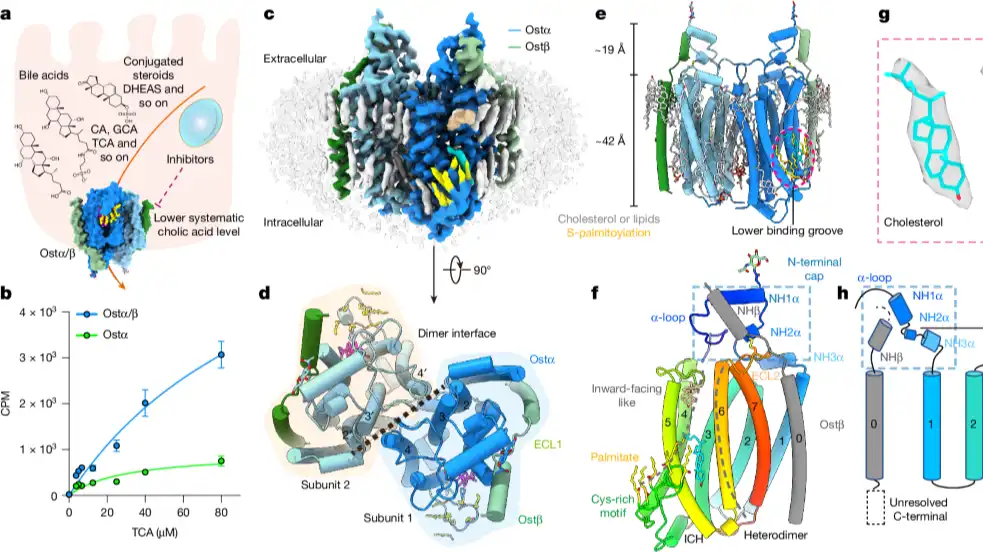
A research team led by Eric H. Xu from the Chinese Academy of Sciences and Ma Xiong from Renji Hospital used advanced technology to crack the code. By using cryo-electron microscopy, they captured high-resolution images of a protein complex called Ostα/β. This protein acts as the gatekeeper for bile acids.
What they found surprised them. Ostα/β doesn’t look like other transport proteins. It forms a unique shape with a special groove on the side that grabs onto bile acids. Once the protein catches an acid, it uses a tunnel to move it through the cell membrane.
The team discovered that this process relies on electricity. Unlike other transporters that burn chemical fuel like ATP, Ostα/β uses the electrical charge across the cell membrane to push bile acids where they need to go.
If the voltage changes, the protein can even switch directions. This makes the cell membrane’s electrical state an active driver of the process, not just a passive background setting.
This discovery does more than just explain digestion. The researchers noticed that Ostα/β looks very similar to another family of proteins called TMEM184. This suggests that scientists might have found a whole new class of transporters that work in this unique way.
Understanding this mechanism opens new doors for treating liver and digestive diseases, as doctors now have a blueprint of exactly how the body recycles these essential fluids.
Source: Nature (2026).