

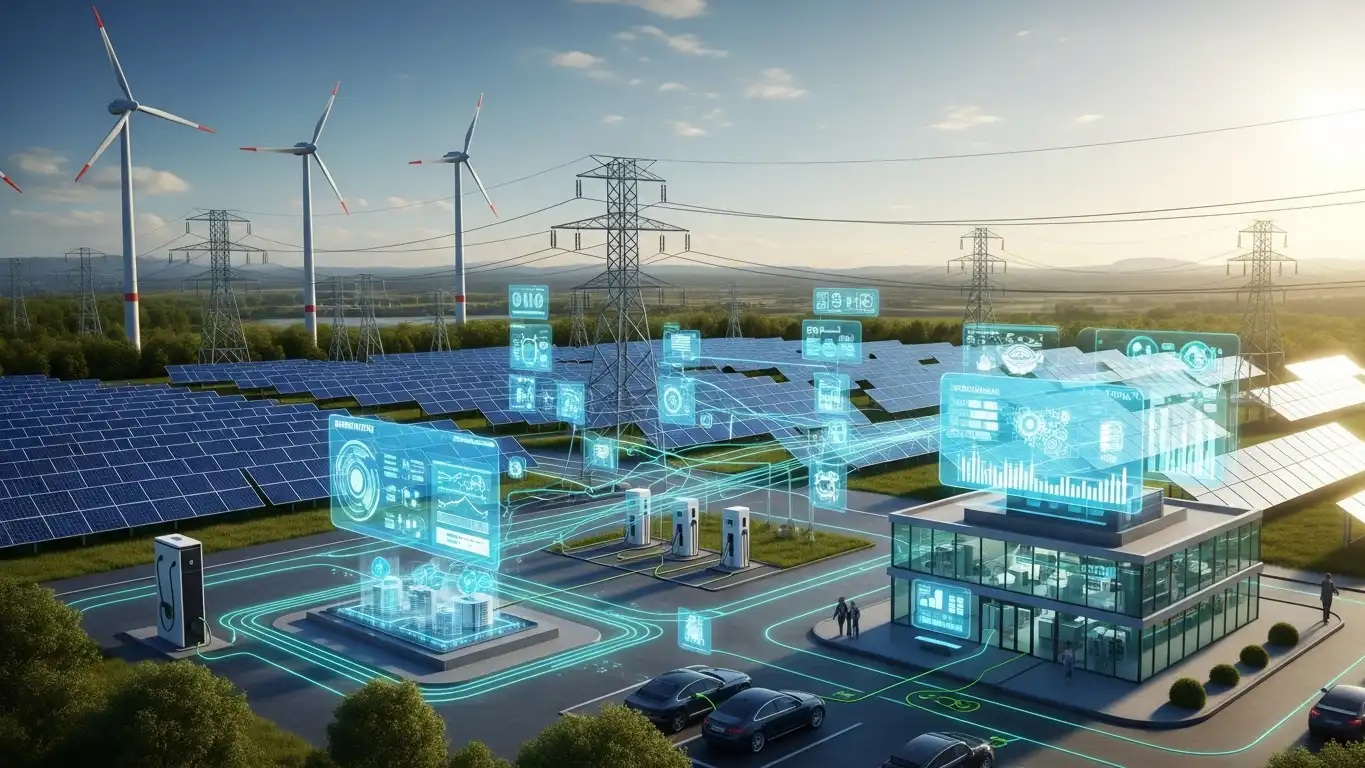
For over a century, the electric power grid has been the unsung hero of the modern world, a sprawling, monumental feat of engineering that brought light, heat, and power to our homes and industries. It was a one-way street, a centralized and analog system built for a different era. Power was generated in large, remote fossil-fuel plants, stepped up to high voltages, and sent across a vast network of transmission and distribution lines to passive consumers at the end of the lines. This centrally controlled, top-down model was a marvel of the 20th century, but it is now dangerously out of step with the demands of the 21st. It is inefficient, fragile, and fundamentally incompatible with the clean, decentralized, and dynamic energy future we must build.
We are now in the midst of a profound and necessary revolution to drag this aging behemoth into the digital age. This is the era of the smart grid and the rise of digital energy networks. This is not a simple upgrade; it is a fundamental reimagining of our entire energy infrastructure. It is about infusing the traditional “iron and copper” of the grid with a sophisticated, intelligent, digital nervous system—a web of sensors, smart meters, advanced analytics, and automated controls. This transformation is turning the old one-way street into a dynamic, multi-directional superhighway of energy and information. For the global energy industry, and for every industry that depends on it, the smart grid is not just an innovation; it is the essential, foundational platform for the global energy transition, enabling a future that is more sustainable, resilient, and efficient than we ever thought possible.
The Burning Platform: Why the 100-Year-Old Grid Can No Longer Meet Our Needs
To understand the urgency and scale of the smart grid revolution, we must first confront the deep and systemic failures of the traditional electrical grid. The system that powered the industrial age is now a major bottleneck, a “burning platform” hindering our progress towards a clean energy future and increasingly vulnerable to the challenges of a new century.
The limitations of the legacy grid are not minor flaws; they are fundamental architectural constraints that demand a complete overhaul.
The Inefficiency of a One-Way System
The traditional grid is a monument to inefficiency. It was designed to handle a worst-case scenario: peak demand on the hottest summer afternoon. To meet this peak, utility companies must have enough power plants on standby to generate the maximum amount of electricity, even though this capacity is only needed for a few hours each year.
This “peak load” problem is the source of massive waste and cost.
- Generation and Transmission Losses: A significant amount of energy—estimated at around 5% in the U.S.—is lost as heat in the transmission and distribution lines as it travels from the power plant to the consumer. In a system built on one-way flow, this is a fixed, unavoidable loss.
- The “Spinning Reserve” and Inefficient Peaker Plants: To ensure grid stability, utilities must maintain a “spinning reserve” of power plants running at low output, ready to ramp up instantly if another plant fails or demand spikes. Furthermore, to meet peak demand, they rely on “peaker plants,” which are often the oldest, dirtiest, and most expensive to operate. This means that the last, and most expensive, kilowatt-hour of electricity sets the price for everyone.
The Rise of Intermittent Renewables: A Two-Way Traffic Problem
The single biggest challenge for the old grid is the massive influx of renewable energy sources like wind and solar. These are the cornerstones of our clean energy future, but they are also fundamentally different from the traditional power plants the grid was designed for.
The variability of renewables creates a massive stability and control problem for a grid built on predictable, centralized generation.
- Intermittency and Variability: The sun doesn’t always shine, and the wind doesn’t always blow. This “intermittency” means that the output from these sources is variable and not always aligned with when we need the power. A cloud passing over a large solar farm can cause a sudden, massive drop in generation, destabilizing the entire grid.
- Decentralization and Reverse Power Flow: Traditionally, power flows in one direction —from the central power plant to the consumer. But a home with rooftop solar panels is now both a consumer and a producer of energy. When that home generates more solar power than it uses, the excess energy flows back into the grid. The old grid infrastructure was never designed to handle this two-way, or “bi-directional,” flow of power, which can overload local transformers and create voltage problems.
A Lack of Visibility and the Fragility of an Analog System
The traditional grid is largely a “blind” system. Utilities have very little real-time visibility into what is happening on the vast network of distribution lines. They often don’t know that a power outage has occurred until customers start calling to report it.
This lack of real-time data makes the grid slow to respond to faults and vulnerable to cascading failures.
- Reactive, Manual Restoration: When a tree falls on a power line, it can take hours for a utility to dispatch a crew to locate the fault and manually reroute power, leaving thousands of customers in the dark.
- Vulnerability to Cascading Failures: A fault in one part of the grid can trigger a chain reaction, causing other parts of the system to overload and fail, leading to massive, widespread blackouts like the 2003 Northeast Blackout in the U.S.
- Growing Cybersecurity Threats: As we add more digital components to the grid, we also expose it to new cybersecurity risks. An analog grid is largely immune to hacking. Still, a digitally controlled grid becomes a tempting target for state-sponsored actors and cybercriminals who could seek to disrupt the power supply.
The Emergence of the “Prosumer” and New Demands on the Grid
The role of the energy consumer is changing dramatically. They are no longer just passive recipients of electricity; they are becoming active participants in the energy market. This new generation of “prosumers” (producer + consumer) and the new technologies they are adopting are placing a whole new set of demands on the grid.
These new loads and resources are fundamentally incompatible with a simple, one-way delivery system.
- The Electric Vehicle (EV) Tsunami: The mass adoption of electric vehicles represents the largest new electrical load the grid has seen in a generation. A single EV charging at home can double a household’s peak electricity demand. If unmanaged, the simultaneous charging of millions of EVs in a neighborhood during the early evening could overload local distribution transformers and cause massive grid instability.
- Energy Storage and Batteries: The rise of behind-the-meter batteries, both in homes (like the Tesla Powerwall) and at commercial facilities, creates a new, dynamic resource. These batteries can store cheap solar energy during the day and discharge it during the evening peak, but the grid needs the intelligence to see and coordinate with these resources.
The Smart Grid Architecture: Weaving a Digital Nervous System
The smart grid is the solution to these profound challenges. It is a comprehensive modernization of the electricity delivery system, integrating advanced communication, sensing, and control technologies to create a grid that is more intelligent, efficient, resilient, and interactive.
It can be thought of as a multi-layered architecture, with each layer adding a new dimension of intelligence and capability.
Layer 1: The Foundation of Advanced Metering Infrastructure (AMI)
The foundational building block of the smart grid is Advanced Metering Infrastructure (AMI), which replaces the old, analog electromechanical meters with digital “smart meters.”
Smart meters are the sensory organs of the grid, providing a rich, real-time stream of data that was previously invisible.
- Two-Way Communication: Unlike old meters that required a utility worker to physically come and read them once a month, smart meters are connected via a two-way communication network (using radio frequency, cellular, or powerline communication). This allows them to send granular energy usage data to the utility (often at 15-minute intervals) and receive signals and commands in return.
- The Benefits of Granular Data:
- Automated Outage Detection: Smart meters can automatically send a “last gasp” signal to the utility the moment they lose power. This means the utility knows exactly which customers are out of service in real time, without waiting for phone calls, allowing it to dispatch repair crews faster and more precisely.
- Remote Connect/Disconnect: Utilities can remotely turn a customer’s service on or off, eliminating the need for a truck roll and providing a faster, more efficient service.
- Enabling New Tariffs: The detailed usage data enables the creation of new, more dynamic pricing models, such as “Time-of-Use” (TOU) rates, which are essential for demand response.
Layer 2: The Sensing and Automation of the Distribution Grid
The intelligence of the smart grid extends far beyond the meter and into the distribution network of wires, poles, and transformers itself. This involves deploying a new generation of sensors and automated control devices.
This is what gives the grid the ability to self-monitor and, eventually, self-heal.
- Advanced Sensors (Phasor Measurement Units – PMUs): PMUs, or synchrophasors, are high-speed sensors that can measure the electrical waves on the grid with incredible precision, providing a real-time, high-fidelity picture of grid stress and stability.
- Automated Switches and Reclosers: These are smart, remotely controllable switches placed on the distribution lines. When a fault occurs (like a tree branch falling on a line), these devices can automatically detect the problem, isolate the faulted section of the grid, and reroute power from an alternative source to restore service to as many customers as possible, often in a matter of seconds. This is the core of a “self-healing” grid.
- Volt/VAR Optimization (VVO): This smart grid application uses sensors and controls to precisely manage voltage levels across the distribution network. By maintaining a more consistent and optimal voltage, utilities can reduce overall energy consumption (a concept known as “conservation voltage reduction”) and improve power quality.
Layer 3: The Brains of the Operation – The Data and Analytics Platform
All the data flowing from the smart meters and grid sensors is useless without the “brains” to process, analyze, and act upon it. At the heart of the smart grid is a sophisticated suite of software platforms that provide advanced analytics and control.
These platforms transform raw grid data into actionable intelligence.
- Advanced Distribution Management Systems (ADMS): An ADMS is the central command-and-control platform for the modern distribution grid. It integrates a wide range of applications—from outage management and fault location to VVO and distributed energy resource management—into a single, unified view for grid operators.
- Geospatial Information Systems (GIS): GIS provides a detailed digital map of the entire grid, allowing operators to visualize the location of all their assets and overlay real-time data from the ADMS.
- Big Data Analytics and AI/ML: Utilities are now massive data companies. They are using AI and machine learning to analyze vast streams of data from the smart grid to forecast energy demand with greater accuracy, predict equipment failures (predictive maintenance), and detect energy theft.
The Transformative Impact: How the Smart Grid Unlocks a New Energy Future
The implementation of a smart grid is not just a technical upgrade; it is a catalyst for a fundamental transformation of the entire energy ecosystem. Its capabilities enable a series of powerful, disruptive changes essential to achieving our clean energy goals.
The smart grid is the foundational enabler for a more sustainable, participatory, and resilient energy system.
The Integration of Distributed Energy Resources (DERs) at Scale
Perhaps the most critical role of the smart grid is to enable the seamless integration of a vast and growing fleet of Distributed Energy Resources (DERs). DERs are any small-scale power generation or storage resource located on the distribution grid, often on the customer’s side of the meter.
The smart grid provides the visibility and control needed to transform these DERs from a problem into a valuable grid asset.
- The DER Ecosystem:
- Rooftop Solar: The most common form of DER.
- Energy Storage: Behind-the-meter batteries in homes and businesses.
- Electric Vehicles (EVs): An EV is essentially a large battery on wheels.
- Smart Appliances and Thermostats: Flexible loads that can be controlled remotely.
- Backup Generators: At commercial and industrial facilities.
- From Unmanaged Threat to Coordinated Resource: Without a smart grid, high DER penetration (especially rooftop solar) can cause major stability problems. With a smart grid, the utility can see, monitor, and coordinate these resources. An advanced ADMS can actively manage solar inverter output or battery charging to help stabilize the local grid, a function known as Distributed Energy Resource Management System (DERMS).
The Rise of Demand Response and the Flexible Grid
For a century, the grid has operated by forcing supply to follow demand. If demand went up, a power plant had to generate more electricity. The smart grid enables the reverse: it allows demand to be shaped to follow the available supply. This is known as Demand Response (DR).
Demand response turns energy consumption into a flexible, controllable resource that can help balance the grid.
- How Demand Response Works: During periods of high demand (and high prices), a utility can use the smart grid’s two-way communication to signal to participating customers to reduce their energy consumption temporarily.
- Dynamic Pricing (Time-of-Use and Real-Time Pricing): The simplest form of DR is dynamic pricing. TOU rates charge customers more for electricity during peak hours (e.g., 4-9 PM) and less during off-peak hours. This provides a natural financial incentive for consumers to shift their energy use, for example, by pre-cooling their house in the afternoon or charging their EV overnight.
- Direct Load Control: A more active form of DR involves the utility having direct, but permission-based, control over certain customer appliances. For example, during a grid emergency, the utility could send a signal to cycle thousands of smart thermostats or water heaters off and on for short periods, shedding a significant amount of load with minimal impact on the customer.
The Era of the Prosumer and the Virtual Power Plant (VPP)
The ultimate expression of a smart, flexible grid is the Virtual Power Plant (VPP). A VPP is a cloud-based distributed power plant that aggregates the capacity of a large number of heterogeneous DERs.
A VPP can orchestrate thousands of individual resources—such as rooftop solar, home batteries, smart thermostats, and EV chargers—so they act as a single, large-scale power plant that can provide the same services to the grid as a traditional fossil-fuel plant.
- How a VPP Works: A VPP operator forms a partnership with homeowners and businesses. Using a sophisticated software platform, they can remotely control and dispatch these aggregated resources. For example, during the evening peak, the VPP could discharge thousands of home batteries onto the grid simultaneously, providing a massive burst of clean power and reducing the need to fire up an expensive and dirty gas peaker plant.
- Vehicle-to-Grid (V2G) Technology: The most exciting frontier for VPPs is Vehicle-to-Grid. With V2G technology and a bi-directional charger, the battery in an electric vehicle can not only draw power from the grid, but also feed power back to it. Still, it can also discharge power back to the grid when needed. A fleet of thousands of parked and connected EVs could act as a massive, distributed battery, providing invaluable services for grid stability.
Enhancing Grid Resilience and Reliability
The smart grid makes our power supply significantly more resilient to extreme weather events, physical attacks, and cyberattacks.
Its self-healing capabilities and enhanced visibility are a game-changer for grid reliability.
- Faster Outage Restoration: The ability to automatically detect, isolate, and reroute power around faults means fewer customers are affected by an outage, and those that are are restored much faster.
- Preventing Cascading Failures: The real-time visibility provided by sensors such as PMUs allows grid operators to detect and respond to grid stress, preventing a small, local fault from cascading into a major regional blackout.
- Microgrids for Critical Facilities: A microgrid is a small, self-contained section of the grid with its own generation (like solar and batteries) that can disconnect from the main grid and operate independently during an outage. Smart grid technologies are essential for controlling microgrids, which are increasingly deployed to provide resilient power to critical facilities such as hospitals, military bases, and data centers.
The Global Landscape: A World in Transition
The transition to a smart grid is a global phenomenon. Still, the pace and priorities of deployment vary significantly from region to region, driven by different policy goals, regulatory environments, and grid challenges.
From Europe’s market-driven approach to China’s state-led push, the world is a laboratory for smart grid innovation.
Europe: Leading the Way in Market Integration and Decarbonization
The European Union has been a global leader in the smart grid transition, driven by its aggressive decarbonization targets and its focus on creating a single, integrated European energy market.
- Ambitious Policy Goals: The EU’s “Clean Energy for all Europeans” package has set ambitious targets for renewable energy penetration and has mandated the large-scale rollout of smart meters.
- Focus on Flexibility Markets: A key focus in Europe is the creation of new markets where DERs and VPPs can compete to sell “flexibility services” (such as frequency regulation and congestion management) to the grid operator, thereby creating new revenue streams for prosumers.
North America: A Focus on Resilience and Modernization
In the United States, the smart grid rollout has been more of a state-by-state patchwork, with initial drivers being the need to modernize aging infrastructure and improve reliability. More recently, the focus has shifted to integrating renewables and enhancing resilience against extreme weather.
- Federal Funding as a Catalyst: The 2009 American Recovery and Reinvestment Act provided a major initial infusion of federal funding that kick-started many large-scale smart meter deployments. More recent legislation, like the Bipartisan Infrastructure Law, is providing another wave of funding for grid modernization and resilience projects.
- A Utility-Led Model: The rollout in the U.S. is largely led by individual investor-owned and public utilities, with regulatory approval from state-level Public Utility Commissions.
China: A State-Directed, Ultra-High Voltage Approach
China has undertaken the largest and fastest smart grid deployment in the world, driven by a top-down, state-directed industrial policy. Its focus has been on building a massive, ultra-high-voltage (UHV) transmission backbone to transport large amounts of renewable energy from the remote western parts of the country to the densely populated centers in the east. The State Grid Corporation of China has installed more smart meters than the rest of the world combined.
Emerging Economies: The Opportunity to Leapfrog
For developing countries, the smart grid represents an opportunity to “leapfrog” the 20th-century model of centralized power generation. Instead of building massive, expensive fossil fuel plants and transmission lines, they can build more decentralized, resilient, and renewable-based energy systems from the ground up, often in the form of microgrids to bring power to remote, off-grid communities.
The Road Ahead: Navigating the Challenges of a Digital Energy Future
The transition to a fully smart, digital energy network is a monumental undertaking, and the path is not without significant challenges. These are complex, multi-decade projects that require massive investment, new regulatory frameworks, and a solution to a new generation of technological and social hurdles.
Overcoming these challenges will require a concerted effort from utilities, regulators, technology providers, and the public.
The Cybersecurity Imperative
The single biggest new risk introduced by the smart grid is cybersecurity. Every one of the billions of new intelligent devices being connected to the grid—from smart meters to EV chargers and solar inverters—is a potential entry point for a malicious actor.
Securing this massively expanded attack surface is a paramount and ongoing challenge.
- The Threat Actors: The threats come from a range of actors, including state-sponsored groups seeking to disrupt critical infrastructure, cybercriminals motivated by financial gain (e.g., ransomware), and hacktivists.
- The Defense-in-Depth Strategy: Securing the smart grid requires a multi-layered, “defense-in-depth” approach. This includes securing the devices themselves, encrypting all communications, segmenting the network to contain breaches, and continuous monitoring of the entire system for anomalous activity.
The Challenge of Data Privacy
Smart meters collect an enormous amount of highly granular data about a household’s energy consumption. This data, while essential for the grid, can also reveal intimate details about a person’s lifestyle—when they are home, when they are awake, and what kinds of appliances they use.
Protecting this sensitive data and ensuring customer privacy are critical and non-negotiable requirements.
- Anonymization and Aggregation: Utilities must have robust policies and technologies in place to anonymize and aggregate data wherever possible.
- Clear Customer Consent: Customers must be given clear, transparent information about what data is being collected and how it will be used, and they must have control over who they share their data with.
The Regulatory and Market Design Hurdle
The old regulatory models, which were designed for a one-way, centralized grid, are no longer fit for purpose. Regulators are grappling with a host of complex new questions.
Creating new market rules and regulatory frameworks that can keep pace with technology is a major challenge.
- How should DERs be compensated? Regulators are wrestling with how to value the services that DERs provide to the grid. The debate over “net metering” for rooftop solar is a prime example of this complex issue.
- Who owns the data? The question of who owns and controls the vast amounts of data generated by the smart grid is a major point of contention between utilities, technology providers, and consumers.
- Performance-Based Regulation: There is a move towards “performance-based regulation,” in which utilities are rewarded not just for the capital they invest but for achieving specific outcomes, such as improved reliability, faster integration of renewables, and better customer service.
The Challenge of Interoperability and Standards
A smart grid is a system of systems, involving technology from hundreds of different vendors. Ensuring that all these different devices and software platforms can communicate and work together seamlessly is a massive challenge. Open standards, such as IEEE 2030.5 and OpenADR, are essential for creating a truly interoperable, “plug-and-play” smart grid ecosystem and for avoiding vendor lock-in.
The Digital Divide and Ensuring an Equitable Transition
Everyone must share the benefits of the smart grid. There is a risk of creating a “digital divide” in which affluent customers who can afford to buy solar panels, batteries, and EVs take advantage of the new energy economy. In contrast, lower-income customers are left paying for the upkeep of the legacy grid. Policy and program design must be intentional about ensuring that the clean energy transition is equitable and that its benefits flow to all communities.
Conclusion
The smart grid is more than just a technological upgrade. It is the intelligent artery of a sustainable and resilient 21st-century civilization. It is the foundational platform that will enable our entire clean energy future. Without its intelligence, its flexibility, and its capacity for two-way communication, the vision of a world powered by abundant, decentralized renewable energy would remain just that—a vision.
The transition is a long and complex one, fraught with technical, financial, and regulatory challenges. But the journey is well underway. Around the world, the analog grid of the past is slowly but surely being infused with a digital pulse. This new, intelligent energy network will do more than just keep the lights on. It will empower consumers to become active participants in their energy future, enable our cities to be cleaner and our infrastructure more resilient, and provide the critical backbone needed to power a thriving, decarbonized global economy. The smart grid is, in the truest sense, the power grid coming of age, finally becoming as dynamic, intelligent, and interconnected as the world it was built to serve.






