

Key Points:
- A Blue Origin New Glenn rocket exploded during a static “hotfire” test at Cape Canaveral Space Force Station in Florida.
- The catastrophic explosion destroyed the launchpad booster, triggering a sharp, double-digit sell-off across high-flying space stocks.
- AST SpaceMobile plummeted over 17%, leading sector-wide losses after Deutsche Bank downgraded the stock to Hold amid launch-delay fears.
- The slide also comes as SpaceX reportedly lowered its highly anticipated IPO valuation target to at least $1.8 trillion.
The commercial space sector suffered a massive, highly synchronized sell-off on Friday, May 29, 2026. This sudden downswing followed the catastrophic explosion of a Blue Origin New Glenn rocket during a static pad test in Florida. The launchpad disaster immediately sent shockwaves through Wall Street, driving down high-flying space equities, paring recent gains from the upcoming SpaceX IPO, and reminding investors of the high execution risks facing private aerospace companies.
Across the sector, shares of launch-exposed and satellite-related companies experienced sharp double-digit declines. Satellite-to-mobile connectivity pioneer AST SpaceMobile (ASTS) plummeted over 17% in morning trading, pushing the stock to a low of $111 per share. Other prominent space players faced similar downward pressure, with Planet Labs (PL) dropping 8% to $47.50, and Rocket Lab USA (RKLB) slipping 6% to $139. Intuitive Machines (LUNR) and Redwire (RDW) also recorded painful tumbles of 12.3% and 9.6%, respectively, while the sector-wide decline triggered a 1.5% decline in broader aerospace index benchmarks.
Interestingly, suborbital tourism operator Virgin Galactic (SPCE) emerged as the sole outlier in the sector-wide rout, surging 11% to reach $5. Because Virgin Galactic competes directly with Blue Origin’s New Shepard suborbital tourism program, traders treated the rival’s launchpad failure as a relative competitive win for the SPCE story. However, for almost every other space-themed equity, the catastrophe triggered a swift, indiscriminate unwind of the major gains accumulated over the past month.
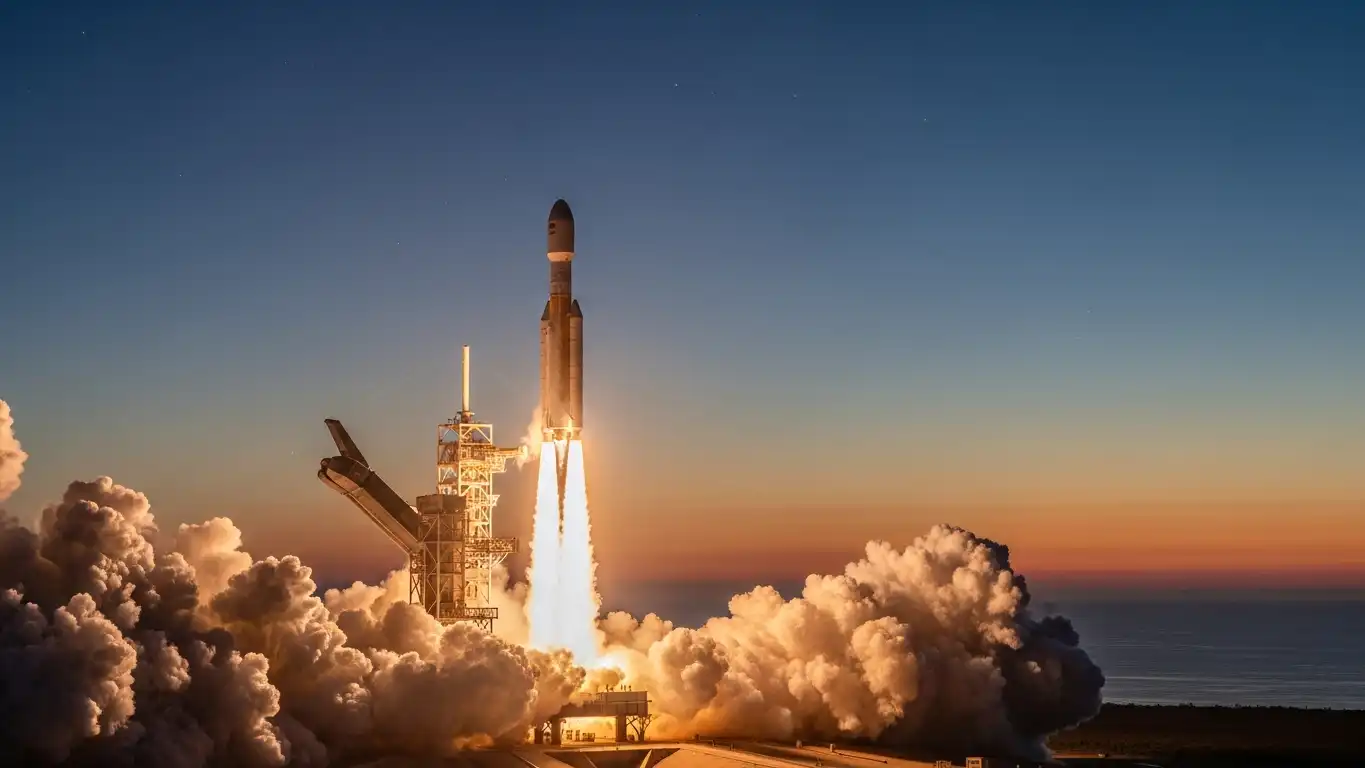
The physical catalyst for the market crash was concrete and spectacular. At approximately 9:00 p.m. on Thursday, May 28, Blue Origin’s 29-story-tall New Glenn rocket suffered a major “anomaly” during a hotfire engine test at Cape Canaveral’s Launch Complex 36. The static-fire test of its seven BE-4 methane-fueled engines erupted into a massive, atomic-bomb-like fireball, destroying the first-stage booster and toppling a heavy lightning protection tower. Blue Origin founder Jeff Bezos acknowledged the loss on social media, describing it as a “very rough day” but promising to rebuild and return to flight.
While the exploded rocket was not carrying AST SpaceMobile’s hardware, the disaster has severely disrupted the company’s long-term deployment schedule. Deutsche Bank immediately downgraded AST SpaceMobile from “Buy” to “Hold,” slashing its price target to $106. Analysts at the bank explained that ASTS will likely fail to meet its highly anticipated target of deploying 45 commercial cell-connectivity satellites in orbit by the end of 2026. Deutsche Bank had previously estimated that Blue Origin’s New Glenn would launch 26 of those 45 satellites this year.
This latest launchpad explosion represents the second major Blue Origin-related mishap to impact AST SpaceMobile in just six weeks. On April 19, a New Glenn rocket successfully launched but suffered an upper-stage engine failure, depositing ASTS’s critical BlueBird 7 satellite into a lower-than-planned orbit. The spacecraft subsequently drifted down and burned up in the atmosphere, representing a total loss of the hardware. While ASTS confirmed that insurance will absorb the financial cost, the consecutive failures have renewed deep investor anxieties regarding launch execution risk.
To mitigate these launch-provider vulnerabilities, AST SpaceMobile is actively trying to diversify its launch partners. The company’s next planned deployment of three advanced BlueBird communications satellites remains scheduled to launch on a SpaceX Falcon 9 rocket in mid-June. Because SpaceX operates a highly reliable, flight-proven fleet, this upcoming launch should remain unaffected by Blue Origin’s developmental issues. However, if Blue Origin’s New Glenn remains grounded for the next six months, the resulting launch shortage will heavily constrain the rest of ASTS’s planned 2026 constellation rollout.
Adding to the sector’s gloomy mood was a separate Bloomberg report indicating that SpaceX has lowered its highly anticipated IPO valuation target. The private space giant is targeting a valuation of at least $1.8 trillion, down from previous, highly hyped estimates of over $2 trillion in April. While the company still intends to raise to $75 billion on the Nasdaq, the slightly lower target has cooled some of the intense “SpaceX IPO hype” that had driven other space stocks higher. This cooling of investor enthusiasm further accelerated the broad-based profit-taking across the sector.
As the global space economy continues its rapid transition toward a projected $1 trillion valuation by 2030, this dramatic week serves as a vital reminder of the high-stakes execution risks of aerospace. While private launch providers are driving unprecedented industrial innovation, the physical laws of rocket propulsion do not tolerate even the slightest hardware errors. Until commercial providers can successfully prove the long-term reliability of their next-generation heavy-lift vehicles, space-tech stocks will remain highly volatile, forcing investors to carefully weigh their structural enthusiasm against the reality of launch risk.