
Key Points:
- Dell Technologies’ stock soared over 30% after posting a blockbuster earnings report, driven by an unyielding global demand for AI servers.
- Anthropic vaulted to a historic $965 billion valuation, solidifying its place as the world’s most valuable artificial intelligence startup.
- French AI pioneer Mistral is exploring the design of its own custom chips to bypass hardware bottlenecks and combat U.S. tech dominance.
- Hexagon spun off its geospatial-focused government technology business into a new independent company named Octave.
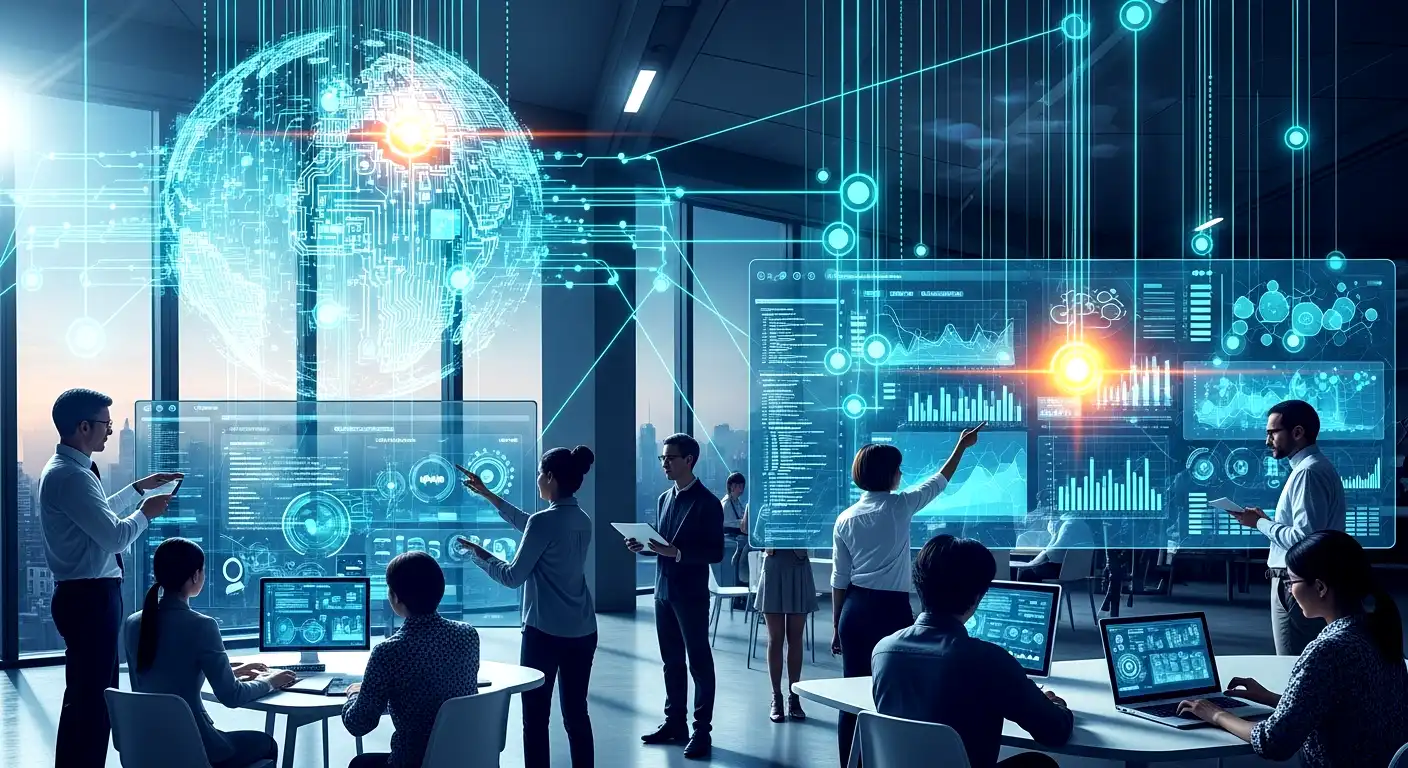
Global technology, media, and telecommunications (TMT) sectors are experiencing an extraordinary wave of structural realignment and capital-intensive development. Wall Street’s latest round of “Market Talks” for May 2026 highlights massive valuation milestones, record-breaking corporate earnings, and deep geopolitical anxieties over U.S. technological dominance. From hardware giants posting unprecedented backlogs to European startups proposing independent silicon designs, the tech industry is reorganizing its core architectures to create highly specialized, sovereign systems designed to capture the multi-trillion-dollar artificial intelligence boom.
Dell Technologies emerged as the standout in the global hardware market, with its stock price soaring by more than 30% in a single trading session. The massive rally followed a blockbuster first-quarter earnings report that easily cleared Wall Street’s expectations, prompting the company to raise its full-year guidance. Dell revealed that its advanced AI server business is experiencing an unprecedented surge in demand, with its order backlog now exceeding a staggering $51 billion. To meet this massive pipeline, the company expects to generate roughly $60 billion in annual AI server revenue alone, cementing its position as a central player in the global data center buildout.
In the startup sector, generative AI pioneer Anthropic achieved a historic milestone by vaulting to a post-money valuation of $965 billion. The massive valuation, secured through its latest $65 billion Series H funding round led by Altimeter Capital and Sequoia, officially makes Claude the most valuable AI startup on the planet, surpassing rival OpenAI. The transaction represents a massive consolidation of capital at the top, showing that institutional investors are willing to pay premium multiples for safety-first, enterprise-focused AI platforms.
This rapid rise of multi-billion-dollar American tech giants has triggered intense anxiety across European capitals, which are struggling to maintain their digital sovereignty. Speaking on the sidelines of the Brussels trade summit, Arthur Mensch, the chief executive officer of French AI pioneer Mistral, warned of the growing dangers of total U.S. technological dominance. Mensch argued that relying solely on American cloud infrastructure and semiconductor suppliers is a dangerous strategic vulnerability for Europe. To protect its digital independence, the Paris-based startup is actively exploring plans to design its own custom silicon processors, joining U.S. hyperscalers in building a vertically integrated hardware stack.
Mistral’s ambitious chip design push comes as the startup rapidly expands its enterprise partnerships to bypass hardware bottlenecks. The company recently signed a landmark strategic agreement with IT services giant Tata Consultancy Services (TCS), making TCS the first global systems integrator to leverage the “Mistral Forge” platform. This system allows international corporations to build customized, high-performance AI models directly grounded in their proprietary enterprise data. By enabling businesses to host their own secure, localized models, Mistral hopes to capture a larger share of the global AI market, which is currently growing at a steady annual rate of over 15%.
To fund these advanced AI initiatives, European tech firms are relying on a robust recovery in regional venture capital investments, which recently recorded a modest 1.5% increase in total market share. At the same time, corporations are streamlining their operations to focus on high-growth core businesses. In a major corporate restructuring move, Swedish industrial technology giant Hexagon announced that it has successfully spun off its geospatial-focused government technology business into a new, independent company named Octave. The spin-off will allow the newly formed entity to focus entirely on supplying specialized software to municipal and defense departments, while freeing up Hexagon’s capital to invest in automated factory technology.
The rapid restructuring across the TMT sector arrives as global semiconductor supply chains remain highly vulnerable to geopolitical shocks. The ongoing, war-driven closure of the Strait of Hormuz has severely disrupted shipping lanes, driving up wholesale energy costs and keeping inflation expectations high. This prolonged energy crisis has forced hardware manufacturers to pay high premiums for raw materials and components, limiting their ability to expand production. By establishing local manufacturing facilities in the United States and Mexico, companies are taking a proactive step to insulate their supply chains from these external geopolitical shocks.
Ultimately, the latest TMT market roundups prove that the artificial intelligence boom has entered a highly practical, capital-intensive phase. Investors are no longer willing to back simple growth narratives; instead, they demand real-world earnings, sustainable margins, and clear paths to data sovereignty. As hardware leaders like Dell scale up production to meet their multi-billion-dollar backlogs, European innovators like Mistral are showing that the battle for technological dominance will be fought across both the software and the hardware layers, completely reshaping the global digital economy by the end of the decade.