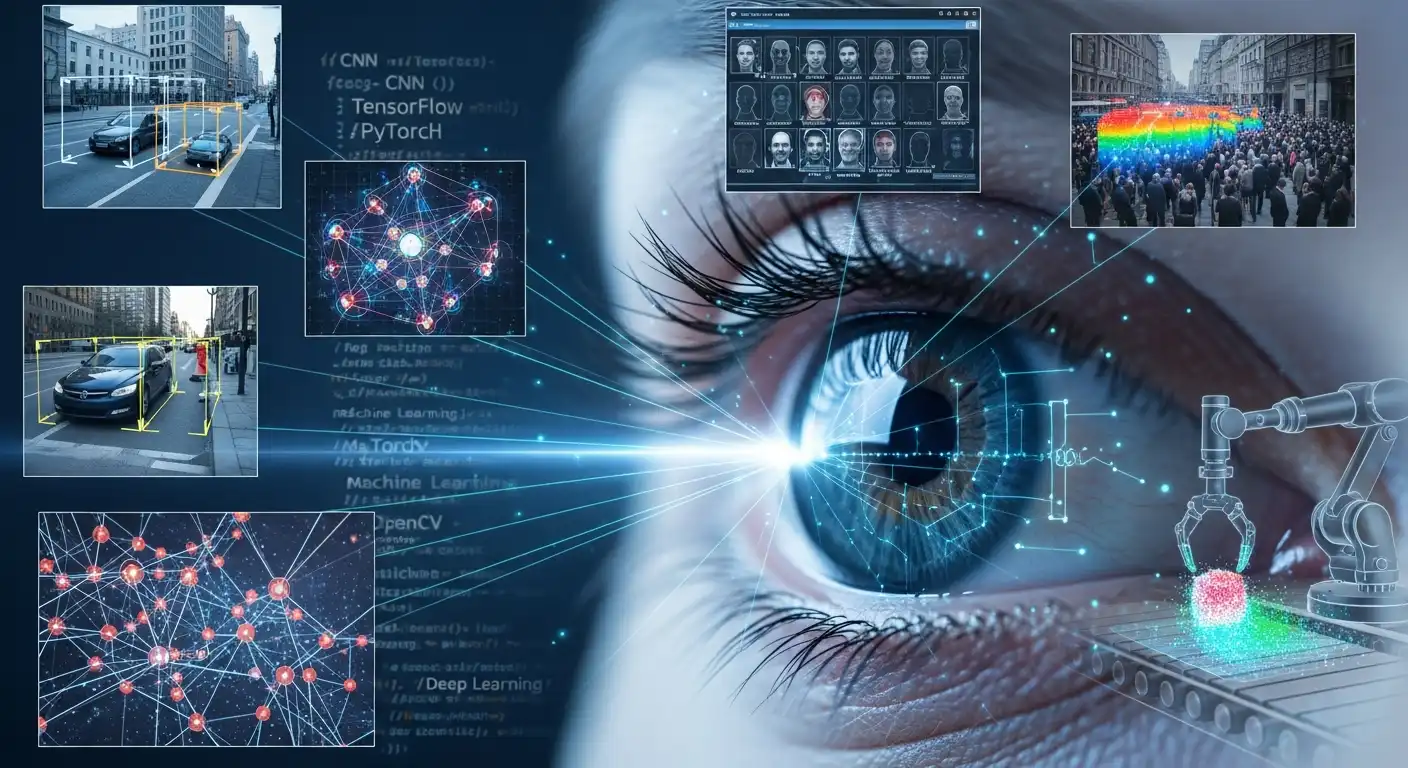
Computer vision is a transformative field within artificial intelligence (AI) that enables machines to interpret and understand the visual world. Computer vision is revolutionizing various industries by leveraging large-scale datasets, advanced algorithms, and sophisticated hardware. This article delves into the fundamentals of computer vision, its applications, underlying technologies, challenges, and future trends.
Understanding Computer Vision
Computer vision involves the use of algorithms to process, analyze, and interpret visual information from the world.
Definition and Scope
Computer vision is a branch of AI that helps computers replicate human vision. It involves capturing, processing, and analyzing visual data from images, videos, and other modalities to interpret the environment. The goal is to automate tasks that the human visual system can perform, such as object recognition, scene reconstruction, and motion analysis.
Historical Development
The roots of computer vision date back to the 1960s, when researchers began exploring ways to enable machines to perceive and interpret visual data. Early efforts focused on simple tasks like edge detection and pattern recognition. The field has since evolved significantly, driven by advancements in machine learning, neural networks, and the availability of large datasets. Key milestones include the development of convolutional neural networks (CNNs) and the advent of deep learning.
Core Components
Computer vision systems typically consist of three main components:
- Image Acquisition: Capturing visual data using cameras, sensors, or other devices.
- Image Processing: Enhancing and preparing the acquired images for analysis.
- Image Analysis and Interpretation: Extracting meaningful information from processed images using algorithms and models.
Applications of Computer Vision
Computer vision transforms various industries by enabling new capabilities and improving existing processes.
Healthcare
In healthcare, computer vision is used for diagnostic imaging, patient monitoring, and surgery assistance. For example, AI-powered imaging systems can accurately detect tumors, fractures, and other abnormalities in medical scans. Additionally, computer vision technologies help monitor patients in real time, alerting healthcare providers to potential issues and improving patient outcomes.
Automotive Industry
The automotive industry is leveraging computer vision to develop advanced driver assistance systems (ADAS) and autonomous vehicles. Computer vision enables lane detection, pedestrian recognition, and traffic sign recognition. In autonomous vehicles, computer vision systems process real-time visual data to make driving decisions, enhancing safety and efficiency on the road.
Retail and E-commerce
In retail and e-commerce, computer vision enhances customer experiences and optimizes operations. For instance, visual search engines enable users to locate products using images rather than text. Computer vision also powers inventory management systems, enabling automated stock monitoring and restocking. Moreover, facial recognition and emotion analysis technologies personalize shopping experiences and improve customer service.
Technologies Behind Computer Vision
Computer vision relies on a combination of hardware, software, and advanced algorithms to function effectively.
Machine Learning and Deep Learning
Machine learning and deep learning are the backbone of modern computer vision systems. These technologies help computers to learn from large datasets and improve their performance over time. Convolutional neural networks (CNNs), a type of deep learning architecture, are particularly effective in image recognition and classification tasks. By training on labeled datasets, CNNs can learn to identify image patterns and features, enabling accurate object detection and recognition.
Image Processing Techniques
Image processing techniques play a crucial role in preparing visual data for analysis. Common techniques include:
- Filtering: Enhancing image quality by reducing noise and highlighting important features.
- Segmentation: Dividing an image into meaningful regions for further analysis.
- Edge Detection: Identifying the boundaries of objects within an image.
These techniques help enhance the accuracy and efficiency of computer vision algorithms.
Hardware Advancements
Advancements in hardware greatly enhance the performance of computer vision systems. High-resolution cameras, sensors, and specialized processors, such as graphics processing units (GPUs) and tensor processing units (TPUs), enable faster and more accurate data processing. The availability of affordable, powerful hardware has democratized access to computer vision technologies, enabling businesses of all sizes to leverage their benefits.
Challenges in Computer Vision
Despite its advancements, computer vision faces several challenges that must be addressed.
Data Quality and Quantity
High-quality and diverse datasets are essential for training accurate computer vision models. However, acquiring and annotating large volumes of data can be time-consuming and expensive. Additionally, biases in datasets can lead to unfair and inaccurate outcomes. Ensuring the availability of high-quality, unbiased data remains a significant challenge.
Real-Time Processing
Real-time processing is crucial for applications like autonomous driving and surveillance. However, processing and analyzing visual data in real time requires substantial computational resources and efficient algorithms. Balancing the need for speed and accuracy is a key challenge in developing real-time computer vision systems.
Privacy and Ethical Concerns
Computer vision raises privacy and ethical concerns, particularly in surveillance and facial recognition applications. It is critical to ensure that these technologies are used responsibly and with respect for individuals’ privacy rights. Addressing these concerns requires clear regulations, transparency, and robust data protection measures.
Future Trends in Computer Vision
The future of computer vision is promising, with several trends poised to drive further advancements and adoption.
Integration with Other AI Technologies
Integrating computer vision with other AI technologies, such as natural language processing (NLP) and robotics, will enable more sophisticated and versatile applications. For example, combining computer vision with NLP can enhance human-computer interactions, while integration with robotics can improve automation and precision in manufacturing and healthcare.
Edge Computing
Edge computing involves processing data closer to the source, reducing latency and bandwidth requirements. This trend is particularly relevant for computer vision applications that require real-time processing, such as autonomous vehicles and IoT devices. Edge computing enables faster, more efficient data processing, supporting real-time decision-making and improving system performance.
Augmented Reality (AR) and Virtual Reality (VR)
The integration of computer vision with AR and VR technologies is set to revolutionize various industries, from gaming and entertainment to education and training. Computer vision enables AR and VR systems to perceive and interact with the physical environment, thereby creating immersive experiences. Future advancements in computer vision will further enhance the realism and functionality of AR and VR applications.
Conclusion
Computer vision is a transformative technology reshaping industries and driving innovation. By enabling machines to interpret and understand visual data, computer vision unlocks new capabilities and improves existing processes in healthcare, automotive, retail, and beyond. Despite challenges related to data quality, real-time processing, and privacy concerns, the future of computer vision looks bright. Continued advancements in machine learning, hardware, and integration with other AI technologies will further enhance the potential of computer vision, paving the way for more intelligent and responsive systems that can revolutionize how we interact with the world.