Key Points:
- China’s Shenzhou-23 crew successfully entered the Tiangong space station on Monday, May 25, 2026, starting a new in-orbit rotation.
- The crew includes Commander Zhu Yangzhu, pilot Zhang Zhiyuan, and Lai Ka-ying, the first-ever astronaut from Hong Kong.
- One of the three astronauts will spend an entire year in orbit on Tiangong to test the limits of human adaptability in space.
- The mission marks the 644th flight of the Long March rocket series, supporting China’s goal of a crewed lunar landing by 2030.
China’s newly launched Shenzhou-23 crewed spacecraft successfully docked with the Tiangong space station early Monday, May 25, 2026. The three-person crew entered the core module, starting a fresh round of in-orbit handovers and setting the stage for a series of historic scientific experiments. This mission marks a vital milestone in Beijing’s multi-billion-dollar aerospace program, which seeks to establish a permanent orbital presence and land humans on the Moon by 2030.
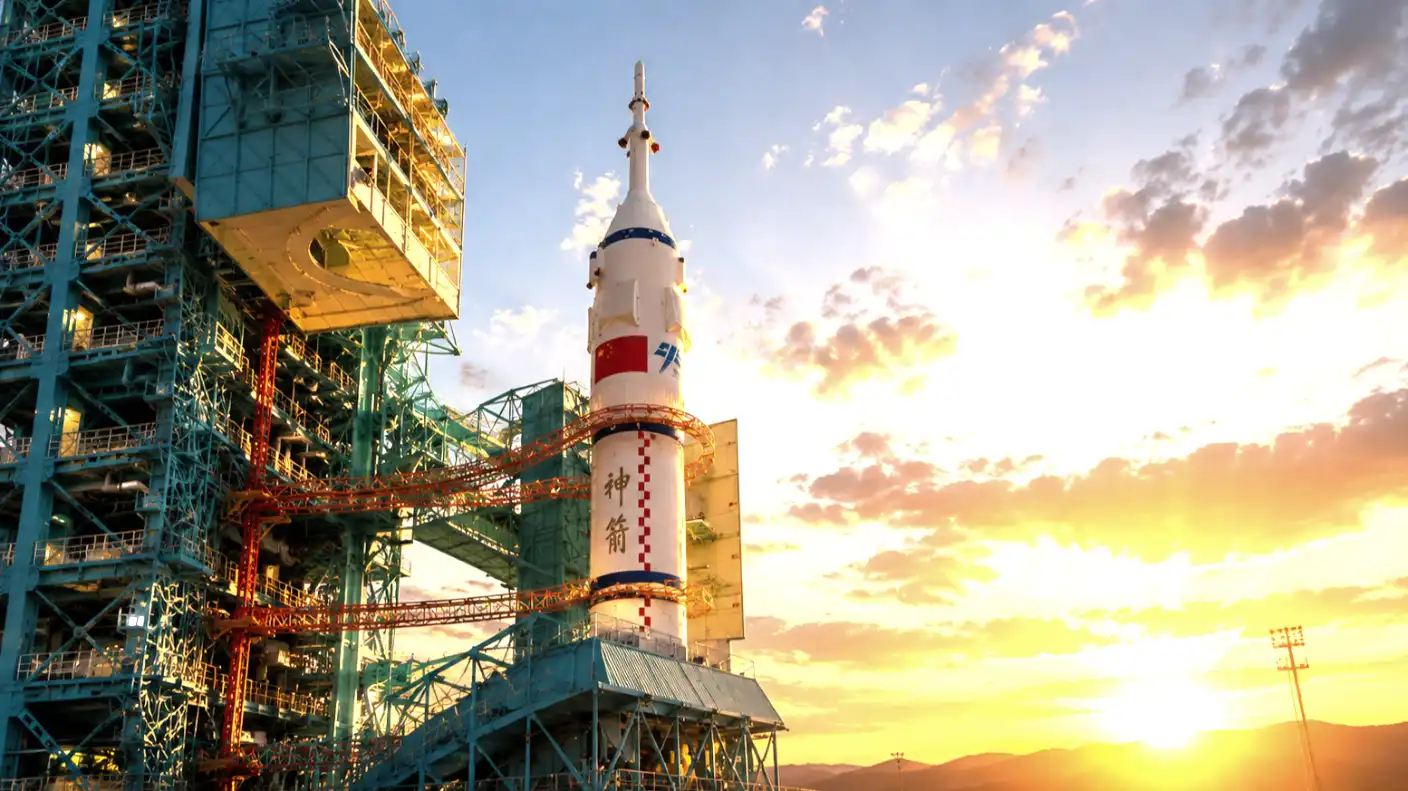
The journey began late Sunday night, May 24, 2026, when a Long March-2F carrier rocket blasted off at 11:08 PM Beijing Time from the Jiuquan Satellite Launch Center in the Gobi Desert. Approximately 10 minutes after liftoff, the spacecraft separated from the carrier rocket and slid into its designated low Earth orbit. The launch represented the 644th flight of the iconic Long March rocket series. Following a fast, automated rendezvous and docking sequence that lasted approximately 3.5 hours, Shenzhou-23 successfully attached to the radial port of the Tianhe core module at 2:45 AM on Monday.
Inside the Tiangong space station, the orbiting Shenzhou-21 crew prepared the module for their incoming colleagues at 5:13 AM Monday. The three Shenzhou-21 astronauts—who have already lived in space for more than 200 days—opened the connecting hatch to welcome the new arrivals. The six astronauts floated together, embraced, and posed for group photos, celebrating the eighth in-orbit space get-together in China’s aerospace history. The two crews will spend several days working together to complete a seamless transition of station operations.
The Shenzhou-23 crew comprises a highly specialized team of space professionals led by mission commander Zhu Yangzhu, an experienced flight engineer who previously participated in the Shenzhou-16 mission. Joining him are spacecraft pilot Zhang Zhiyuan, a former air force pilot, and payload specialist Dr. Lai Ka-ying. For both Zhang and Lai, this mission represents their first-ever trip into space. Dr. Lai’s participation carries immense historical and political significance, as she is the first astronaut from the Hong Kong Special Administrative Region to travel to space and China’s fourth female astronaut to reach orbit.
Before joining China’s elite space program, Dr. Lai served as a superintendent in the Hong Kong Police Force and earned a doctoral degree in computer forensics. Her background highlights the expanding diversity of China’s astronaut corps, which now recruits highly skilled civilian scientists and payload specialists from across different regional administrative districts. With Dr. Lai’s historic flight, Beijing aims to demonstrate closer scientific integration and foster national pride within the Hong Kong region.
During their six-month mission, the crew will execute dozens of cutting-edge scientific and application projects. These experiments span several fields, including space life science, microgravity fluid physics, and aerospace medicine. The astronauts will also conduct several extravehicular activities, install debris-protection shields to shield the station from high-speed space debris, and manage cargo transfers from incoming support vessels.
For the first time in China’s space history, the agency scheduled one of the three crew members to stay at the orbiting space station for a full year. This 365-day mission will allow medical researchers on Earth to monitor the astronaut’s health in real time, gathering vital biological data to understand how long-duration microgravity environments affect human organ systems, muscle mass, and bone density.
This year-long stay is a critical stepping stone for China’s broader deep-space ambitions. To send a human crew to the Moon by 2030, scientists must first understand the absolute physical and psychological limits of human adaptability in space. By compiling a detailed, multi-system biological database from this 365-day mission, the China Manned Space Agency (CMSA) will design the life-support systems and shielding required for future lunar transit vehicles.
So far, China has sent 30 different astronauts into space, establishing itself as a premier global space power alongside the United States. Supported by an annual civil space budget that global analysts estimate exceeds $12 billion, China continues to rapidly expand the capabilities of its “Heavenly Palace” space station. As the Shenzhou-23 crew begins its work, the successful docking and hatch-opening sequence demonstrates that China’s methodical approach to space exploration remains firmly on track.