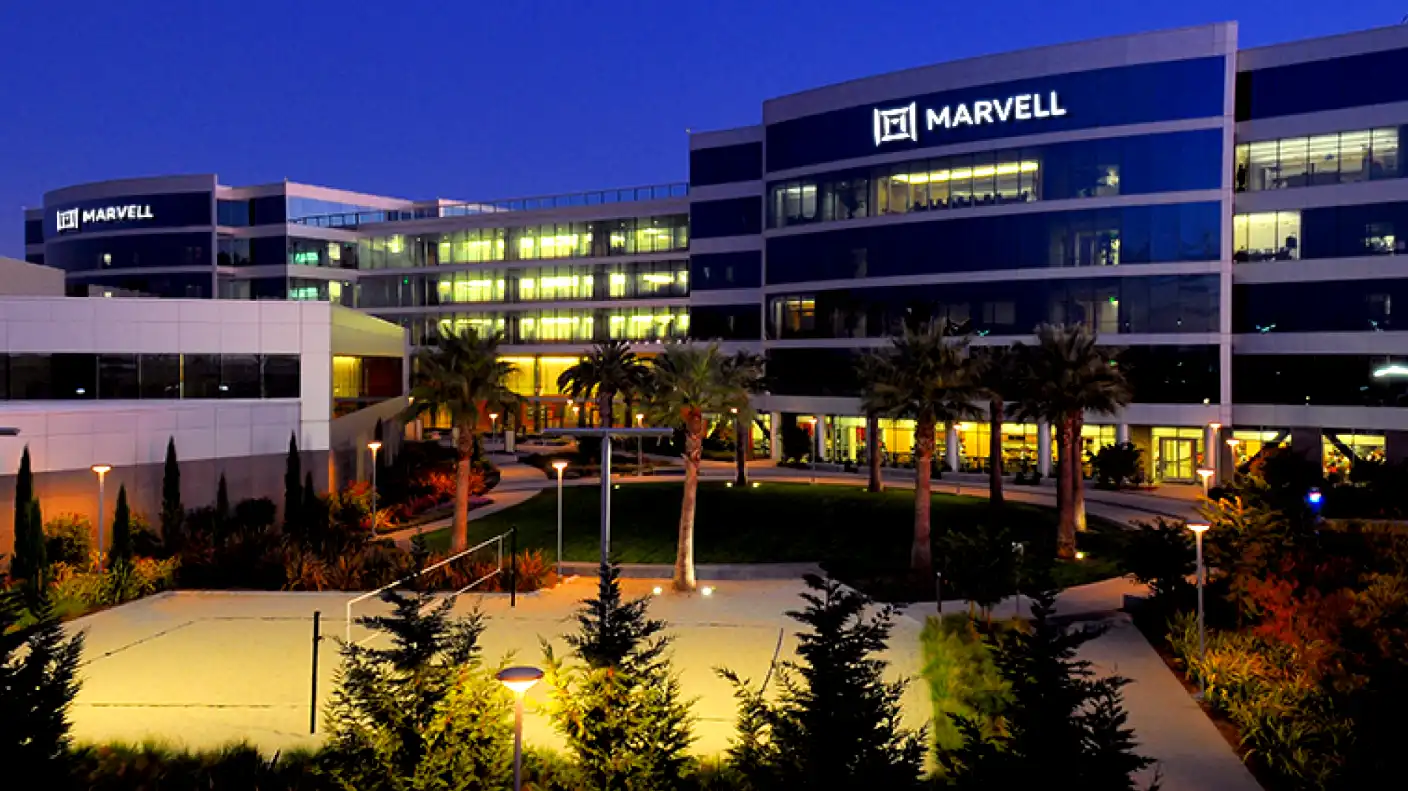
Key Points:
- At Computex 2026, Nvidia CEO Jensen Huang publicly declared Marvell Technology the “next trillion-dollar company,” triggering a 24% surge in its stock.
- The massive verbal endorsement follows a strategic $2 billion investment Nvidia made in Marvell to co-develop silicon photonics technology.
- The companies are collaborating on the NVLink Fusion platform to bypass the massive data center networking bottlenecks in 100,000-GPU clusters.
- Marvell’s high-margin data center business now accounts for 75% of its revenue, with custom ASIC projects projected to top $10 billion by 2029.
The global semiconductor industry has officially entered a highly competitive, hardware-centric phase in which connectivity is taking center stage. On Tuesday, June 2, 2026, at the Computex tradeshow in Taipei, Taiwan, Nvidia CEO Jensen Huang publicly endorsed Marvell Technology as the “next trillion-dollar company.” This massive verbal backing sparked an immediate frenzy on Wall Street, driving Marvell’s stock price up by more than 24% in premarket trading. Huang’s statement highlights how the physical constraints of the artificial intelligence boom are shifting from raw computing power to high-speed networking and connectivity infrastructure.
The high-profile endorsement reflects a deepening commercial alliance between the two chipmaking giants. In March 2026, Nvidia made a massive $2 billion strategic investment in Marvell, transforming former rivals into key ecosystem partners. The two companies are engaging in deep, joint engineering collaboration via the NVLink Fusion platform. Under this framework, they are working together to develop silicon photonics technology and advance next-generation, high-bandwidth optical transmission to power massive AI installations. While the joint development projects currently account for roughly 1.5% of Marvell’s total operating expenses, the strategic return of this partnership remains immense.
The technological necessity for this partnership stems from a critical transition in AI data center design. As engineers scale AI clusters from 10,000 GPUs to 100,000 GPUs, data transmission efficiency has become the single biggest bottleneck limiting overall computing power. “The AI industry has entered a stage of full commercialization; computing power is revenue, and computing power is profit,” Huang explained onstage during a joint discussion with Marvell CEO Matt Murphy. If data cannot move seamlessly between servers, clusters, and regional data centers, even the most advanced graphics cards sit idle, making Marvell’s optical interconnect solutions invaluable.
While Huang’s prediction has ignited intense investor enthusiasm, Marvell still has a long hill to climb before it can officially join the elite trillion-dollar corporate circle. The company currently has a market capitalization of approximately $181 billion to $192 billion. To reach a $1 trillion valuation, Marvell’s stock would need to gain roughly 420%, or expand more than fivefold from its current levels. Nevertheless, investors are increasingly pricing the firm as an indispensable, structural cornerstone of the global technological transition.
This massive market rerating is already highly visible in Marvell’s stellar stock performance. Year-to-date in 2026, the company’s share price has climbed by approximately 130%, backed by a staggering 254.3% gain over the past twelve months. This rapid capital appreciation reflects a fundamental transition in Marvell’s revenue structure, as the firm successfully moves away from legacy consumer and enterprise networking clients to focus almost entirely on high-margin, cloud-scale artificial intelligence customers.
The data center segment now accounts for approximately 75% of Marvell’s total revenue, representing a massive expansion from the 50% share it held just two years ago. The company expects this division’s revenue to grow by roughly 50% this year alone, driven by relentless buying from global hyperscale cloud providers. Furthermore, the company’s custom application-specific integrated circuit (ASIC) chip business is on track to become a massive profit center, with analysts projecting it will generate more than $10 billion in annual revenue by fiscal 2029.
The company’s short-term and medium-term financial outlooks further support this bullish thesis. Marvell’s forecast for second-quarter revenue stands at approximately $2.7 billion, comfortably beating Wall Street’s consensus expectations. Looking further ahead, the company has raised its fiscal 2028 revenue outlook to about $16.5 billion. This robust guidance confirms that the company is translating the massive, industry-wide demand for silicon photonics and advanced packaging directly into healthy corporate cash flows.
In his Computex address, Marvell CEO Matt Murphy emphasized that the future of AI scaling depends entirely on optical connectivity. For short distances within a single server rack, copper cabling remains the most cost-effective option. However, as cluster sizes expand to include hundreds of thousands of GPUs spread across massive, geographically distributed campuses, traditional copper suffers from severe signal degradation and immense power loss. Transitioning to advanced silicon photonics—which uses light waves rather than electrical currents to transmit data—enables hyperscalers to deploy massive, unified computing resources with ultra-low latency.
Ultimately, Jensen Huang’s public endorsement of Marvell Technology as a future trillion-dollar giant underscores how rapidly the AI infrastructure race is shifting in focus. While the first wave of the tech boom rewarded raw processor design and high-capacity memory, the next phase of innovation will belong to the connectivity leaders who can move data across these systems with maximum efficiency. By securing a $2 billion partner in Nvidia and cementing its place in the NVLink Fusion ecosystem, Marvell has positioned itself to dominate this vital transmission layer, proving that the road to superintelligence is paved with optical fibers.