Key Points:
- Kioxia Holdings surpassed Toyota to become Japan’s largest listed company by market value.
- The memory chipmaker’s shares jumped 7.6 percent, lifting its market cap above 44 trillion yen.
- The valuation leap comes just 18 months after Kioxia’s December 2024 public market debut.
- Explosive demand for NAND flash storage in AI data centers has driven the company’s rapid growth.
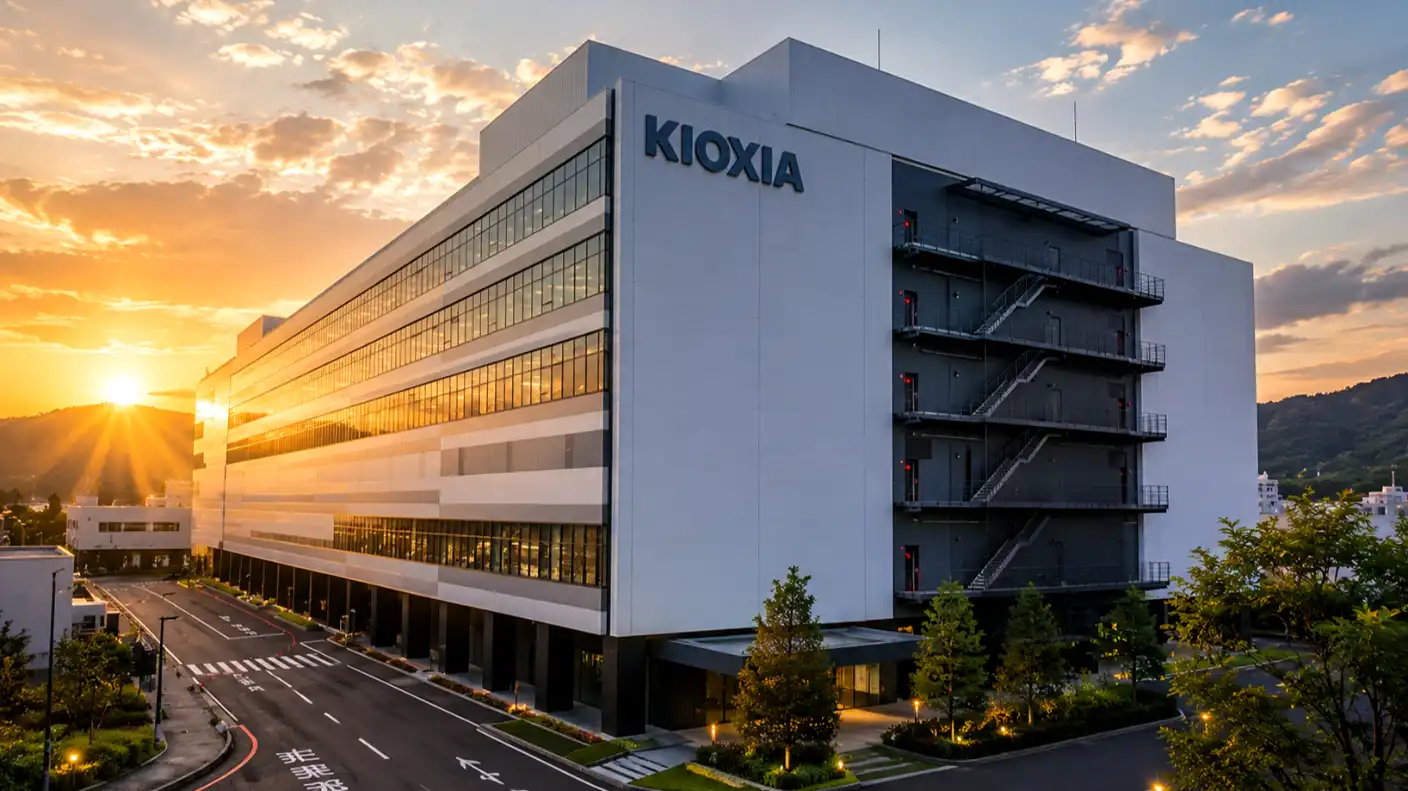
Memory storage giant Kioxia Holdings Corp. has surpassed automotive giant Toyota Motor Corp. to become Japan’s most valuable listed company by market capitalization. This massive milestone underscores how the global artificial intelligence boom is rapidly reshaping the country’s corporate landscape. A relentless surge in demand for the memory chips used in AI data centers has forced investors to reprice semiconductor and storage firms as critical, strategic infrastructure.
Kioxia’s shares jumped 7.6% on Friday, lifting the memory maker’s total market value above 44 trillion yen, or approximately $274 billion. This rapid ascent pushed the firm just past long-time market leader Toyota, which closed the trading session with a market capitalization of 43.8 trillion yen, equivalent to $273.1 billion. This historic reshuffling marks a stunning achievement for the semiconductor pioneer, occurring just 18 months after its public market debut on the Tokyo Stock Exchange.
The company’s rise to the top spot represents an unprecedented story of wealth creation in Japanese corporate history. When Kioxia went public in December 2024, the market valued the firm at a modest 780 billion yen, or about $5.2 billion. At the time, investors viewed NAND flash memory primarily as a volatile, low-margin commodity play. Since then, the stock has skyrocketed by more than 3,500% from its initial offering price, driven by a structural shift in how hyperscale data centers store and retrieve massive datasets.
This valuation boom mirrors a staggering turnaround in the company’s underlying financial health. After enduring a severe industry downturn, Kioxia reported a record quarterly operating profit of 596.8 billion yen for the fiscal quarter ending in March. More impressively, management recently guided for a massive operating profit of approximately 1.3 trillion yen, or roughly $8.2 billion, for the June quarter alone. Executive officers declared that the company is officially entering a massive super cycle, propelled by the relentless storage demands of generative AI inference and large language models.
While high-performance graphics processing units have captured the bulk of market attention, processing massive training and inference data requires ultra-fast, high-density storage solutions. Generative AI models must access massive pools of unstructured data at all times. This technological requirement has elevated the strategic importance of NAND flash memory, transforming standard solid-state drives (SSDs) into vital components of high-performance computing clusters. As a result, global funds are pricing memory supply as a critical industrial bottleneck, driving capital straight to Kioxia.
The company’s rise to national prominence represents a major vindication for its founders and private equity backers. Kioxia traces its origins to Toshiba Corporation’s memory chip division, which famously pioneered NAND flash technology in 1987. Facing immense financial pressure from losses in nuclear power, Toshiba sold the division to a Bain Capital-led consortium in 2018 for $18 billion. Rebranded as Kioxia in 2019, the firm spent years as a privately held entity refining its 3D flash technology before seeking a public listing.
The ongoing AI rotation is rapidly rewriting the traditional hierarchy of Japan Inc. Earlier this month, technology conglomerate SoftBank Group briefly surpassed Toyota to take the top spot on optimism surrounding OpenAI’s listing plans, before slipping to fourth place after a broader market correction. The country’s revamped top 20 stocks now include other key AI-related players, such as Murata Manufacturing, which supplies specialized power-stabilizing capacitors to AI data centers, and semiconductor testing equipment leader Advantest.
Meanwhile, Toyota’s descent to second place highlights the challenges facing traditional manufacturing conglomerates. The automaker’s shares have fallen by approximately 17% so far this year. A combination of rising oil prices, escalating military tensions in the Middle East, and persistent concerns over the global auto sector’s rocky transition to electric vehicles and software-defined mobility has kept pressure on the auto giant’s stock, leaving room for nimble, high-tech rivals to capture the lead.
Ultimately, the reshuffling of Japan’s most valuable companies signals a permanent change in how global investors perceive the nation’s equity markets. For decades, international funds viewed Japan primarily as a cyclical, manufacturing-driven market dominated by automakers and industrial heavyweights. The rise of Kioxia and SoftBank proves that Japan is successfully re-establishing itself as a critical, high-growth hub for artificial intelligence infrastructure. As demand for advanced memory continues to outpace supply, the newly crowned market leader is well-positioned to drive the next wave of global technological expansion.