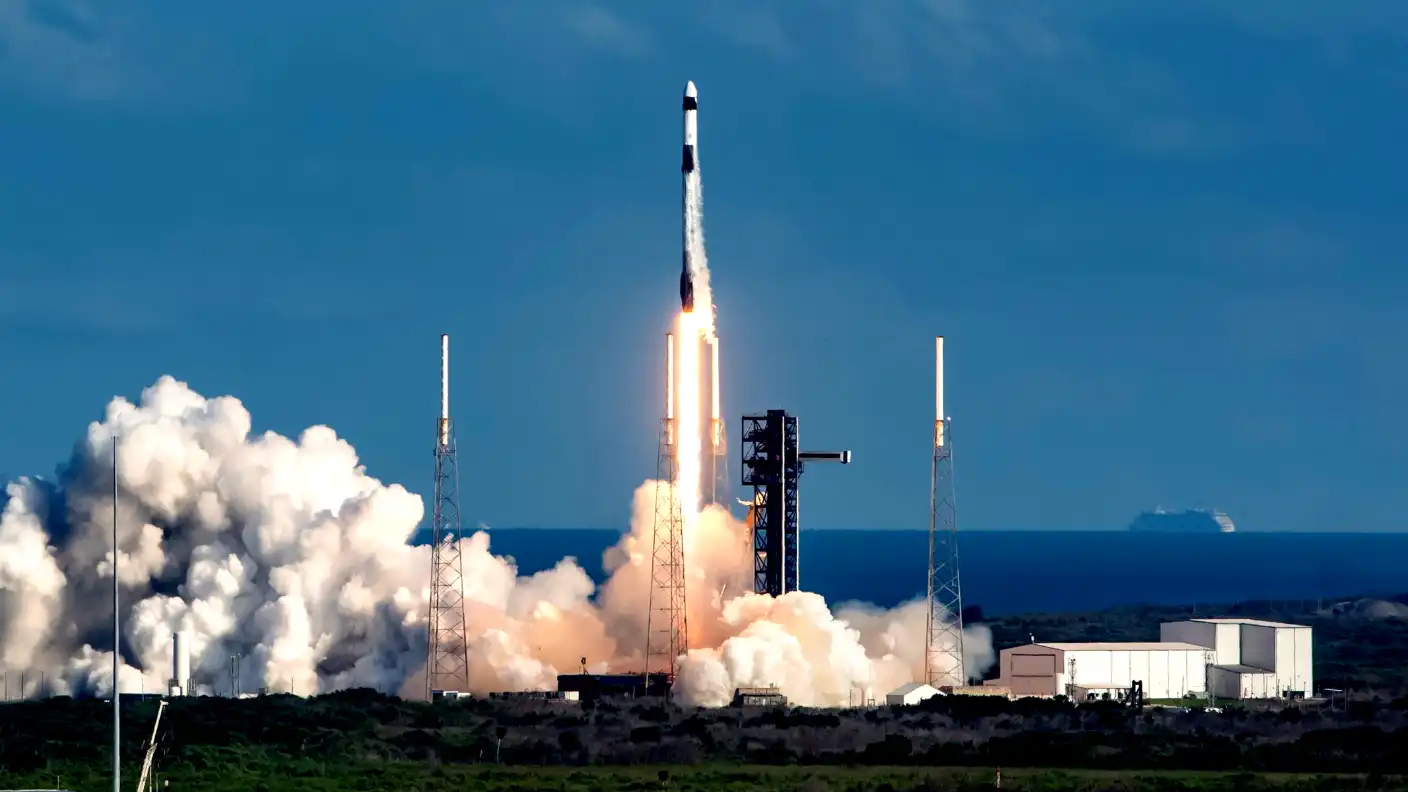
The global space race is rapidly shifting from the dominion of giant, multi-ton spacecraft to highly agile, medium-sized constellations. South Korea is moving swiftly to secure its position in this modern landscape. The country is preparing to launch its fourth next-generation medium-sized satellite into orbit. This mission represents a key milestone for the newly formed Korea AeroSpace Administration (KASA) and the country’s growing commercial space sector. Known as the Compact Advanced Satellite 500-4 (CAS500-4), the 514-kilogram spacecraft will launch aboard a SpaceX Falcon 9 rocket from Vandenberg Space Force Base in California.
This mission marks a major step forward in South Korea’s plan to build an independent, domestic public observation infrastructure. Historically, South Korean government departments and private entities relied heavily on foreign satellite providers for agricultural mapping, forestry management, and disaster monitoring. The CAS500-4 satellite, however, is a homegrown solution. It features a domestic production rate exceeding 75% for its critical bus and core payload. Once active in orbit, this advanced satellite will scan the entirety of the Korean Peninsula every three days, supplying critical data to public agencies and the private sector alike.
The upcoming launch highlights the deepening partnership between South Korea’s space agency and private aerospace companies like SpaceX. By utilizing the proven reliability of the Falcon 9 launch vehicle, South Korea is accelerating its satellite deployment schedule. This strategy allows the country to bypass previous delays and build out its low-Earth orbit infrastructure at a fraction of the historical cost.
Technical Details and Core Specifications of CAS500-4
The development and assembly of the CAS500-4 represent years of collaborative research and engineering. The satellite is built upon a standardized 500-kilogram-class platform designed to optimize manufacturing times and reduce overall system costs. South Korean aerospace leader Korea Aerospace Industries (KAI) headed the development program, translating complex scientific requirements into a robust, orbit-ready platform.
The satellite will operate in a sun-synchronous orbit at a target altitude of approximately 888 kilometers. This specific orbit ensures that the satellite passes over the same point of the Earth’s surface at the same local solar time, providing consistent lighting conditions that are essential for accurate, long-term environmental and agricultural analysis.
The Optical System and Spectral Bands
The core of the CAS500-4 payload is its wide-area observation camera. Developed with domestic technology, the camera features a spatial resolution of 5 meters and an expansive swath width of 120 kilometers. While 5-meter resolution may seem less detailed than some high-resolution military reconnaissance satellites, it is highly optimized for wide-area scanning. This wide field of view allows the satellite to image massive swathes of territory in a single pass, enabling it to map the entire Korean Peninsula on a rapid three-day cycle.
To maximize its utility for environmental science, the optical payload operates across five distinct spectral bands. These bands are finely tuned to capture specific wavelengths of light reflected from the Earth’s surface. By analyzing these wavelengths, researchers can evaluate crop vigor, determine soil moisture levels, identify forest health anomalies, and detect the early signs of insect infestations. This multispectral approach turns raw imagery into highly actionable intelligence for farmers, foresters, and policymakers.
The Launch Orbit Insertion Timeline
Securing a successful orbit requires a highly coordinated sequence of events post-liftoff. The Falcon 9 rocket will lift off from California, carrying the satellite through the upper atmosphere. Approximately 2 hours and 22 minutes after launch, the CAS500-4 satellite is scheduled to separate from the upper stage of the Falcon 9. This separation marks the beginning of the satellite’s independent flight.
The first critical milestone in space is establishing ground contact. Roughly 31 minutes after separation, the satellite is scheduled to make its first transmission to Earth via the Svalbard ground station in Norway. This Norwegian ground station, situated deep within the Arctic Circle, is uniquely positioned to communicate with polar-orbiting satellites on almost every orbit. This initial contact will confirm the health of the satellite, its solar array deployment status, and the functional integrity of its power subsystems.
Following the Svalbard contact, South Korean engineers will perform sequential status checks using the King Sejong Station in Antarctica and the Korea Aerospace Research Institute (KARI) ground station in Daejeon, South Korea. Once ground teams verify that all systems are stable, the satellite will undergo a thorough four-month initial calibration and testing phase in orbit. If everything goes according to plan, the satellite will begin full-scale mission operations in the first half of 2027.
Revolutionizing Agriculture and Forest Management via Space Data
The primary mission of CAS500-4 is to revolutionize South Korea’s national land management capabilities. The country’s Ministry of Agriculture, Food and Rural Affairs, the Rural Development Administration, and the Korea Forest Service will be the primary users of the satellite’s data stream. By shifting from foreign commercial satellite imagery to an independent domestic source, the South Korean government expects to save millions of dollars annually while significantly increasing the frequency and precision of its observations.
Combating Agricultural Fraud with Satellite AI
One of the most practical applications for the new satellite is monitoring the domestic agricultural sector, specifically in managing public subsidies. South Korea operates a Public Direct Payment Program designed to support local farmers. To ensure that subsidies are distributed fairly and legally, officials must verify that farmers are actively cultivating the registered plots and that the reported crops match actual field conditions.
In the past, this verification required manual field surveys. Code inspectors had to travel across rural regions to verify compliance directly, which was both time-consuming and expensive. With the arrival of the CAS500-4, the government plans to integrate satellite imagery with advanced artificial intelligence models. This agricultural AI will automatically scan the Korean Peninsula every three days, cross-referencing satellite data with the agricultural business registration database.
The system will flag uncultivated land, unauthorized structures, and cases where forests have been illegally converted into farmland. By remotely identifying these irregularities, the government can optimize its physical inspections, drastically reducing the administrative burden while blocking fraudulent subsidy claims.
Disaster Management and Forest Health Monitoring
South Korea’s rugged topography makes it highly vulnerable to natural disasters such as landslides, forest fires, and typhoons. The Korea Forest Service plans to utilize the high-frequency imagery from CAS500-4 to establish an early-warning and rapid-response network.
Because the satellite revisits the peninsula every three days, it can track the rapid spread of forest diseases, such as pine wilt disease, which threatens millions of trees across the country. Additionally, during the dry spring season, the satellite will monitor fuel moisture levels in dense forest zones. If a wildfire breaks out, the near-real-time data will assist emergency response teams in tracking smoke plumes, predicting fire paths, and coordinating evacuation efforts.
Beyond disaster response, the satellite will play a central role in climate change analysis. By monitoring forest growth, canopy cover density, and vegetation changes over several years, South Korean scientists can calculate the nation’s carbon sequestration rates more accurately. This carbon accounting is essential as South Korea works toward its national climate goals and international emissions treaties.
KASA’s Broader Ambitions: From Low-Earth Orbit to the Moon
The launch of the CAS500-4 is not an isolated project. It is part of a broader, highly ambitious space program coordinated by South Korea’s newly established space agency. KASA has set a clear path to transform the country into a major space-faring nation over the next decade, focusing heavily on commercial low-Earth orbit networks and deep-space exploration.
South Korea plans to establish its own low-Earth orbit satellite communications network, mirroring commercial systems like SpaceX’s Starlink. KASA plans to deploy between 128 and 512 small communications satellites by 2035. The government estimates the cost of this satellite network at between 4 trillion won ($2.62 billion) and 13.2 trillion won every five years.
This network is designed to safeguard South Korea’s national security, ensure communication sovereignty, and lay the technological foundation for the upcoming 6G telecommunications era. By developing the spacecraft and launch technologies domestically, South Korea aims to foster a self-sustaining industrial ecosystem capable of competing on the global stage.
In tandem with this satellite network, KASA is accelerating its timeline for deep-space exploration. The agency recently announced plans to pull forward South Korea’s first lunar landing to 2030, a full two years ahead of the previous 2032 target. Instead of waiting for the country’s next-generation heavy launch vehicle to debut in 2032, the government plans to leverage a privately developed small lunar lander to achieve this milestone. This aggressive scheduling showcases South Korea’s determination to establish a physical presence on the lunar surface as part of the broader international space economy.
To support the commercialization of its space programs, the government is establishing a unique Special Purpose Company (SPC). This joint venture between public agencies and private firms will be more than 70% owned by the private sector. The SPC will be tasked with commercializing and selling the massive amounts of geographic and environmental data compiled by South Korea’s satellite constellations. By selling high-precision imagery and analytics to domestic and international clients, the government expects the SPC to generate over $1.7 billion in sales by 2034, proving that space exploration can be a highly profitable economic engine.
The Transition to Private-Led ‘New Space’ Era
The launch of the CAS500-4 satellite highlights a fundamental structural change in South Korea’s aerospace industry. For decades, space projects were entirely managed, funded, and executed by state-run research organizations like KARI. Private aerospace firms merely acted as component suppliers, working under tight government specifications.
This traditional model is giving way to the “New Space” era, where private enterprises take the lead in design, manufacturing, assembly, and eventual commercialization. The CAS500 program was specifically designed to facilitate this transition.
During the development of the first unit, CAS500-1, Korea Aerospace Industries worked alongside KARI as a joint design partner, absorbing core design and assembly technologies. By the time the CAS500-2 program was initiated, KAI had taken over the primary development role, demonstrating that a private South Korean firm could successfully manage a complex Earth observation satellite program from end to end.
This transition was put to a severe test during the development of CAS500-2. Originally scheduled to launch in 2022 aboard a Russian Soyuz rocket, the mission was delayed for nearly four years due to the geopolitical fallout from the Russia-Ukraine war. Rather than allowing the program to stall, KASA and KAI pivoted, renegotiating contracts and successfully shifting the payload to a SpaceX Falcon 9 rocket. The CAS500-2 was launched into orbit on May 3, 2026, establishing immediate ground communication and demonstrating the resilience of South Korea’s private space sector.
With the CAS500-4, the standardization of the 500-kilogram satellite platform is fully realized. By creating a reliable, highly modular satellite bus, South Korea can drastically reduce the time and capital required to build future satellites. This standardization is not just beneficial for domestic programs; it also positions South Korean aerospace companies as competitive exporters. Many developing nations are eager to establish their own Earth observation capabilities but lack the budget for multi-billion-dollar space programs. South Korea’s standardized, mid-sized platforms offer a highly cost-effective alternative, opening up a lucrative export market for domestic manufacturers.
Conclusion and Future Milestones
The upcoming launch of the CAS500-4 satellite from Vandenberg Space Force Base aboard a SpaceX Falcon 9 rocket represents a vital turning point for South Korea’s space capabilities. By integrating cutting-edge, domestically developed optical technologies with a highly standardized and cost-effective satellite platform, South Korea is securing its data sovereignty and laying the groundwork for a highly advanced agricultural and environmental management system.
The data gathered by this satellite will provide tangible, day-to-day benefits for South Korean citizens. From optimizing agricultural policies and identifying illegal land use to monitoring forests for early signs of disease and coordinating emergency responses during natural disasters, the CAS500-4 will serve as an indispensable eye in the sky.
As KASA continues to push the boundaries of low-Earth orbit satellite networks and targets an ambitious lunar landing by 2030, the success of the CAS500-4 mission will validate the nation’s private-led “New Space” strategy. By shifting the manufacturing leadership to private enterprises like Korea Aerospace Industries, South Korea is not only building a robust national space program but is also positioning itself as a key player in the global commercial space economy. The upcoming Tuesday launch is more than just another satellite deployment; it is a clear statement of South Korea’s intent to lead the next generation of space technology.