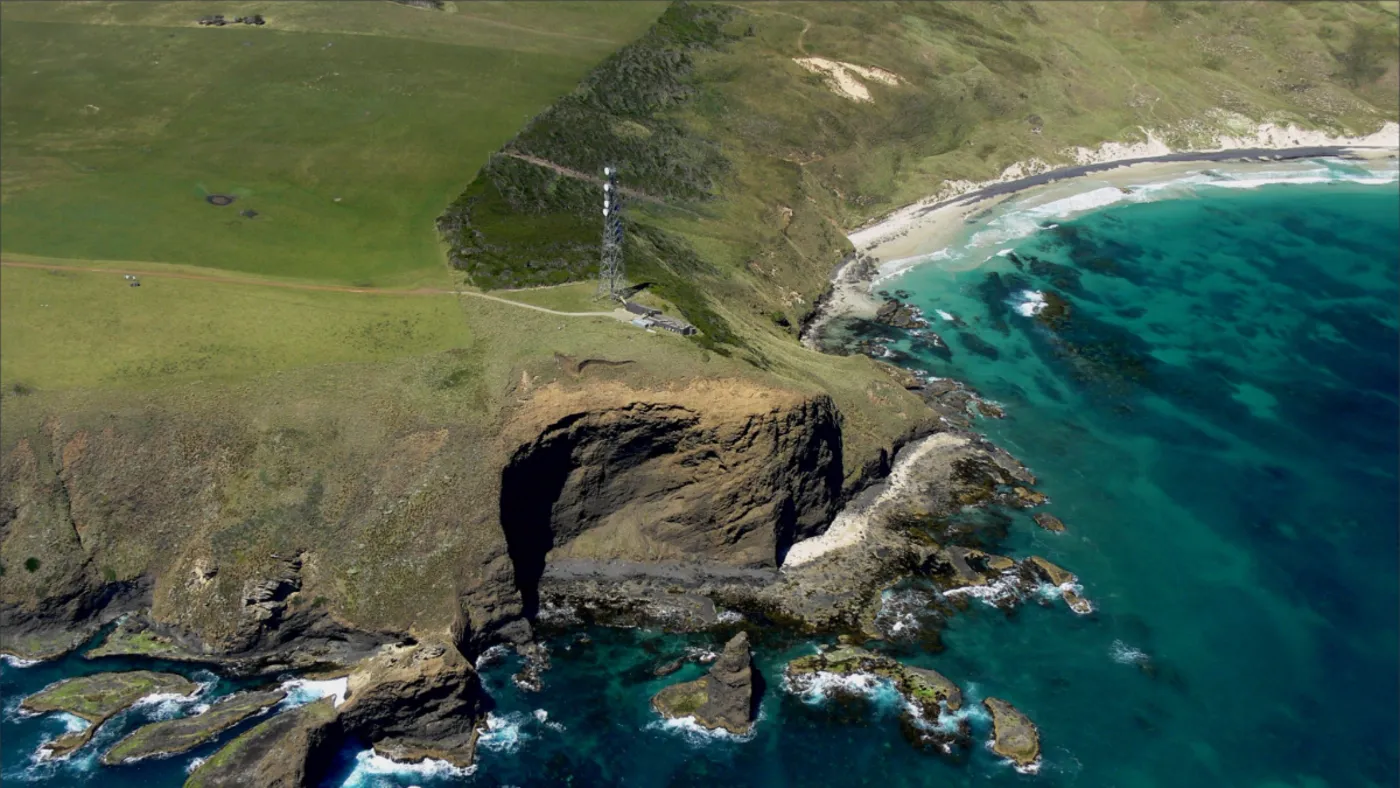
Perched precariously on the windswept, jagged cliffs of northwestern Tasmania, the Cape Grim Baseline Air Pollution Station is celebrating half a century of active scientific service. Since its establishment in 1976, this remote facility has served as the world’s most critical listening post for the global atmosphere. As major industrialized nations grapple with rising greenhouse gas concentrations and shifting weather patterns, the continuous, high-precision data collected at Cape Grim provides the ultimate, unvarnished baseline of how human activity is changing the chemical composition of our planet’s air.
The station’s geographic location makes it uniquely qualified for this global mission. Situated directly in the path of the “Roaring Forties”—powerful westerly winds that blow uninterrupted across thousands of miles of the Southern Ocean—Cape Grim regularly receives some of the cleanest, most pristine air on Earth. When the wind blows from the southwest, it has not touched land since leaving the icy shores of Antarctica or the southern tip of South America, offering scientists a rare opportunity to measure “baseline air” that is entirely free from the localized pollution of cities, highways, and industrial factories.
Managed jointly by the Australian Bureau of Meteorology and the Commonwealth Scientific and Industrial Research Organisation, known as CSIRO, Cape Grim is celebrating its fifty-year milestone at a highly critical moment for climate science. The data compiled at this windswept outpost does more than just track the steady rise of carbon dioxide; it serves as a vital diagnostic tool for global policy. From proving the success of international ozone treaties to monitoring the health of the Southern Ocean’s carbon sink, Cape Grim’s half-century of data provides the empirical foundation upon which modern climate science is built.
The Physics of Pristine Air: Why Cape Grim is Globally Unique
To understand why scientists travel to the edge of the world to collect air, one must look at the global atmospheric circulation patterns. The Earth’s atmosphere is constantly moving, driven by solar heating and the planet’s rotation. In the mid-latitudes of the Southern Hemisphere, this movement creates a permanent band of powerful westerly winds known as the Roaring Forties, which blow between 40 and 50 degrees south latitude consistently.
Because the Southern Hemisphere is dominated by vast oceans rather than landmasses, these winds travel over thousands of kilometers of open water without encountering a single city, factory, or major agricultural development. As the wind sweeps across the sea, natural processes—such as wave action and rainfall—effectively scrub the air clean of short-lived pollutants, dust, and aerosols. By the time this air collides with the basalt cliffs of Cape Grim, it represents a perfectly mixed, highly representative sample of the background southern hemisphere atmosphere.
Harnessing the Roaring Forties for Baseline Measurement
Operating a high-precision atmospheric research station in this environment requires extreme vigilance. Scientists cannot simply turn on their instruments and record data continuously. If the wind shifts even slightly to the east, it blows over the agricultural farmlands of Tasmania or the industrial cities of mainland Australia, introducing local pollutants like wood smoke, vehicle emissions, and agricultural methane into the sample.
To prevent this local contamination from corrupting the global dataset, Cape Grim utilizes a highly sophisticated “sector-control” system. The station’s computers constantly monitor wind speed and direction.
When the wind is blowing from the western “clean air sector,” the automated systems open the intake valves, channeling the pristine air into high-precision chromatographs and storage flasks.
If the wind shifts outside of this narrow sector, the intake valves automatically close, and the data collected during that period is filtered out of the baseline archive.
This strict protocol ensures that the station’s historical record remains an untarnished, highly accurate reflection of the global background atmosphere.
Fifty Years of Data: Charting the Unstoppable Rise of Greenhouse Gases
The primary legacy of Cape Grim’s fifty years of operation is its continuous, high-precision measurement of greenhouse gases. When the station first began taking measurements in 1976, the atmospheric concentration of carbon dioxide sat at approximately 330 parts per million. At the time, global warming was primarily an academic theory discussed in specialized research departments.
Today, the data collected at the station tells a far more urgent story. In mid-2026, the baseline carbon dioxide concentration recorded at Cape Grim crossed a historic milestone of 423 parts per million, reflecting a relentless, near-exponential upward curve over the past half-century.
While this figure is slightly lower than the global average—which is driven higher by the high concentration of industrial activity in the Northern Hemisphere—it represents the permanent, background baseline of the planet’s atmosphere.
The steady rise from 330 to 423 parts per million is the ultimate, undeniable proof of how fossil fuel consumption is altering the global climate.
The Carbon Dioxide Curve: A Fifty-Year Trajectory
The carbon dioxide data collected at Cape Grim is particularly valuable because of its absolute consistency. Because the station utilizes the same, highly calibrated measurement protocols established by the World Meteorological Organization, researchers can compare modern readings directly with those taken in the 1970s without worrying about instrumentation bias or systemic errors.
This long-term record reveals that the rate of carbon accumulation is actively accelerating. In the late 1970s, CO2 concentrations at the station rose by an average of 1.2 parts per million annually.
Today, despite international climate agreements and the rapid expansion of renewable energy, that rate of accumulation has doubled, rising by an average of 2.4 parts per million per year.
This acceleration highlights the immense lag in global decarbonization efforts, proving that the world must implement far more aggressive emissions cuts to stabilize the background atmosphere.
Methane and Nitrous Oxide: The Secondary Drivers of Warming
While carbon dioxide remains the primary focus of climate policy, scientists at Cape Grim also monitor dozens of other, highly potent greenhouse gases. Chief among these are methane and nitrous oxide, which possess significantly higher warming potentials than CO2 on shorter timescales.
The station’s long-term dataset shows that baseline concentrations of both methane and nitrous oxide are rising steadily. Methane, which is released by agricultural activities, landfill decay, and fossil fuel extraction, has experienced a sharp, unexplained acceleration over the past several years.
Nitrous oxide, driven primarily by industrial fertilizer use, continues its gradual, relentless upward march.
By tracking these secondary gases with high precision, Cape Grim provides policymakers with the diagnostic data needed to design targeted reduction strategies, ensuring that national climate plans address the full spectrum of global warming drivers.
Inside the Cape Grim Air Archive: Retrospective Science in a Bottle
One of the most innovative and globally unique programs operating at Cape Grim is the Cape Grim Air Archive. Established in 1978 by pioneering CSIRO scientists, the archive is a physical “air library” containing thousands of stainless steel flasks filled with pristine baseline air collected at the station over the past four decades.
This physical archive represents an extraordinary scientific asset. When scientists collected these air samples in the late 1970s and 1980s, the analytical instruments of that era were relatively primitive, capable of measuring only a handful of major gases.
By preserving these physical samples under high pressure in non-reactive containers, Cape Grim has created a time machine for modern researchers.
The Tasmanian Liquid Air Library
The ability to look back in time has proved invaluable as new, previously unknown industrial pollutants enter the global environment. When modern chemists discover a new synthetic greenhouse gas or an ozone-depleting industrial chemical, they can visit the Cape Grim Air Archive to test the older samples using modern, ultra-sensitive mass spectrometers.
This retrospective analysis allows researchers to trace the historical emissions trajectory of a newly discovered chemical with absolute accuracy.
They can determine exactly when the chemical first entered the global atmosphere, how fast its concentration has grown, and which geographic regions are the primary sources of the emissions.
This program has led to the discovery of several previously unmonitored hydrofluorocarbons and industrial solvents, prompting immediate international regulatory action to phase them out before they can cause widespread environmental damage.
Proving the Triumph of the Montreal Protocol
The data preserved in the Cape Grim Air Archive played a vital, historic role in saving the global ozone layer. When scientists first discovered in the 1970s that chlorofluorocarbons (CFCs) were migrating to the stratosphere and destroying the ozone layer, the chemical industry fiercely contested the findings, demanding absolute empirical proof before agreeing to phase out the highly profitable refrigerants.
Cape Grim provided that proof. By analyzing both real-time measurements and archived air samples, researchers demonstrated that CFC concentrations were rising rapidly in the background atmosphere, and that these synthetic chemicals were directly linked to the widening ozone hole over Antarctica.
This empirical data served as the foundational evidence that led to the signing of the historic Montreal Protocol in 1987.
Subsequent measurements at the station documented a steady, historic decline in global CFC levels, proving that coordinated international environmental policy can successfully reverse global ecological threats.
The Vulnerability of the Southern Ocean Carbon Sink
Beyond measuring the composition of the air, the research conducted at Cape Grim is critical for understanding the health of the Southern Ocean. The Southern Ocean is the unsung hero of the global climate system, acting as a massive, highly efficient carbon sponge that absorbs approximately 40% of all human-generated carbon dioxide absorbed by the world’s oceans.
However, scientists are warning that this critical natural sink is showing signs of severe stress. As global temperatures rise and wind patterns shift, the delicate relationship between the atmosphere and the ocean is changing, threatening to weaken the ocean’s ability to absorb carbon and potentially accelerating the rate of global warming.
Measuring the Ocean’s Unsung Carbon Sponge
The interaction between the atmosphere and the ocean is a continuous, bidirectional exchange. Carbon dioxide dissolves into the cold, turbulent waters of the Southern Ocean, where it is pulled down into the deep ocean by sinking water currents and consumed by massive blooms of microscopic marine organisms.
By measuring the carbon dioxide concentrations in the wind blowing off the ocean, scientists at Cape Grim can calculate exactly how much carbon the ocean is absorbing at any given moment.
This continuous monitoring allows researchers to validate complex global carbon-cycle models, tracking the efficiency of the ocean sink with unprecedented precision and ensuring that climate projections are based on real-world observations rather than theoretical calculations.
Warming Waters and Shifting Wind Currents
The latest data from Cape Grim and oceanographic research vessels reveal that the efficiency of the Southern Ocean carbon sink is facing significant headwinds. Rising global temperatures have caused the surface waters of the ocean to warm, reducing their physical ability to dissolve carbon dioxide.
At the same time, climate change has caused the powerful westerly winds of the Roaring Forties to shift further south toward Antarctica, altering the upwelling of deep, carbon-rich ocean waters.
This upwelling brings older carbon to the surface, reducing the ocean’s capacity to absorb new emissions from the atmosphere.
If this vital natural sink continues to weaken, a larger percentage of human-generated CO2 will remain in the atmosphere, triggering a powerful, self-reinforcing feedback loop that will accelerate global warming and make the transition to net-zero emissions even more difficult for global policymakers.
Rebuilding the Station for the Next Fifty Years
As the Cape Grim Baseline Air Pollution Station enters its second half-century of operation, the facility is undergoing a major, multi-million-dollar modernization program. The harsh, salty, and windswept environment of the Tasmanian coast places extreme physical stress on the station’s buildings and scientific instruments, requiring constant maintenance and upgrades to protect the integrity of the data.
The Australian Bureau of Meteorology and the CSIRO have launched a joint capital campaign to rebuild the station’s laboratories, install state-of-the-art atmospheric sampling towers, and deploy next-generation mass spectrometers capable of measuring gases at the parts-per-quadrillion scale.
These upgrades will ensure that Cape Grim remains the premier global observatory for the next fifty years, providing future generations of scientists with the precise, untarnished data needed to navigate the challenges of a changing world.
The unfolding story of global warming requires absolute clarity, scientific integrity, and a long-term commitment to empirical observation. By perched on the edge of the world, facing the most hostile winds on earth, and meticulously preserving the history of our planet’s air, the scientists at Cape Grim have built a monument to human curiosity and environmental responsibility.
The lessons of the past fifty years prove that the choices we make today are permanently written in the background atmosphere of our planet, and Cape Grim will continue to stand as our most reliable, honest witness, tracking our progress toward a sustainable future.