U.S. President Donald Trump’s bold policy pledge to double national electricity production, slash consumer energy costs by 50%, and fast-track federal power approvals for artificial intelligence data centers has met widespread skepticism from energy economists, utility executives, grid operators, and legal experts. Speaking to business leaders and technology founders, the administration framed energy expansion as an urgent national security imperative, arguing that winning the global artificial intelligence race against international rivals requires unleashing massive domestic baseload power from natural gas, coal, and nuclear energy sources.
The federal proposal promises to streamline environmental reviews, issue executive orders expediting power plant permits, and mandate rapid electrical grid interconnections for technology companies building massive server facilities. Administration officials assert that sweeping regulatory rollbacks will unleash a private energy construction boom, supplying gigawatts of low-cost power to fuel artificial intelligence models while simultaneously lowering utility bills for American households.
However, power industry veterans and regulatory scholars emphasize that political declarations cannot instantly overcome the physical, logistical, and legal laws governing the United States electrical grid. Constructing high-voltage transmission lines, building new power plants, and manufacturing heavy electrical equipment require multi-year engineering lead times that cannot be bypassed through executive decree. Furthermore, the federal government faces strict constitutional boundaries, as state utility commissions maintain legal authority over local power plant siting, retail electricity rates, and distribution infrastructure.
TechGolly provides a detailed analysis of the data center power debate, evaluating grid capacity constraints, regulatory jurisdiction limits, equipment supply chain shortages, hyperscaler clean energy mandates, and the realistic timeline for energizing next-generation artificial intelligence infrastructure.
Unpacking the Energy Demands of the Artificial Intelligence Buildout
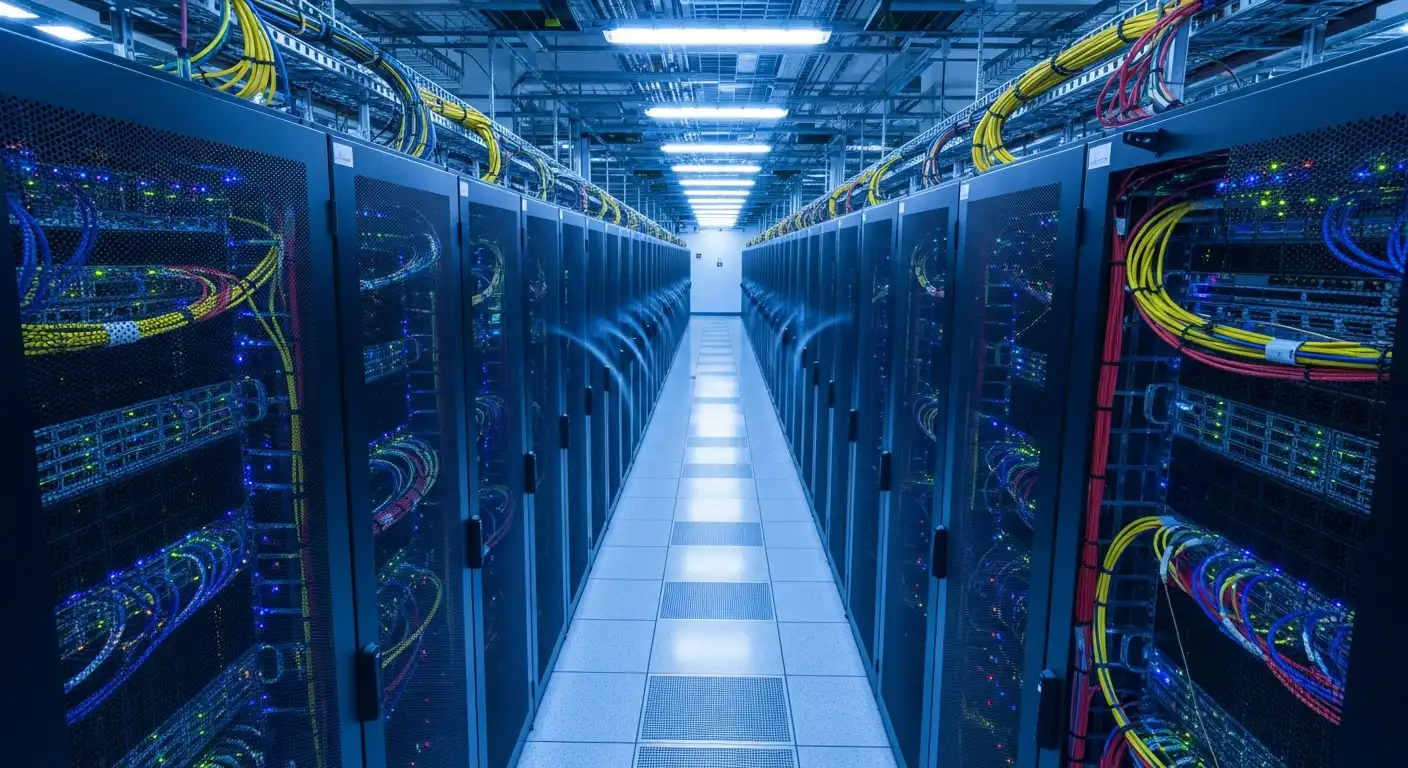
The primary driver behind the national power debate is the staggering electricity appetite of modern artificial intelligence hardware. Unlike traditional cloud computing facilities that process routine website traffic and business software, artificial intelligence training clusters require dense arrays of high-power graphics processing units running at maximum thermal design power 24 hours a day, 365 days a year without interruption.
A single gigawatt-scale artificial intelligence data center campus consumes approximately 1,000 megawatts of continuous electrical power—an amount equivalent to the output of a commercial nuclear reactor or a large combined-cycle natural gas plant, capable of powering over 800,000 residential homes. Industry projections indicate that total United States data center power consumption could surge from roughly 200 terawatt-hours today to over 600 to 1,000 terawatt-hours by 2030, rising from 4% of total national electricity demand toward 10% to 12%.
To support this computational expansion, mega-cap technology conglomerates including Microsoft, Amazon, Alphabet, and Meta are committing over $200 billion annually in combined capital expenditures. Technology companies are competing aggressively to construct liquid-cooled server halls housing hundreds of thousands of specialized processing chips. However, technology executives report that obtaining physical land and server chips has become secondary to a far greater challenge: securing firm, long-term grid interconnection agreements.
In major data center hubs such as Northern Virginia, Ohio, Texas, and Georgia, local electrical utilities are informing data center developers that new large-scale power connections will require waiting 4 to 7 years. In some constrained regional utility territories, utilities have placed moratoriums on new high-voltage connections until regional transmission lines and new baseload generation plants are constructed.
Interconnection Queue Bottlenecks and Grid Operator Realities
A primary structural obstacle delaying data center power delivery is the massive backlog of power generation projects stuck in regional transmission interconnection queues. Across the United States, independent power producers have submitted over 2,000 gigawatts of proposed generation and energy storage capacity to regional transmission organizations, including PJM Interconnection, the Midcontinent Independent System Operator (MISO), and the Electric Reliability Council of Texas (ERCOT).
Regional grid operators are legally required to conduct rigorous electrical engineering impact studies before allowing any new power plant or major industrial load to connect to the high-voltage transmission grid. These complex studies evaluate whether adding a 1,000-megawatt data center or natural gas plant will trigger thermal overloads, cause localized voltage collapse, or compromise regional grid reliability during peak summer and winter weather events.
Conducting these regional grid impact studies routinely takes 3 to 5 years. Furthermore, if a study reveals that connecting a new facility requires upgrading regional transmission lines or building new electrical substations, the project developer must pay for those infrastructure upgrades, adding hundreds of millions of dollars to total capital expenses.
Constructing new high-voltage interstate transmission lines represents one of the slowest infrastructure processes in North America. Obtaining land rights-of-way, navigating federal environmental reviews under the National Environmental Policy Act (NEPA), and securing construction approvals from multiple state utility commissions typically requires 7 to 10 years from initial design to final energization.
State Jurisdiction versus Federal Executive Authority
The administration’s promise to unilaterally fast-track power approvals and slash utility bills by 50% faces severe legal limits under the United States Constitution and federal energy statutes. Under the Federal Power Act, regulatory authority over the power sector is divided between federal and state governments.
The Federal Energy Regulatory Commission (FERC) exercises jurisdiction over interstate wholesale electricity sales and high-voltage transmission line tariffs. However, state Public Utility Commissions (PUCs) hold exclusive legal sovereignty over retail electricity pricing, local power distribution networks, and the physical siting and permitting of power plants constructed within state boundaries.
Consequently, a presidential executive order cannot legally compel a state public utility commission in Virginia, Ohio, or Georgia to approve a natural gas power plant permit or lower retail electricity rates. State utility commissioners are legally bound by state statutes to ensure that utility investments remain just and reasonable for local captive ratepayers, preventing private commercial enterprises from receiving preferential treatment at public expense.
State regulators are increasingly resisting attempts to pass data center infrastructure costs onto residential utility customers. If a regional electric utility spends $1 billion building new high-voltage transmission lines and natural gas peaking plants to supply a private AI data center, state regulators may order the utility to charge those capital costs directly to the technology company rather than spreading the expense across household monthly power bills.
Legal scholars also point out that federal environmental rollbacks will face immediate litigation in federal courts. Environmental advocacy organizations and state attorneys general regularly challenge federal permit waivers, alleging violations of clean air, clean water, and endangered species protection statutes. Court-ordered injunctions and environmental litigation can freeze construction projects for years, nullifying administrative efforts to accelerate project timelines.
Equipment Supply Chain Bottlenecks: Transformers and Turbines
Even if all regulatory permits were granted instantly, physical manufacturing capacity for specialized heavy electrical hardware remains a severe bottleneck for global grid expansion. The surge in worldwide electricity demand has exhausted global supply chains for critical electrical grid components.
High-voltage step-up transformers—essential industrial units that step up power plant voltages for long-distance transmission—currently face delivery lead times of 3 to 4 years from major global manufacturers including Siemens Energy, GE Vernova, and Hitachi Energy. Prices for large power transformers have increased by over 80% since 2020 due to shortages of specialized materials, including high-grade grain-oriented electrical steel (GOES) and heavy copper windings.
Similarly, heavy-duty industrial gas turbines used in combined-cycle natural gas power plants are virtually sold out through the late 2020s. Global turbine manufacturers are operating production facilities at maximum capacity, with backlog orders extending past 2028. An energy developer attempting to construct a new 1,000-megawatt natural gas facility today cannot obtain primary gas turbines and high-voltage transformers before 2028 or 2029.
This physical manufacturing constraint means that political pledges to double national electricity output within a single presidential term are physically impossible. Expanding global factory capacity to manufacture heavy electrical machinery requires billions of dollars in capital investments and specialized labor training, setting physical limits on the speed of grid expansion.
The Clean Energy Alignment Dilemma: Hyperscalers versus Fossil Policies
A significant strategic disconnect exists between the administration’s proposal to expand fossil fuel generation (coal and natural gas) and the binding corporate sustainability commitments of major technology buyers.
All four major North American hyperscalers—Microsoft, Google, Amazon, and Meta—operate under strict corporate climate pledges, targeting 100% carbon-free energy coverage for their data center operations by 2030 or 2040. These corporate commitments are not merely public relations campaigns; they are legally binding contractual frameworks integrated into corporate bond covenants, international ESG reporting mandates, and customer service level agreements.
While technology companies are desperate for new baseload power, they are hesitant to sign long-term Power Purchase Agreements (PPAs) with newly constructed unabated coal or natural gas plants that would violate their corporate carbon-reduction mandates. Instead, technology firms are actively seeking zero-carbon baseload energy sources, driving a historic commercial resurgence in nuclear power.
In landmark corporate energy deals, Microsoft contracted to purchase 100% of the output from the restarted 835-megawatt nuclear unit at Three Mile Island under a 20-year agreement with Constellation Energy. Amazon Web Services acquired a 960-megawatt nuclear-powered data center campus co-located directly beside Talen Energy’s Susquehanna nuclear station in Pennsylvania. Simultaneously, Google and Amazon signed advance development agreements to fund early deployments of Small Modular Reactors (SMRs) with advanced nuclear startups.
However, advanced nuclear technologies offer no immediate relief for current power shortages. Small Modular Reactors remain in early design certification and pilot testing phases, with commercial deployments not expected until the mid-2030s. Consequently, technology companies face a difficult choice between delaying data center construction or temporarily relaxing corporate environmental standards to procure fossil-fuel grid power.
Localized Market Price Impacts and Ratepayer Backlash
The rapid concentration of data center construction is already triggering sharp electricity price increases in regional wholesale power markets, creating political and social backlash among local communities and industrial power buyers.
In the PJM Interconnection market—the largest regional electricity grid in the United States, spanning 13 states including Virginia, Ohio, and Pennsylvania—the annual capacity auction price cleared at $269.92 per megawatt-day, representing an extraordinary 800% increase over the previous year’s clearing price of $28.92 per megawatt-day. The price spike was driven directly by accelerating data center load forecasts combined with the scheduled retirement of older fossil fuel power plants.
Rising capacity prices translate directly into higher monthly utility bills for residential homeowners, small business owners, and non-tech industrial manufacturers across the Mid-Atlantic region. Local manufacturing trade associations have filed formal complaints with federal regulators, warning that soaring power expenses threaten the economic viability of traditional industrial factories.
Social and environmental opposition to data center expansion is also escalating in local communities. Residents in Virginia, Maryland, and Georgia are organizing public protests and lobbying county zoning boards to block new data center developments. Local concerns center on noise pollution from cooling fans, high water consumption for liquid cooling towers, and the construction of high-voltage transmission lines that cut through residential neighborhoods and rural farmland.
Strategic Outlook for National AI Infrastructure and Power Grid Policy
Resolving the data center power challenge will require pragmatism, engineering innovation, and coordinated policy reforms rather than political slogans. To maintain American leadership in artificial intelligence while protecting grid stability, technology companies, energy developers, and policymakers are pursuing alternative infrastructure strategies.
One rapidly growing approach is behind-the-meter co-location. Rather than waiting years to connect to the public utility grid, data center developers are building dedicated power generation facilities directly on site, co-locating server halls beside natural gas power plants equipped with carbon capture systems or behind existing nuclear power facilities. Operating off-grid or behind the meter allows data centers to bypass regional transmission queues and begin operations years faster.
Another essential reform involves overhauling federal and state transmission planning. FERC recently issued Order 1920, mandating that regional transmission operators execute long-term, 20-year transmission planning that accounts for changing generation mixes and surging industrial loads. Upgrading existing transmission lines with high-performance advanced conductors—which can double the power capacity of existing rights-of-way without requiring new land permits—offers a fast, cost-effective method to increase grid throughput.
Ultimately, the artificial intelligence revolution is forcing a fundamental recognition: computation and energy are inseparable physical quantities. The digital economy cannot expand faster than the physical energy infrastructure supporting it.
Key Takeaways for Technology Executives and Energy Investors
The complex realities surrounding data center power deployment offer crucial strategic lessons for corporate decision-makers, technology architects, utility managers, and institutional investors.
First, power availability has replaced silicon availability as the primary limiting factor for artificial intelligence growth. Corporate technology roadmaps must prioritize energy procurement and grid access strategies early in project planning, treating power availability as a foundational constraint on software scaling.
Second, executive political pledges cannot override physical manufacturing timelines and state regulatory laws. Technology leaders must evaluate power deployment timelines based on realistic equipment lead times, regional grid study queues, and state public utility commission filings rather than political announcements.
Third, clean energy baseload technology represents an extraordinary investment opportunity. Developing advanced nuclear power, geothermal systems, long-duration energy storage, and natural gas with carbon capture will yield high returns as Big Tech companies deploy capital to secure zero-carbon baseload power.
Finally, long-term success requires active collaboration between technology companies, local utilities, and community stakeholders. Technology firms that proactively invest in local grid infrastructure, minimize community disruption, and pay their fair share of capital costs will secure stable power connections, building the physical foundation for the artificial intelligence economy.