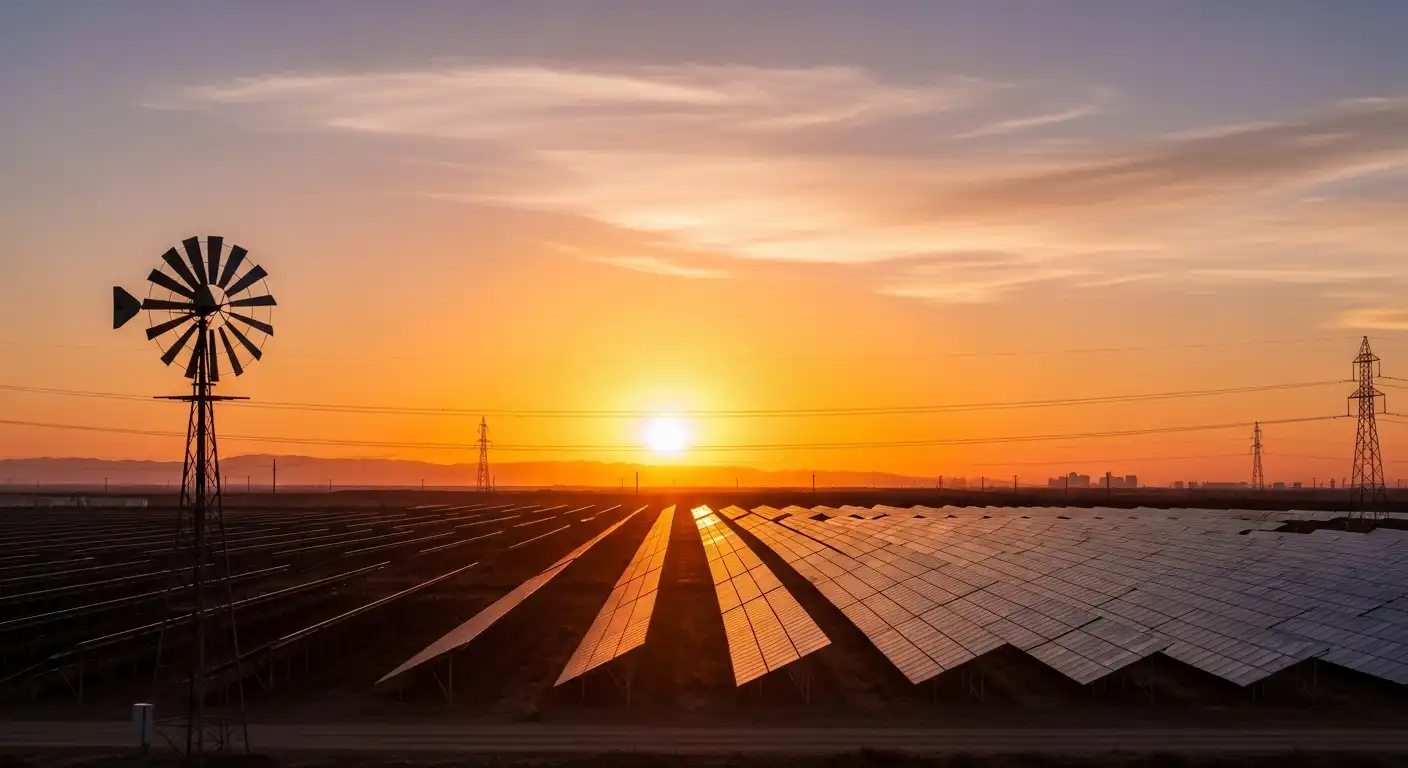
Massive expanses of arid sand and gravel across northwest China are rapidly turning into the epicenter of the world’s largest clean power buildout. Just west of Korla in the Xinjiang Uygur Autonomous Region, endless rows of dark blue photovoltaic panels stretch across the horizon. This shimmering installation in the Shangku high-tech industrial zone represents a fundamental shift in how the nation generates, consumes, and exports electricity.
Operated by PetroChina Tarim Oilfield, the 1.3-gigawatt photovoltaic facility marks the energy giant’s first million-kilowatt-class renewable installation. Covering 35,000 mu, or approximately 2,333 hectares of previously barren desert, the plant has generated more than 1.6 billion kilowatt-hours of clean electricity since connecting to the regional power grid. The project highlights a broader national campaign to turn vast, sun-drenched desert basins into massive power generation hubs that fuel urban factories thousands of miles away while cleaning up domestic heavy industry.
The Engineering Scale of Desert Solar Installations
Building multi-gigawatt power stations in extreme desert environments requires innovative civil engineering, automated maintenance, and massive logistics networks. In places where summer ground temperatures exceed 50 degrees Celsius and violent sandstorms frequently sweep across the plains, keeping solar modules operational presents unique challenges.
Autonomous Management and Robotic Maintenance
The Shangku solar complex runs with minimal on-site personnel. Inside a centralized control room, digital management software tracks power generation across every sub-array in real time. Instead of employing hundreds of manual field laborers to clean dust and grit from panels, the facility deploys fleets of intelligent cleaning robots.
These automated robots travel along module rails during the night, sweeping away fine desert dust without using water, which remains an extremely scarce resource in the Tarim Basin. Overhead, autonomous drones equipped with high-resolution thermal cameras fly pre-programmed inspection routes. The drones detect micro-cracks, faulty wiring, and hotspots on individual photovoltaic cells before electrical failures can spread. This automated approach keeps operating costs down while keeping power generation efficiency above 98% across the entire 1.3-gigawatt array.
Expanding Renewable Megaprojects Across Southern and Northern Xinjiang
The Shangku facility is only one piece of a much larger renewable energy network spreading across the region. In southern Xinjiang’s Ruoqiang County, developers have built a massive 4-gigawatt solar farm that blankets the edge of the Taklimakan Desert. Near the regional capital of Urumqi, a 1-gigawatt hybrid wind-solar installation captures strong mountain winds alongside intense solar radiation.
By the close of recent development phases, regional authorities had constructed six distinct 10-gigawatt-class renewable energy bases. Total installed renewable capacity across Xinjiang reached 169 million kilowatts, making up 64% of the region’s entire electrical generation capacity. This clean power expansion outpaces traditional thermal coal generation, turning a region historically known for fossil fuel extraction into an engine for zero-emission energy production.
West-to-East Transmission Keeps Coastal Hubs Running
Generating hundreds of billions of kilowatt-hours of green energy in remote deserts solves only half the logistical puzzle. China’s biggest industrial consumers and densest populations live thousands of miles to the east in coastal megacities like Shanghai, Hangzhou, and Guangzhou.
Ultra-High-Voltage Corridors Overcome the Distance Barrier
To move electricity across continental distances without massive energy losses, grid engineers built ultra-high-voltage direct current transmission corridors. These high-capacity power lines operate at up to 1.1 million volts, carrying bulk power across mountain ranges and plateaus directly into eastern manufacturing zones.
As a primary generation hub for the national West-to-East power transmission program, Xinjiang has transmitted an aggregate of 304.36 billion kilowatt-hours of renewable electricity to other provinces. Clean energy now makes up roughly 30% of all outbound electricity leaving the region. This continuous flow of desert-generated power allows coastal industrial provinces to run export manufacturing facilities, electric vehicle charging networks, and municipal grids with fewer local coal-fired power plants.
Green Power Trading and Industrial Decarbonization
The massive supply of renewable electricity has fueled a boom in regional green power market trading. Annual green electricity transactions across the Xinjiang Power Exchange Center reached 43.43 billion kilowatt-hours, representing a massive 230% year-on-year increase.
This surging trading volume directly replaces fossil fuels. The traded clean power saved 13.13 million metric tons of standard coal consumption and prevented 35.47 million metric tons of carbon dioxide emissions in a single year. Commercial enterprises, high-tech manufacturing parks, and data processing centers are actively purchasing these green power certificates to meet corporate sustainability goals and avoid carbon border tariffs on exported goods.
Petrochemical Giants Pivot Toward Zero-Carbon Operations
The push to build clean energy in western deserts is fundamentally altering the business models of traditional fossil fuel extractors. State-owned energy producers are using their capital, engineering expertise, and land rights to lead the renewable rollout.
Decarbonizing the Oil Patch from Within
The Tarim Basin contains some of the deepest and most challenging oil and gas reservoirs in the world, historically requiring vast amounts of diesel fuel and coal-fired electricity to run heavy drilling rigs, compression stations, and refining units. PetroChina Tarim Oilfield is now using solar power generated at facilities like Shangku to run its own extraction operations.
By electrifying oil extraction pumps, gas processing plants, and water treatment facilities with on-site solar energy, the company is systematically lowering the carbon intensity of every barrel of oil and cubic meter of natural gas it extracts. The ultimate goal is to create zero-carbon industrial parks where renewable energy powers petrochemical refining, chemical synthesis, and administrative facilities. This low-carbon operating model provides a clear blueprint for other legacy resource extraction companies operating in arid environments.
Developing Multi-Energy Hybrid Export Hubs
Renewable power generation fluctuates based on sunlight and wind conditions. To ensure grid reliability, project planners in southern Xinjiang are developing integrated energy export hubs that combine multiple power sources.
These hybrid installations integrate utility-scale wind farms, vast solar arrays, natural gas peaking plants, and pumped-storage hydropower facilities into a unified generating network. When wind speeds drop or the sun sets, flexible gas turbines and hydro storage units immediately ramp up production within seconds. This balance stabilizes the grid, prevents voltage drops, and guarantees a steady baseload supply of clean electricity for both local industrial parks and cross-country export lines.
The Nationwide Renewable Milestone and Global Energy Dynamics
The rapid transformation across Xinjiang reflects a profound structural shift occurring across the entire Chinese energy sector. Desert installations are driving national clean power figures to historic highs.
Wind and Solar Capacity Surpasses Fossil Fuels
Across the nation, total installed wind and solar capacity reached 1.84 billion kilowatts, officially surpassing total thermal coal and gas capacity for the first time in history. This milestone marks a critical turning point in global energy history. For more than a century, industrial growth depended almost exclusively on burning fossil fuels. Today, the world’s second-largest economy builds more renewable generation capacity in a single year than most developed nations have installed throughout their entire history.
This buildout directly impacts the economics of global renewable manufacturing. High domestic demand drives massive economies of scale for solar panel fabricators, wind turbine makers, and power electronics companies. The production efficiencies gained on multi-gigawatt desert projects have driven global solar module prices down by more than 85% over the past decade, making solar energy the cheapest form of new electricity generation in history.
Economic Development and Modernization in Remote Regions
The influx of hundreds of billions of dollars in clean energy infrastructure is transforming the economic landscape of western China. Communities that once relied exclusively on seasonal farming, mineral extraction, or livestock grazing now benefit from modern infrastructure investments.
Constructing mega-scale solar and wind farms creates thousands of construction, engineering, and equipment assembly jobs. Local vocational schools are training young technicians in automated robotic maintenance, high-voltage electrical engineering, and drone piloting. The expanded electrical grid provides stable, inexpensive power to remote towns, supporting local agricultural cold-storage facilities, modern textile factories, and digital service hubs.
By tying local economic progress directly to national climate targets, the clean energy push fosters long-term regional development and builds a modern industrial economy in historically underserved desert regions.
Long-Term Outlook for Desert Clean Power Hubs
China’s aggressive development of desert renewable energy shows how nations can turn geographical disadvantages into major industrial assets. Arid, sun-scorched deserts that were once viewed as barren wastelands are now recognized as strategic energy reserves capable of powering modern digital economies.
As energy storage technology improves and ultra-high-voltage transmission networks expand, the volume of clean power flowing out of the Tarim Basin and surrounding desert zones will continue to climb. The combination of automated robotic maintenance, massive multi-gigawatt project footprints, and integrated transmission grids demonstrates that running modern industrial economies on renewable energy is both technically achievable and financially viable.