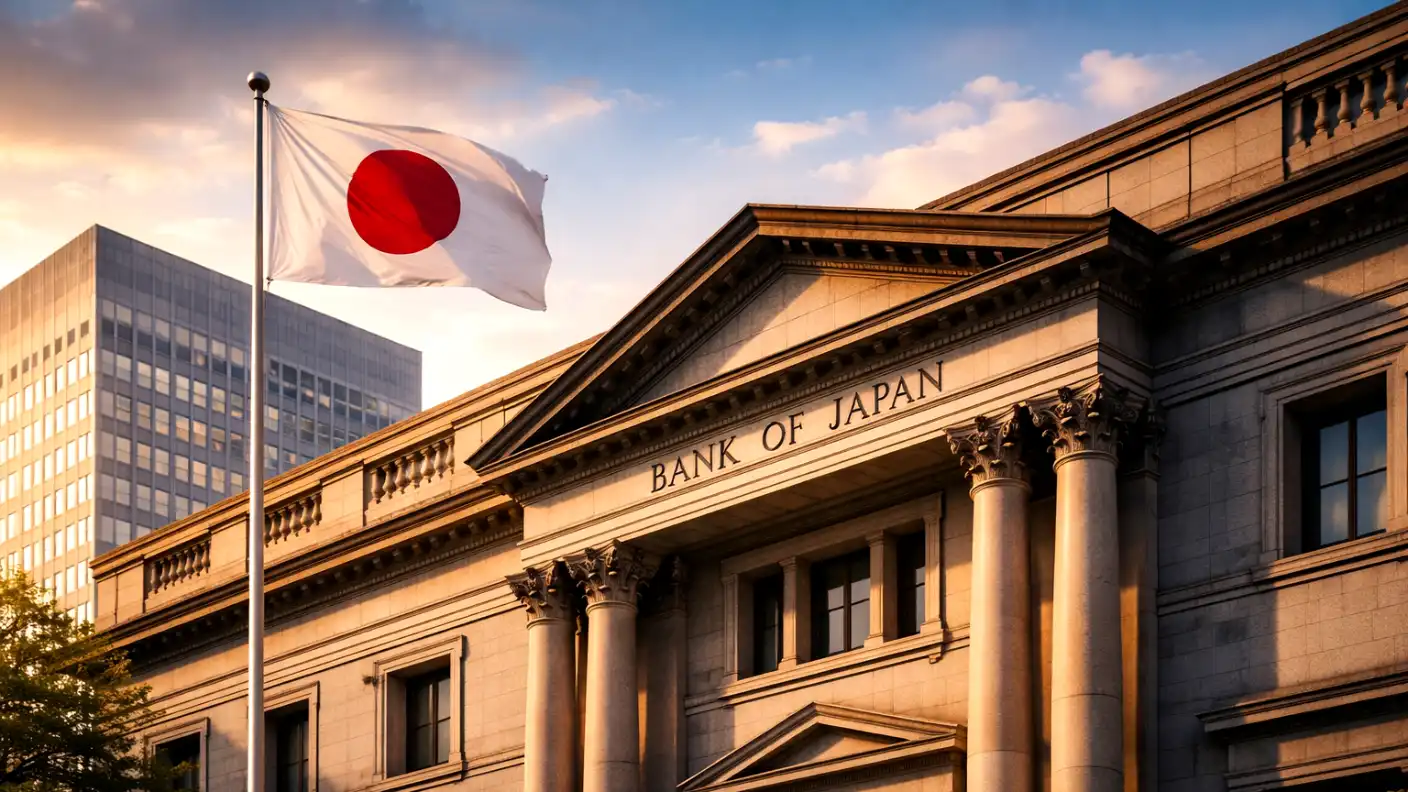
Japan’s economy is navigating its most delicate financial transformation in more than three decades. After languishing through deflationary stagnation, falling real wages, and zero-bound interest rates, the world’s fourth-largest economy has entered a long-awaited period of nominal economic expansion. Corporate revenues are setting historical records, spring wage negotiations have delivered the largest pay increases in thirty years, and consumer prices have held consistently above the central bank’s target for more than two consecutive years.
However, this economic revival faces its most perilous test in a generation. The Bank of Japan, under the leadership of Governor Kazuo Ueda, is executing a historic exit from decades of ultra-loose monetary policy. As the central bank steadily raises benchmark interest rates away from zero and scales back its massive purchases of government bonds, monetary authorities must walk a narrow tightrope.
Policymakers must raise borrowing costs fast enough to tame imported inflation and stabilize a volatile currency, while avoiding policy missteps that could choke consumer spending, trigger global financial contagion through carry-trade liquidations, or overwhelm national government finances burdened by a public debt ratio exceeding 260% of gross domestic product.
The Historic Exit from Negative Interest Rates and Yield Curve Control
The transformation of Japanese monetary policy marks the end of one of the longest and most radical central banking experiments in human history.
Dismantling Decades of Radical Monetary Experimentation
For more than a decade under the aggressive Abenomics framework, the Bank of Japan deployed unprecedented monetary stimulus tools to defeat deflation. The central bank introduced negative interest rates of minus 0.1%, implemented Yield Curve Control to cap 10-year government bond yields near zero, and purchased trillions of yen in equity exchange-traded funds and real estate investment trusts.
That era of radical policy has officially closed. The Bank of Japan dismantled its yield curve control framework, ended negative short-term interest rates, halted new equity ETF purchases, and raised its policy rate in progressive steps toward 0.50% and higher.
Furthermore, the central bank laid out a clear quantitative tightening schedule to reduce its monthly Japanese Government Bond purchases from roughly 6 trillion yen down to 3 trillion yen, or approximately $20 billion, by early 2026. This withdrawal of monetary life support allows market forces to dictate sovereign bond yields for the first time in a generation, forcing commercial banks, corporations, and institutional investors to relearn how to operate in a positive-interest-rate environment.
Achieving the Virtuous Cycle of Wages and Prices
The fundamental justification for the central bank’s policy pivot is the emergence of a self-sustaining wage-price cycle. In previous decades, Japanese businesses operated under a chronic deflationary mindset, competing entirely on price cuts and freezing worker salaries to survive sluggish domestic demand.
That behavioral pattern has broken down. In nationwide Shunto spring labor negotiations, labor unions secured average wage increases surpassing 5.1% to 5.3%, marking the steepest annual salary gains since the early 1990s.
Crucially, small and mid-sized enterprises—which employ more than 70% of Japan’s private-sector workforce—matched these wage increases to retain skilled labor in a graying society facing severe demographic shortages.
With core consumer price inflation remaining firmly above the 2% target, businesses are regularly passing rising labor and material costs down to end consumers. The transition from cost-push inflation driven by foreign commodity spikes to demand-pull inflation driven by rising domestic wages represents the exact structural condition the central bank spent decades trying to achieve.
The High-Stakes Dilemma of Japan’s 260 Percent Debt Burden
While rising interest rates signal economic normalization, they create immense financial challenges for the Ministry of Finance, which manages the heaviest public debt burden in the developed world.
Escalating Sovereign Debt Servicing Costs for the Ministry of Finance
Japan’s total outstanding public debt has climbed past 1,300 trillion yen, or roughly $9 trillion, representing an astonishing 260% of national gross domestic product. For decades, the true fiscal burden of this debt was suppressed by the central bank’s zero-interest-rate policy, which kept government borrowing costs near zero.
As benchmark bond yields rise, the cost of servicing this massive debt pile expands rapidly. Financial modeling from the Ministry of Finance indicates that every 100-basis-point increase in sovereign bond yields adds tens of billions of dollars to annual debt-servicing obligations over a multi-year refinancing cycle.
Annual sovereign debt servicing outlays—encompassing interest payments and debt redemptions—are projected to climb toward 30 trillion yen, consuming more than a quarter of the entire annual national budget.
This rising interest expense threatens to crowd out critical public expenditures on national defense modernization, child welfare subsidies, and clean energy transition programs, forcing policymakers to choose between unpopular tax increases or politically risky spending cuts.
Managing the Giant Balance Sheet of the Bank of Japan
The central bank itself faces significant accounting exposure as interest rates normalize. Through years of aggressive quantitative easing, the Bank of Japan accumulated more than 50% of the entire outstanding Japanese Government Bond market, expanding its balance sheet to a size larger than the entire annual economic output of the nation.
When bond yields rise, the market value of the central bank’s existing bond portfolio falls, creating massive unrealized paper losses that can exceed tens of trillions of yen.
Furthermore, as the central bank raises the interest rate it pays on commercial bank reserve deposits held at the BOJ, its interest expenses rise immediately, while the yield on its long-term bond assets remains locked at low historical levels. While central banks cannot experience commercial bankruptcy and can carry paper losses on their balance sheets, large accounting deficits could spark political scrutiny and complicate coordination between monetary and fiscal authorities.
Currency Volatility and the Global Carry Trade Shockwaves
The normalization of Japanese interest rates has introduced severe volatility into global foreign exchange markets, highlighting the international systemic risks tied to the yen.
The Fragility of Multi-Trillion-Dollar Yen Carry Trades
For years, zero interest rates in Japan made the yen the premier funding currency for global financial speculation. International hedge funds, institutional asset managers, and family offices borrowed trillions of yen at near-zero interest rates, converted the capital into foreign currencies, and invested the proceeds into high-yielding assets, including United States Treasuries, American technology equities, and emerging market sovereign bonds.
When the Bank of Japan raises interest rates while other major central banks begin cutting rates, the interest rate gap narrows, triggering violent carry-trade unwinds. As investors rush to buy back yen to close out foreign leveraged bets, the Japanese currency experiences sudden, sharp rallies, moving from 160 per dollar down toward 140 within weeks.
These rapid currency spikes force global macro funds to liquidate equity positions to meet margin calls, triggering market-wide selloffs across Wall Street, Europe, and Asia. The challenge for central bankers is timing rate hikes carefully to avoid sparking synchronized global liquidity shocks that rebound into the domestic economy.
Imported Inflation Squeezing Household Living Costs
Currency volatility carries direct consequences for everyday Japanese citizens. When the yen traded at historic lows near 160 per dollar, the cost of imported food, crude oil, and raw materials surged, triggering an acute cost-of-living crisis.
Japan imports more than 90% of its primary energy resources and roughly 60% of its caloric food supply. The weak currency inflated retail electricity bills, gasoline prices, and grocery costs, forcing median-income households to curb discretionary spending.
While large multinational exporters enjoyed record yen-denominated corporate profits, domestic real household consumption contracted for consecutive quarters. Central bankers recognize that maintaining an excessively loose monetary posture risks further currency depreciation that impoverishes domestic consumers, making a steady, predictable path of rate normalization necessary to restore real household purchasing power.
Corporate Transformation and the Reshoring of Advanced Industry
Despite monetary headwinds, Japan’s corporate sector is fundamentally healthier and more competitive than at any point since the asset bubble collapse of the late 1980s.
Multi-Billion-Dollar Capital Expenditures in Semiconductors and AI
Japanese industrial conglomerates are executing a multi-billion-dollar domestic capital investment boom, reshoring mission-critical manufacturing lines and building high-tech manufacturing capacity. The Japanese government and private enterprise have mobilized over 10 trillion yen, or roughly $65 billion, in public subsidies and private capital to rebuild the nation’s domestic semiconductor and artificial intelligence computing sectors.
Taiwan Semiconductor Manufacturing Co. completed and opened its advanced Kumamoto fabrication campus, with plans underway for a second multi-billion-dollar mega-fab in the region. In Hokkaido, state-backed chipmaker Rapidus is constructing a premier 2-nanometer logic fabrication plant in Chitose.
Simultaneously, American memory giant Micron Technology is investing billions to deploy extreme ultraviolet lithography tools at its Hiroshima fab. These massive industrial projects create high-wage engineering jobs, revitalize regional supply chains, and ensure that Japan’s manufacturing base remains a vital pillar of the global high-tech hardware ecosystem.
Corporate Governance Reforms Unlocking Trillions in Cash Reserves
The revitalization of Japanese equities is anchored in aggressive corporate governance reforms initiated by the Tokyo Stock Exchange. For decades, Japanese corporations were notorious for hoarding massive cash reserves, maintaining complex cross-shareholding structures, and ignoring shareholder returns, causing hundreds of listed companies to trade at price-to-book ratios below 1.0.
The Tokyo Stock Exchange introduced strict compliance directives requiring listed companies trading below book value to disclose concrete plans to improve capital efficiency and boost return on equity.
Japanese corporations responded with record capital management reforms. Listed companies have executed historical volumes of corporate share buybacks, raised dividend payout ratios past 40%, and dismantled unproductive cross-shareholdings.
Furthermore, corporate mergers, activist investor engagements, and management buyouts have reached historic highs. This corporate restructuring has attracted hundreds of billions of dollars in foreign institutional investment, establishing the benchmark Nikkei 225 at historic highs and turning the Tokyo exchange into one of the best-performing equity markets in the world.
Political Transitions and the Future of Japanese Monetary Policy
The execution of monetary policy in Japan cannot be separated from the complex dynamics of domestic ruling-party politics and sovereign elections.
Navigating Ruling Party Politics and Fiscal Pressures
The ruling Liberal Democratic Party is navigating a challenging political environment characterized by public scrutiny over political funding scandals, leadership transitions, and voter frustration regarding the cost of living.
Different political factions hold contrasting views on the future of economic policy. While certain conservative factions advocate for continued fiscal expansion and low borrowing costs to support industrial subsidies, reformist leaders emphasize fiscal discipline, structural deregulation, and the necessity of monetary normalization to strengthen the yen.
Governor Kazuo Ueda must maintain the central bank’s legal independence while coordinating with government leadership. Raising interest rates too aggressively ahead of national elections could draw political backlash if borrowing costs for small businesses and mortgage holders rise too quickly, requiring central bank communications to remain exceptionally transparent and data-dependent.
The Long-Term Path Toward a Sustainable Terminal Rate
As the Bank of Japan progresses along its normalization path, financial markets are focused on identifying the neutral terminal interest rate—the theoretical rate that neither stimulates nor restricts economic growth.
Leading monetary economists project that Japan’s nominal neutral interest rate sits between 1.0% and 1.5%. Reaching this terminal baseline will require the central bank to implement several additional 25-basis-point rate increases over the coming years.
Central bank officials have emphasized that future policy adjustments will depend entirely on economic data, particularly the durability of services inflation and the outcome of subsequent annual wage negotiations. If real wages turn sustainably positive and consumer spending rebounds, the Bank of Japan can proceed with gradual rate hikes, successfully concluding its generational transition toward a modern, balanced monetary architecture.
A Defining Crossroad for Japan’s Economic Future
The monetary normalization campaign led by the Bank of Japan represents a defining moment in modern economic history. Japan is attempting a feat that few advanced economies have successfully achieved: escaping a multi-decade liquidity trap and dismantling massive unconventional monetary stimulus without triggering an economic recession or financial crisis.
The stakes could not be higher. Successfully navigating this transition will secure Japan’s economic renaissance, establishing a vibrant economy powered by rising wages, healthy corporate competition, sustainable investment returns, and a stable currency.
Conversely, misjudging the pace of rate hikes risks either reigniting deflationary pressures through premature tightening or allowing currency depreciation and imported inflation to erode household living standards.
As Governor Kazuo Ueda and his policy committee evaluate incoming economic data, the world is watching closely. The revival of corporate investment, the strength of Shunto wage negotiations, and the resilience of domestic manufacturing prove that Japan’s economic foundation is durable. By executing monetary normalization with precision and discipline, the Bank of Japan can close the book on three lost decades and secure a prosperous, stable economic future for generations to come.