Key Points:
- Chinese scientists successfully tested a ground-based system that wirelessly beams solar energy via microwaves.
- The team transmitted 1,180 watts of power over a distance of 100 meters with an 88.0% beam collection efficiency.
- Researchers beamed 143 watts of continuous power to a drone flying at 30 kilometers per hour.
- A new design, called the Omega architecture, allows a single central station to power multiple moving satellites simultaneously.
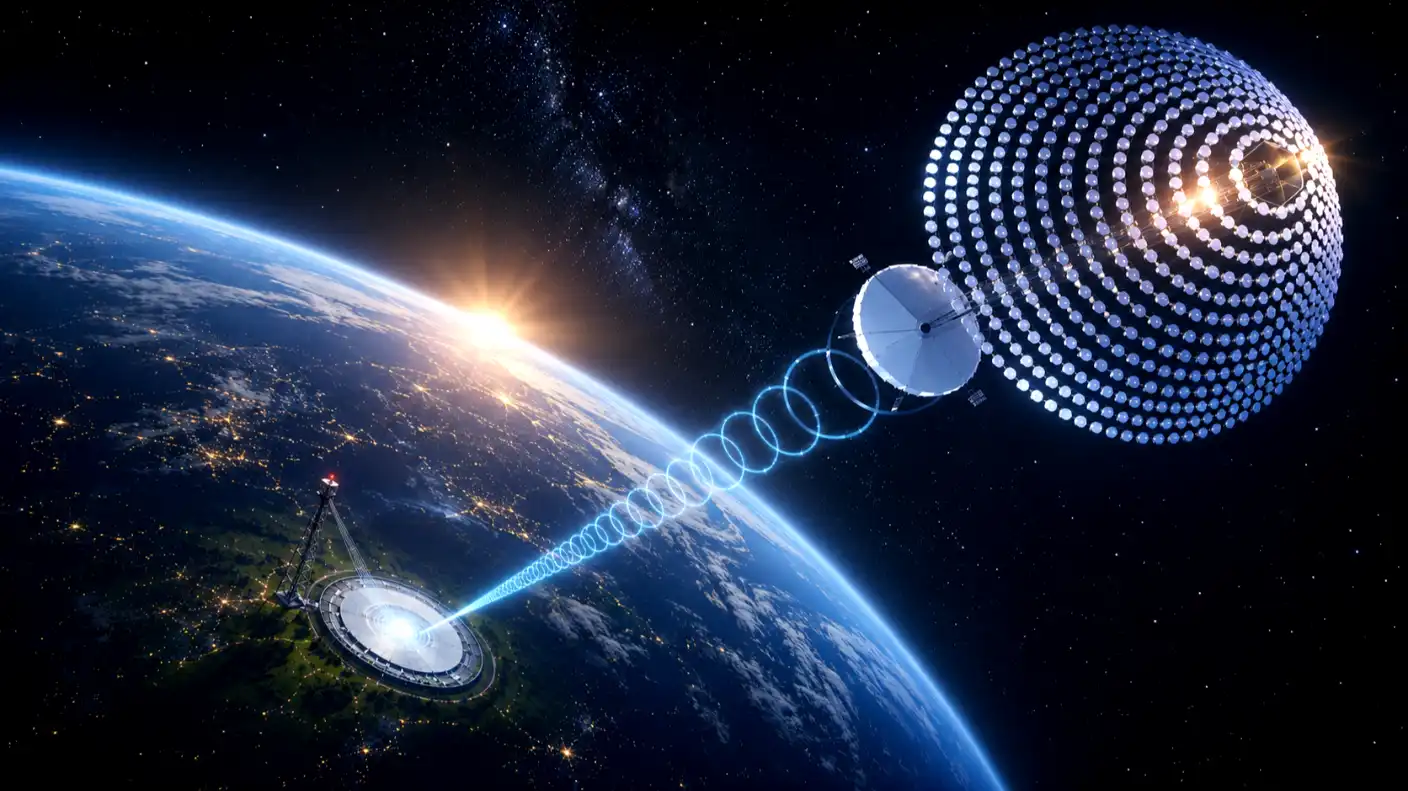
A team of Chinese researchers just hit a massive milestone in renewable energy and space exploration. Led by Duan Baoyaofom of the Chinese Academy of Engineering, the group made significant strides in the Zhuri project, a name that translates to “o Chasing the Sun.”n. The team successfully advanced the key technologies needed to build a solar power station in space. They also proved they can beam that harvested energy wirelessly using microwaves.
The idea of a space solar power station excites scientists all over the world. In space, the sun shines all day and all night. Cloud cover, bad weather, and the cycle of day and night never block the sunlight. A station in orbit can harvest solar energy 24 hours a day and send it directly where people or machines need it most.
To prove this concept actually works, the research team built a comprehensive ground verification system. This testing facility allowed them to send microwave energy through the air without using any physical wires. During their tests, the scientists successfully achieved a kilowatt-level power output over a distance of more than 100 meters. This successful test marks a giant step toward taking this technology out of the laboratory and putting it into practical engineering applications.
The test data showed very promising results. The system generated an output power of 1,180 watts across the open test field. It also achieved a direct current-to-direct current transmission efficiency of 20.8%. Furthermore, the receiver captured the energy with a beam-collection efficiency of 88.0%. These numbers show that engineers can transmit high-power energy over long distances with minimal loss along the way.
Duan explained exactly how this technology will change the entire space industry. He compared the future space solar power station to a flying microwave charging station. Right now, every single satellite must carry its own heavy solar panels and bulky batteries to survive in orbit. A central charging station could completely break this traditional reliance. It would use advanced microwave wireless transmission technology to beam continuous energy directly to spacecraft in orbit.
Beaming power to a stationary target on the ground is one thing, but spacecraft move very fast. The team needed to prove their system could track and hit a moving target accurately. They set up a separate experiment using a drone to test this exact scenario. The system successfully tracked the flying drone and delivered a stable 143 watts of power while the drone flew at 30 kilometers per hour. The transmitter kept the drone powered perfectly at a distance of 30 meters. This test shows that engineers could soon use microwaves to keep drones flying indefinitely without forcing them to land and recharge.
Sending power to a single moving drone solves only part of the problem. A real space station will need to power many satellites at once. To solve this issue, the team proposed an innovative design called the distributed Omega architecture. This unique framework integrates multiple scientific disciplines and focuses heavily on system-level reliability.
The Omega architecture overcomes some of the hardest challenges in modern physics. It allows the system to send long-range, high-power, high-efficiency microwave energy to multiple moving targets simultaneously. Thanks to this breakthrough, a single transmitter system can supply power to an entire fleet of satellites simultaneously.
Putting heavy equipment into space costs a fortune, so engineers must make everything as small and light as possible. The researchers reported significant progress in shrinking their technology. They successfully miniaturized the transmitting and receiving antennas while making them much lighter. They integrated these smaller components into a tight, efficient package that rockets can easily carry into orbit.
The team also improved the station’s core function. They found new ways to concentrate solar energy much more effectively. They improved the photoelectric conversion efficiency, meaning the system converts more sunlight into usable electricity. With the ground tests proving so successful, China now has the solid groundwork needed to deploy these wireless power stations in space in the near future.