Key Points:
- China will launch the Shenzhou-23 crewed spacecraft on May 24, 2026, from the Jiuquan Satellite Launch Center.
- The three-member crew includes commander Zhu Yangzhu, Zhang Zhiyuan, and Dr. Lai Ka-ying, who is the first-ever astronaut from Hong Kong.
- The mission will run more than 100 science experiments, including studies on artificial embryos, advanced batteries, and rare-earth alloys.
- One astronaut will remain in orbit for a full year to gather data on how the human body adapts to long-duration space residency.
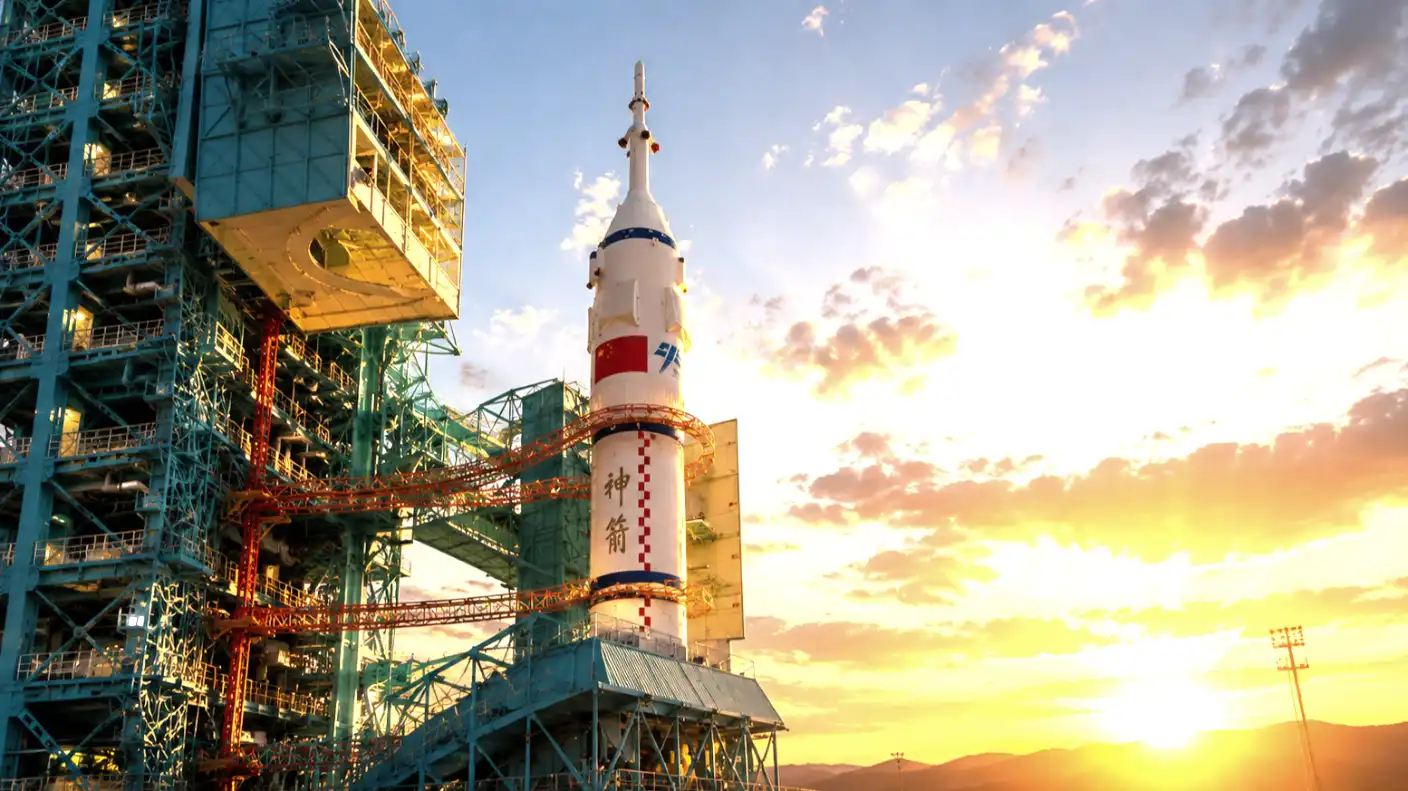
China is preparing to launch its latest crewed space mission to the Tiangong space station on May 24, 2026. The China Manned Space Agency (CMSA) announced that the Shenzhou-23 spacecraft will lift off at 11:08 p.m. Beijing Time from the Jiuquan Satellite Launch Center in northwestern China. The crew will ride aboard a Long March-2F carrier rocket, which technicians are currently filling with propellant in preparation for the late-night launch.
This launch marks the 40th flight mission of China’s manned space program and the seventh crewed expedition during the application and development phase of the Tiangong space station. A three-member crew will pilot the spacecraft, led by mission commander Zhu Yangzhu. Joining him are astronaut Zhang Zhiyuan and payload specialist Dr. Lai Ka-ying. The mission marks a major milestone for regional inclusion, as the 43-year-old Dr. Lai is a mother of 3 children and the first-ever astronaut from Hong Kong to join a Chinese spaceflight.
Once the spacecraft enters low Earth orbit, it will perform a fast, automated rendezvous and docking maneuver with the radial port of the Tianhe core module. This docking will temporarily create a massive orbital complex consisting of three separate spacecraft and three modules. The incoming crew will meet the Shenzhou-21 team currently orbiting to perform an in-orbit rotation. After completing the handover process, the Shenzhou-21 crew will return to Earth, landing at the Dongfeng site in Inner Mongolia after spending 203 days in space.
The Shenzhou-23 mission features a highly demanding scientific agenda. The CMSA plans to execute more than 100 new science and application projects during the crew’s six-month stay. These experiments focus on cutting-edge fields, including space life science, materials science, microgravity fluid physics, aerospace medicine, and advanced space technologies. The crew will also test a new type of space energy storage battery, which could improve the energy capabilities of future space stations by 15% or more if successful.
One of the most notable experiments on the roster involves the study of “artificial embryos.” The crew will use zebrafish and mouse embryos, as well as stem cell-derived artificial embryos, to explore how space environments affect development. This research aims to help scientists understand the establishment of an embryonic research system in space, spanning from lower vertebrates to higher mammals. These biological experiments could pave the way for long-term human survival and reproduction during future deep-space exploration missions.
Materials science will also take center stage during the 180-day mission. The crew will research the manufacturing of advanced materials under microgravity conditions. Specifically, they will study how to regulate and produce high-performance rare-earth permanent magnets and lightweight high-entropy alloys. Since China controls a massive share of global trade in critical minerals, developing these high-performance alloys in space could yield breakthroughs in terrestrial tech manufacturing, defense, and high-efficiency electric motors.
Furthermore, the mission will test the physical limits of human endurance. While typical space station rotations last about six months, one member of the Shenzhou-23 crew will carry out a year-long in-orbit residency experiment. This 365-day stay aims to explore human adaptability and gather detailed physical data. Scientists will track the astronaut’s health to build a multi-omics atlas, which will help space agencies understand the long-term impact of microgravity on human organs and bone density.
Aside from scientific research, the crew will handle daily operational tasks on the Tiangong space station. They will conduct several extravehicular activities, manage incoming cargo transfers, and install debris-protection devices to shield the station from high-speed space debris. They will also install and retrieve external payloads. The crew plans to share their journey with the public through interactive science education broadcasts and community welfare activities, showcasing their progress to students back on Earth.