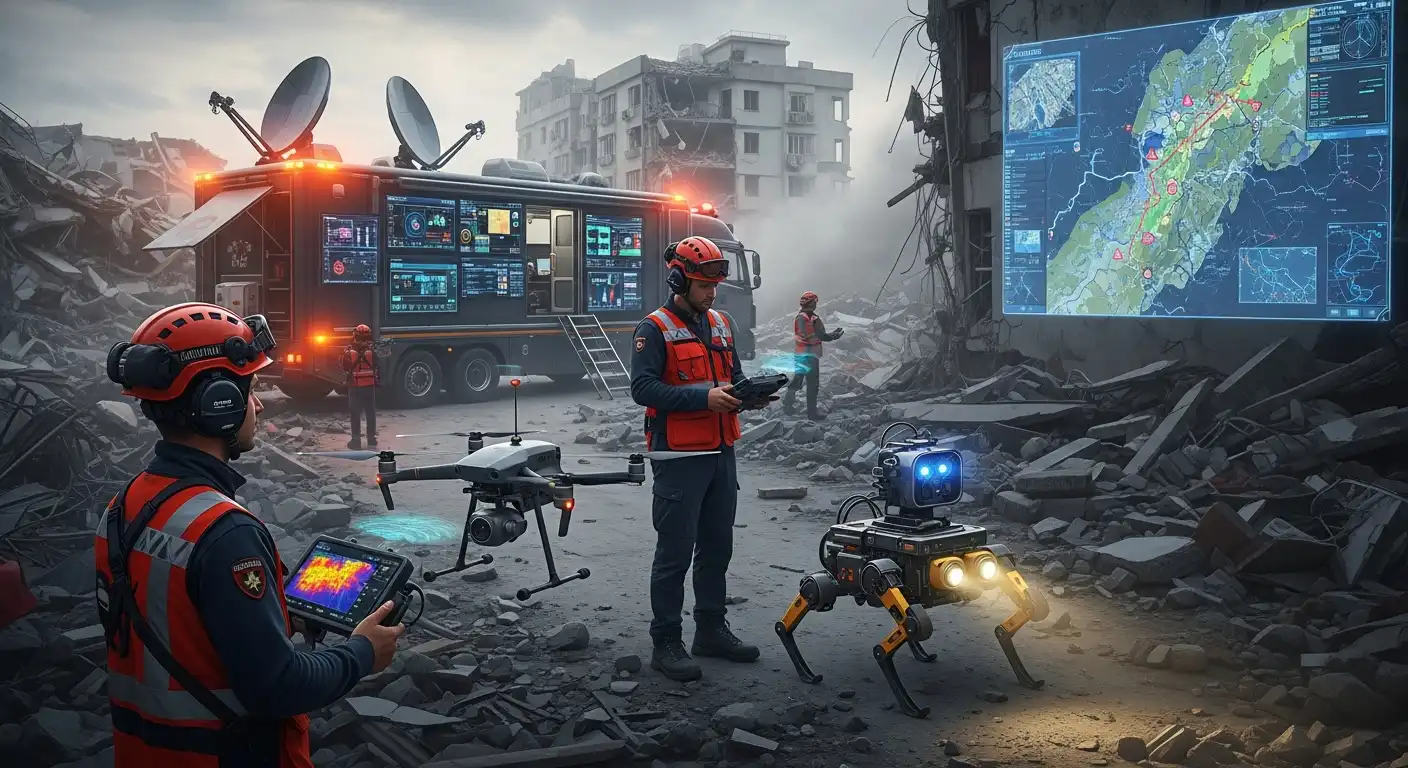
Japan is moving through a significant structural transition in its economic and domestic policy. As Europe and North America struggle to manage the inflationary aftermath of recent supply-chain shocks, Tokyo has turned its focus toward building long-term sovereign resilience. Known globally for its unique vulnerability to severe environmental hazards—including earthquakes, volcanic eruptions, and typhoons—Japan is attempting to transform its geographical challenges into a powerful new engine for economic growth.
Under an ambitious national strategy scheduled for compilation, the Japanese government plans to heavily subsidize and export its cutting-edge disaster prevention technologies. The headline target is bold: Tokyo hopes to double its overseas sales within the disaster prevention sector to 2 trillion yen (approximately $12 billion) by 2030, compared to 2024 baseline numbers. This initiative is a central pillar of Prime Minister Sanae Takaichi’s broader drive to catalyze economic growth through strategic public-private investments that enhance national security and crisis management.
To execute this vision, the Japanese parliament recently cleared the path for a brand-new, centralized Disaster Management Agency to launch. This agency will coordinate with private-sector tech firms, financial institutions, and academic researchers to identify, catalog, and export domestic innovations. By combining advanced robotics, satellite monitoring, and artificial intelligence with a highly structured commercial export pipeline, Japan aims to establish itself as the undisputed global leader in crisis mitigation.
The Takaichi Economic Paradigm: Investing in National Resilience
The 2 trillion yen export push is not an isolated policy; it represents the structural core of the new administration’s macroeconomic platform. Since taking office, Prime Minister Sanae Takaichi has championed a “responsible proactive fiscal policy,” launching a large-scale economic package worth 21.3 trillion yen. While previous administrations prioritized immediate semiconductor and digital manufacturing exports, Takaichi’s team is redirecting capital toward national resilience and crisis preparedness, designating 17 strategic fields for long-term public-private investment.
Disaster prevention sits at the absolute top of this strategic list. On May 19, 2026, the House of Representatives took a historic step toward centralizing this effort by approving legislation to establish a dedicated, standalone Disaster Management Agency. Scheduled to launch, this new command center will operate directly under the Cabinet, absorbing and dramatically expanding the functions of the Cabinet Office’s legacy disaster management division.
The new agency will employ approximately 352 specialized personnel, a significant increase from the previous staff level of 220. Backed by expanded budgetary support and the legal authority to issue direct recommendations to other government ministries, the agency will act as both a domestic safety coordinator and an international business developer, pushing Japanese technology standards into overseas markets.
Reorganizing the Cabinet Office: The Disaster Management Agency Launch
The creation of the standalone agency addresses a long-standing structural weakness in Japan’s safety infrastructure. Previously, responsibility for disaster preparation, immediate emergency rescue, and long-term recovery was split among different ministries, including the Ministry of Internal Affairs and Communications, the National Police Agency, and local municipal offices. This fragmented setup often led to communication bottlenecks during large-scale emergencies.
The new agency will consolidate these responsibilities under a single, highly efficient command structure. Beyond coordinating emergency response teams during active crises, the agency’s primary daily mission is to systematically find, evaluate, and fund advanced technology solutions. By establishing a direct link between private software developers, hardware engineers, and government procurement offices, the agency will accelerate the commercialization of dual-utility technologies.
Proactive Fiscal Policy: Funding the 17 Strategic Fields
Takaichi’s proactive fiscal framework represents a major shift away from traditional austerity. The administration argues that spending public money on crisis preparedness is not a fiscal drain, but a highly productive form of capital investment. By directing state funds into the 17 designated strategic fields, the government aims to stimulate domestic demand, create high-paying technology jobs, and build valuable intellectual property that can be exported globally.
Under this investment model, the state acts as the initial customer for unproven technologies. The government-backed disaster prevention program will absorb the heavy upfront research and development costs of advanced hardware and software systems, allowing Japanese firms to scale their production. Once these technologies are proven and refined in domestic municipal environments, companies can export them at highly competitive prices to international markets, turning public safety expenditures into a source of national export revenue.
Core Technologies: Remote Operations, Satellite Grids, and Wearable Exoskeletons
The technological innovations driving Japan’s resilience strategy represent a massive leap in how humanity interacts with hazardous environments. Rather than relying solely on traditional concrete seawalls and physical shelters, Tokyo’s approach leverages advanced robotics, physical artificial intelligence, and real-time orbital telemetry to manage crises dynamically.
The most critical field of development is the remote operation of heavy machinery. During landslide, volcanic, or earthquake crises, rescue and recovery workers must frequently operate in extremely unstable areas where further collapses or toxic gas leaks remain a constant threat. By integrating low-latency communication networks and high-definition virtual reality interfaces with construction equipment, operators can control excavators, bulldozers, and cranes from safe command centers located miles away.
In addition to heavy machinery, Japan is deploying orbital surveillance and physical AI tools to protect public infrastructure. This includes using satellite radar arrays to detect microscopic shifts in roads, dams, and bridges, as well as wearable robotic suits designed to reduce physical strain on rescue workers.
High-Tech Machine Autonomy: Lessons from the 2024 Noto Earthquake
The practical utility of remote-controlled machinery was demonstrated during the Noto Peninsula earthquake in January 2024. In the immediate aftermath of the disaster, massive landslides blocked critical coastal roads, cutting off evacuation centers and preventing rescue vehicles from reaching isolated villages.
Because the ground remained highly unstable and hit by continuous aftershocks, sending traditional construction crews into the landslide zones was too dangerous. The government deployed advanced, remote-controlled excavators equipped with multi-angle cameras and real-time telemetry sensors. Operators located in Tokyo and Osaka successfully cleared thousands of tons of debris from the affected highways without putting a single human life at risk. The Noto experience proved that remote machinery is no longer a futuristic concept, but a vital, life-saving tool that the global market is eager to adopt.
Orbital Surveillance: Satellite Diagnostics for Aging Public Infrastructure
As developed nations grapple with aging public infrastructure, maintaining thousands of miles of roads, water mains, and sewage pipelines has become an expensive administrative burden. Japan’s growth strategy addresses this challenge by exporting satellite-based diagnostic systems that use synthetic aperture radar (SAR) to monitor infrastructure health from space.
These satellite networks can detect ground subsidence and structural deformations as small as a few millimeters. By analyzing how roads and water pipelines expand and contract over time, the software can pinpoint potential water main leaks or sinkholes before they cause catastrophic disruptions. This continuous, space-based monitoring allows municipalities to prioritize maintenance work, preventing expensive infrastructure failures while reducing the need for manual, street-by-street inspections.
The Cost Hurdle and the Dual-Utility Evaluation Platform
Despite the clear benefits of advanced disaster prevention technologies, widespread adoption has faced a persistent obstacle: high initial acquisition costs. Local municipalities, particularly those in rural or economically stagnant regions, often struggle to justify spending millions of dollars on remote-control machinery or advanced robotic suits that may sit idle in storage facilities for years between active crises.
To break this adoption bottleneck, the Japanese government is introducing a novel procurement model based on “dual-utility” evaluation. The newly established Disaster Management Agency will actively solicit advanced technologies from private firms, which will then be evaluated by a third-party panel of experts representing the industry, academia, government, and finance sectors.
The panel’s primary task is to assess how these technologies can be utilized during normal, non-disaster situations. If a remote-control heavy machinery system can also be used for standard, daily construction projects, or if a satellite monitoring platform can be used for routine road maintenance, the technology receives a high evaluation. The government then catalogs these approved systems and officially recommends them to local governments, offering targeted subsidies to accelerate their integration into daily municipal operations.
The Dual-Utility Solution: Making Disaster Prep Profitable in Normal Times
The dual-utility framework completely changes the financial calculations for local governments and private enterprises. Instead of viewing disaster prep equipment as an expensive insurance policy that drains capital, municipalities can treat these purchases as active productivity tools.
For example, a construction firm that purchases a remote-control excavator can use the machine daily to improve worker safety and efficiency on standard urban job sites. If a natural disaster strikes, the local government can immediately draft that same equipment into the emergency response effort. By proving that these technologies can deliver continuous, daily economic value, the government hopes to lower the financial barriers to adoption, creating a self-sustaining domestic market that will serve as a launchpad for global exports.
The Role of the Third-Party Expert Panel
The third-party expert panel plays a critical role in validating the commercial viability of these technologies. By bringing together university researchers, software developers, government procurement officers, and private venture capitalists, the panel ensures that the funded projects meet strict standards of cost-efficiency and real-world utility.
Financial institutions on the panel assess whether a technology can be easily insured and financed, while academic researchers verify the scientific accuracy of its predictive models. This rigorous, multi-disciplinary review process prevents the state from funding overly complex, impractical projects. The resulting catalog of approved technologies acts as a gold-standard seal of quality, giving foreign governments and international corporate buyers the confidence to purchase Japanese systems.
The Global Blueprint: Exporting Resilience and ‘Profiting’ Overseas
The ultimate objective of Japan’s national resilience strategy is to capture a significant share of the rapidly expanding global market for climate-change adaptation and crisis mitigation. The outline of the envisioned growth strategy frankly analyzes this goal, emphasizing a “focus on contributing to solving common global challenges and ‘profiting’ overseas.”
As climate change drives more frequent and severe weather events worldwide—including torrential rainfall in Europe, prolonged droughts in Australia, and devastating floods in Southeast Asia—governments are scrambling to upgrade their defense infrastructures. Japan plans to position itself as the premier global supplier of these technological solutions.
The export push will focus heavily on three core areas: satellite-based flood and earthquake monitoring systems, predictive AI simulation software, and advanced remote-recovery robotics. By packaging these technologies with long-term maintenance contracts and expert consulting services, Japanese firms can build a stable, recurring source of export revenue.
Exporting Japanese Standards: The International Forum in Thailand
The practical deployment of this export strategy is already visible in international markets. In February, 22 Japanese organizations and companies—including technology conglomerate NEC Corporation—traveled to Thailand to participate in the International Forum on Fire and Disaster Management, hosted by Japan’s Fire and Disaster Management Agency.
At the forum, NEC introduced software-based disaster countermeasures specifically designed to address Thailand’s persistent seasonal flooding challenges. The system utilizes advanced weather forecasting, river flow simulations, and real-time satellite data to predict flood risks up to 72 hours in advance, allowing local authorities to evacuate high-risk neighborhoods and position rescue assets before the water rises. By actively demonstrating these solutions in regional hubs, Japan is establishing its domestic technical standards as the default choice for developing nations throughout Southeast Asia.
The Multi-Billion Dollar Addressable Market
The global addressable market for disaster mitigation technology is projected to grow exponentially over the next decade. As international insurance companies raise premiums in response to rising climate risks, corporate property developers and municipal governments are facing intense economic pressure to invest in resilient infrastructure.
Tokyo’s target to reach 2 trillion yen (roughly $12 billion) in overseas sales by 2030 is highly realistic given these global dynamics. By offering complete, integrated systems that combine space-based monitoring with ground-level robotic response tools, Japanese exporters can address the complex safety challenges facing modern megacities, ensuring that the country’s technology sector remains a vital driver of global economic resilience.
The Future of Sovereign Resiliency Markets
Japan’s ambitious plan to double its disaster prevention exports to 2 trillion yen represents a profound transformation in how nation-states view national security and economic growth. By establishing a dedicated Disaster Management Agency, championing dual-utility technology, and aggressively pursuing international distribution channels, Tokyo is turning its natural vulnerabilities into a source of long-term economic and geopolitical strength.
The success of this strategy will depend on the government’s ability to maintain its proactive fiscal policies and foster close cooperation between private innovators and public procurement offices. As climate volatility continues to challenge traditional safety models worldwide, the demand for highly resilient, automated, and predictive crisis-management tools will only grow. Through its bold investments in national resilience, Japan is not only protecting its own citizens but is also building a vital technological blueprint that will help the rest of the world survive the environmental challenges of the 21st century.