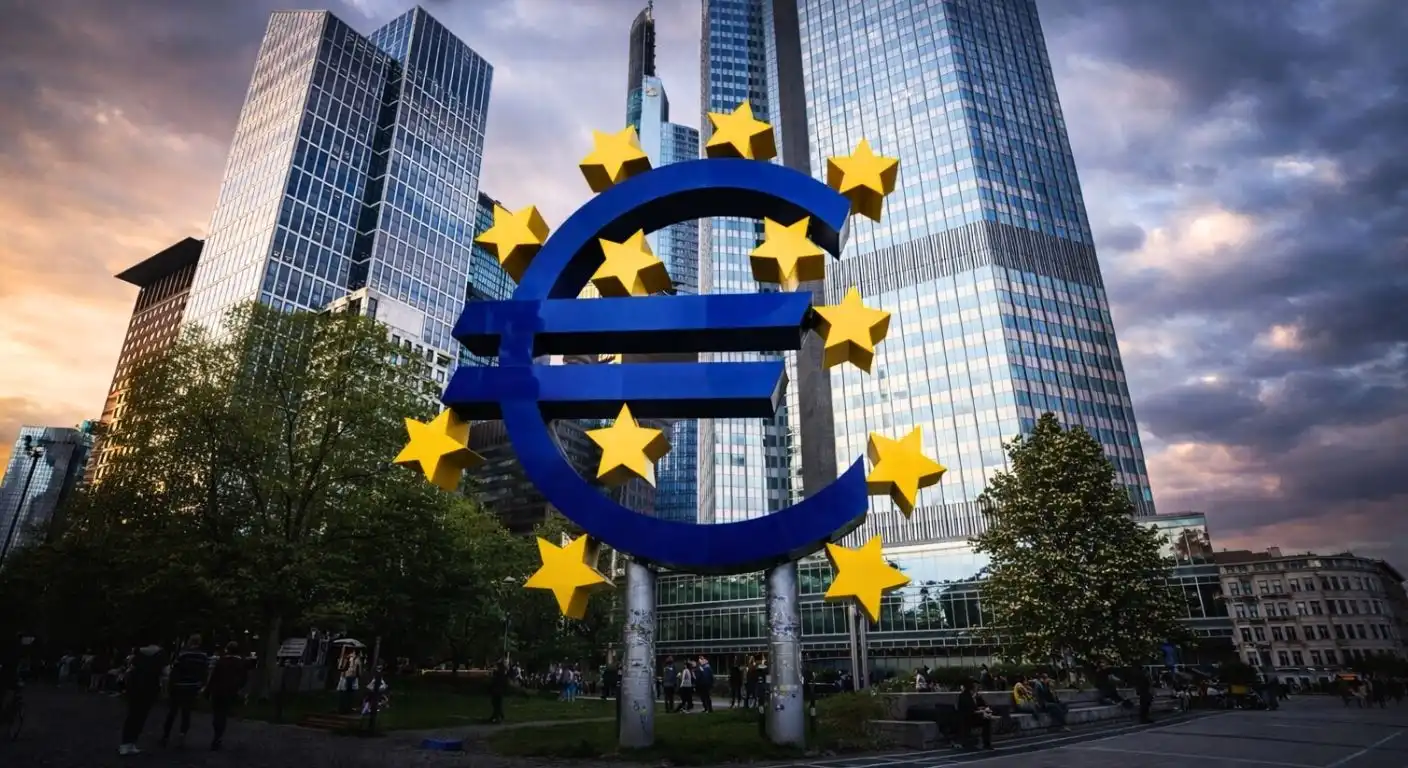
The European financial landscape is facing a challenging, highly volatile period of stagflationary pressure. Caught between a massive energy shock driven by geopolitical conflict and a sharp contraction in regional economic growth, the European Central Bank is executing a delicate balancing act. According to recent market surveys and interest rate derivatives pricing, the central bank is widely expected to keep its benchmark deposit rate steady at 2.25% at its upcoming monetary policy meeting.
This projected pause represents a temporary breather. Rather than signaling an end to the current tightening cycle, the July hold is a strategic waiting period. The Governing Council intends to keep the door wide open for another quarter-point interest rate hike in September, which would lift the benchmark rate to a 23-year high of 2.5%. This unyielding, hawkish stance has turned the European Central Bank into the most aggressive monetary authority among the world’s major economies, as the bank prioritizes its mandatory inflation-fighting commitment over the region’s slowing economic output.
The current economic dilemma is a direct result of a highly volatile international landscape. The re-escalation of the military conflict in the Middle East has disrupted critical shipping traffic through the strategic Strait of Hormuz, driving global energy costs up and forcing economists to slash their growth forecasts for the Eurozone. For the central bank, navigating this complex landscape requires a highly flexible, data-dependent approach. It must decide whether to continue raising rates to prevent inflation from becoming permanently embedded in the economy, or pause its tightening cycle to support a highly fragile, underperforming industrial base.
The Strategic Shift: Navigating the Eurozone’s Stagflationary Trap
The European Central Bank’s upcoming interest rate decision represents a major, highly watched test of corporate and consumer resilience. In June, the central bank surprised global markets by executing a quarter-point interest rate hike to 2.25%, making it the first Group of Seven central bank to tighten monetary policy in direct response to the economic fallout of the Middle East conflict.
The decision was highly controversial, as some economists argued that raising borrowing costs would worsen the region’s economic slowdown.
However, the Governing Council’s primary mandate is to maintain price stability, which is defined as keeping inflation anchored near its long-term 2.0% target. With the consumer price index in the euro area registering at 3.2% in May—and core inflation measures remaining stubbornly high—policymakers concluded that waiting to act would represent a far greater risk.
By raising rates early, the central bank attempted to prevent a dangerous wage-price spiral from taking hold, proving that it is willing to tolerate short-term economic pain to defend the long-term purchasing power of the single currency.
Dismantling the June “Insurance Hike” Narrative
The aggressive nature of the June rate hike led some market analysts to dismiss the move as a temporary “insurance hike”—a preemptive, one-off increase designed to signal resolve to the markets, with the expectation that the central bank would quickly return to a neutral stance.
Speaking at the annual monetary policy conference in Sintra, Portugal, European Central Bank President Christine Lagarde flatly rejected this description.
Lagarde defended the June decision as a necessary, highly justified response to real, rising inflationary pressures. She argued that without the quarter-point increase, the Eurozone faced the very real risk of inflation lingering above the 2.0% target well into 2028.
The central bank is no longer operating under the assumption that the current energy price shocks are a temporary, transitory phenomenon. By taking a firm stand, the bank is attempting to anchor long-term inflation expectations, ensuring that businesses and households do not begin adjusting their long-term contracts and wage demands to reflect higher permanent price levels.
Preventing the Anchor of Inflation Expectations from Slipping
The primary fear driving the central bank’s hawkish stance is the threat of inflation expectations becoming unanchored. If businesses and workers begin to believe that the central bank is willing to tolerate inflation above its 2.0% target to support economic growth, they will adjust their behavior accordingly.
Workers will demand larger annual wage increases, and businesses will raise their prices to cover their rising payroll costs, creating a self-reinforcing inflation loop that is incredibly difficult to break.
To prevent this scenario, the central bank must demonstrate absolute, uncompromising resolve.
By raising interest rates even as economic growth stutters, the bank is proving to the markets that it will always prioritize its price-stability mandate.
This policy commitment is designed to keep long-term inflation expectations firmly anchored at 2.0%, reducing the overall cost of the transition and ensuring that when the energy shocks eventually subside, the economy can return to a stable, non-inflationary growth path.
The Shift from Jumbo Hikes to Meeting-by-Meeting Calibration
While the central bank remains highly hawkish, the mechanics of its tightening cycle have changed significantly compared to the historic interest rate hikes of 2022 and 2023. During that previous crisis, which was triggered by the sudden loss of Russian pipeline gas, the bank was forced to implement massive, consecutive half-point and three-quarter-point interest rate increases to prevent double-digit inflation from running out of control.
Today, the central bank is operating with far greater predictive precision and advanced economic modeling.
Lagarde explained that the bank no longer needs to use these giant, blunt-force rate hikes to manage the economy.
Instead, policymakers can adopt a more measured, meeting-by-meeting approach, calibrating their rate adjustments to the specific, evolving shocks they face.
This gradual approach allows the bank to observe how its previous rate hikes are filtering through the financial system, reducing the risk of making a major policy mistake that could trigger a deep, unnecessary recession.
The Eurozone’s Stagflationary Reality: Mediocre Growth and Sticky Prices
The operational challenge facing the European Central Bank is made exponentially harder by the stagnant, underperforming nature of the Eurozone economy. The conflict in the Middle East has taken a massive toll on domestic demand, corporate investment, and consumer confidence across the continent, forcing economists to slash their growth projections.
According to a comprehensive Bloomberg survey of 56 economists, the median estimate for Eurozone GDP growth was cut to a meager 0.5%.
This is a significant decline from the 0.7% anticipated in previous months and sits well below the European Central Bank’s own optimistic baseline forecast of 0.8%, proving that the region is facing a prolonged period of economic stagnation.
The Impact of a Squeezed Industrial Base
The economic slowdown is particularly severe in the region’s primary manufacturing hubs, most notably Germany. High energy costs, rising trade protectionism, and a lack of technological innovation have severely impacted the competitiveness of European heavy industry, forcing many energy-intensive businesses to scale back their operations or permanently relocate their facilities to lower-cost regions like North America.
This industrial contraction has created a highly fragile, low-growth environment across the Eurozone.
While the services and tourism sectors have remained relatively resilient, they cannot carry the entire weight of the European economy.
The central bank finds itself caught in an uncomfortable monetary bind: if it continues to raise interest rates to fight inflation, it risks pushing these struggling manufacturing industries toward bankruptcy, accelerating the deindustrialization of Europe’s industrial heartlands.
Persistent Inflation and the Two Percent Target Struggle
Despite the weak economic growth, consumer prices remain stubbornly high. While preliminary official data showed that Eurozone inflation eased slightly to 2.8% in June, down from 3.2% in May, it remains far above the central bank’s mandatory 2.0% target.
This persistent inflation prevents the central bank from considering any near-term monetary easing.
According to the median estimates of surveyed economists, the European Central Bank is highly unlikely to consider its first interest rate cut until September 2027, representing a prolonged, high-interest-rate environment that will continue to weigh heavily on businesses and households.
The bank’s governing council remains highly cautious, realizing that cutting rates too early would risk reigniting inflation, forcing an even more aggressive and damaging rate-hike campaign later.
The Geopolitical Transmission: How the Strait of Hormuz Shapes Monetary Policy
The primary transmission mechanism connecting the Middle East conflict to European interest rates is the global energy market. The Strait of Hormuz serves as the world’s most critical maritime chokepoint, facilitating the daily movement of roughly 20% of global oil and liquefied natural gas shipments.
When military strikes and maritime blockades disrupt this narrow waterway, the immediate economic consequence is a sharp increase in the price of crude oil and natural gas.
Because Europe relies heavily on imported energy to power its industrial plants and heat its residential homes, these global energy spikes pass directly through local utility companies, driving up electricity and heating bills for millions of consumers and creating a powerful, imported inflation shock.
The Brent Crude Price Correction and the Short-Lived Relief
The financial markets experienced a temporary period of relief during the late spring, as Brent crude oil prices corrected from their peak of $118 per barrel to hover near $94.
This price retreat was supported by a temporary, highly fragile ceasefire agreement between regional powers, which allowed some shipping traffic to resume and lowered the immediate risk premium in the energy markets.
This temporary price correction is the primary reason why the European Central Bank is expected to maintain its policy rate at 2.25% at its upcoming July meeting.
Because energy prices remained within the baseline scenarios established by the bank’s forecasters, policymakers do not need to rush into an immediate, emergency rate hike.
However, this relief has proved to be short-lived, as the collapse of the ceasefire and renewed military clashes in July have pushed oil prices back onto an upward trajectory, keeping the threat of intense inflation pressures highly active.
The Threat of Second-Round Effects on Wages and Services
The central bank’s primary long-term concern is the threat of second-round inflationary effects. When a sudden energy shock raises the cost of living, workers naturally demand larger wage increases to protect their purchasing power.
If employers agree to these high wage demands, they must raise their own product prices to maintain their profit margins, creating a self-reinforcing wage-price spiral that can become permanently embedded in the service sector.
While recent data suggests that wage pressures are slowly easing—with the annual growth in compensation per employee projected to slow to 3.2%—any prolonged increase in energy prices could easily reverse this trend, forcing the central bank into a much more aggressive, highly disruptive rate-hike campaign later.
Strategic Outlook: The Battle for the September Inflection Point
As the European Central Bank prepares for its July meeting, the financial community is focused entirely on the upcoming September meeting as the ultimate inflection point of the current monetary cycle.
The July pause is widely viewed as a quiet waiting period, allowing policymakers to gather crucial economic data, assess the stability of the Middle East shipping lanes, and review their updated, medium-term growth and inflation forecasts.
Money markets currently price in an overwhelming 85.2% probability of a quarter-point rate hike at the September 10 meeting, which would lift the benchmark deposit rate to 2.5%.
This projected hike reflects a growing consensus that the global era of cheap money and zero interest rates is definitively over, replaced by a new era of high capital costs and active, defensive central banking.
As the Governing Council navigates this highly volatile landscape, its ability to maintain price stability while protecting the fragile economic growth of the Eurozone will be the ultimate test of its strategic vision, determining whether Europe can successfully build a stable, prosperous, and highly resilient economic foundation for the digital age.