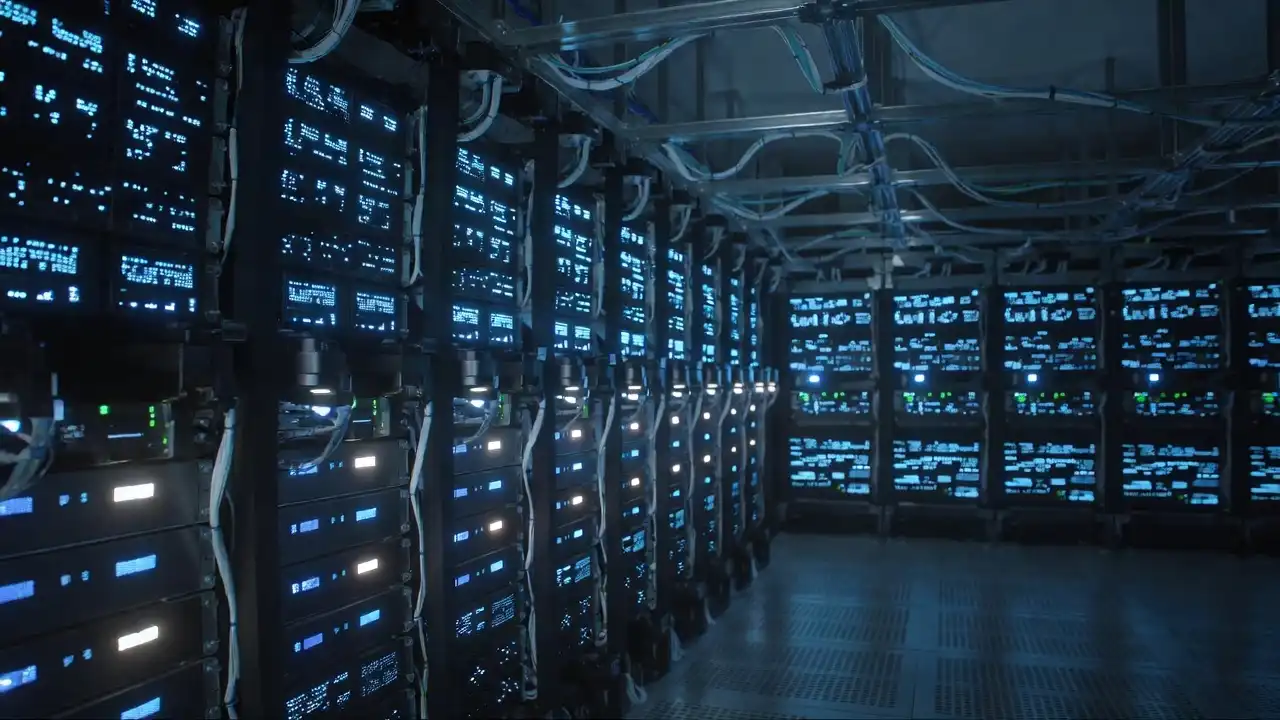
The rapid, unchecked physical expansion of artificial intelligence has officially triggered a coordinated national uprising. In an extraordinary demonstration of grassroots mobilization, opponents of the artificial intelligence infrastructure buildout organized synchronized protests in at least 125 locations across the United States. This nationwide day of action represents the first unified, national effort to channel public anger against the multi-billion-dollar computing complexes that are quietly taking over American towns, straining local power grids, depleting water tables, and roiling regional politics.
This national day of action comes as public opposition to data centers emerges as one of the few issues capable of uniting Americans across deeply polarized ideological lines. A recent national survey conducted by Reuters and Ipsos revealed a striking gap in public trust: only one-third of Americans approve of the current, rapid pace of data-center construction in the country. Even more tellingly, only 14% of respondents stated they would support a data center being built inside their own local community to support artificial intelligence projects for technology giants like Meta Platforms, Alphabet, Amazon, Microsoft, and Elon Musk’s xAI.
As these synchronized protests unfold from the desert of California to the tech hubs of Texas and Georgia, they signal a major, highly volatile shift in the political landscape. For years, technology companies and local officials operated in relative secrecy, signing non-disclosure agreements to greenlight massive, energy-devouring computing projects behind closed doors. Today, those backroom deals have sparked a powerful, nonpartisan populist movement that is transforming from localized zoning disputes into a defining national debate over resources, transparency, and community sovereignty.
The Birth of HumansFirst: Parallel to the 2009 Populist Wave
The nationwide protests are being coordinated by a newly formed grassroots group called HumansFirst. The organization was co-founded by Amy Kremer, a prominent political activist and a former leader of the modern-day Tea Party movement. Kremer has drawn a direct historical parallel between the current anti-data-center movement and the right-wing populist uprising that emerged in 2009 to protest what citizens saw as excessive government spending, taxation, and federal overreach.
However, Kremer is highly careful to emphasize that the current backlash against artificial intelligence infrastructure is strictly nonpartisan. The movement is drawing in progressive environmentalists, conservative rural landowners, local farmers, and tech-skeptical urban youth who are equally angry about the physical impacts of these massive developments. The common denominator uniting these diverse groups is a shared sense of powerlessness. They are tired of waking up to find that multi-billion-dollar industrial complexes are being constructed next to their homes and schools without their prior knowledge or consent.
According to HumansFirst, the goal of the coordinated protests is to demand absolute transparency in the siting process, force developers to protect local water and power resources, and establish strict municipal mechanisms to hold technology companies accountable when they fail to deliver on their promised economic benefits. The organization is framing the unchecked buildout of data centers as an unacceptable infringement on personal liberty and local self-determination, setting the stage for a major, high-profile political conflict.
Red and Blue States United on the Protest Map
The geographic distribution of the 125 protest sites provides a highly accurate guide to where the regional battles over digital infrastructure are currently hottest. The protests are not confined to traditional tech hubs like Silicon Valley or northern Virginia; instead, they are spreading rapidly across both conservative strongholds and progressive states, demonstrating the universal, nonpartisan nature of the public’s anger.
Texas, which has emerged as a major national hotspot for data center development due to its independent electrical grid and cheap land, hosted the largest number of protests, with demonstrators gathering at 16 different locations across the state.
Georgia, a critical political swing state that has experienced a massive influx of tech investments, followed closely behind with 11 scheduled protests.
Meanwhile, California, Florida, and Pennsylvania each hosted 7 protests, proving that the anxiety over resource depletion and grid stability is felt equally in progressive coastal regions and conservative southern states alike.
First-Time Activists Take to the Streets
The national mobilization has drawn in thousands of first-time activists who had never previously participated in political demonstrations. These “political nomads” represent a new, highly unpredictable force in local politics, motivated not by traditional party loyalty, but by a direct, personal desire to protect their homes, families, and neighborhoods from industrial encroachment.
In Texas, 31-year-old organizer Eva Cardona explained her decision to lead a local protest by pointing out that the rapid, unregulated growth of artificial intelligence infrastructure had been alarming her for months.
Cardona noted that she wanted to do something much more active and hands-on than simply posting her frustrations on social media, reflecting a growing desire among younger citizens to participate in direct, physical community organizing.
By taking to the streets, these first-time activists are forcing local town councils and county commissioners to realize that rubber-stamping major data center projects will carry a severe, immediate political price at the ballot box.
The Physical and Ecological Strain of Advanced Compute
The primary drivers of the public’s anger are the immense, highly disruptive physical demands that modern artificial intelligence data centers place on local resources. Unlike traditional data centers that primarily hosted passive cloud storage and email servers, advanced generative AI models require extraordinary amounts of raw computing power.
This power density translates directly into massive consumption of water, electricity, and land, placing an unsustainable burden on local municipal infrastructure.
Furthermore, the physical construction of these massive, multi-acre complexes permanently alters the visual and sensory character of the rural and suburban communities they occupy.
The constant, high-frequency hum generated by industrial cooling towers and backup generators can be heard for miles, creating a persistent source of noise pollution that disrupts the peace of once-quiet residential neighborhoods and rural farming communities.
The Battle for the Colorado River: The Imperial County Conflict
The environmental cost of the data center boom is particularly visible in water-stressed regions of the American West. In California’s desert Imperial County, left-leaning activist Ivan DelSol is helping lead a major protest against a proposed, high-capacity data center project that is currently slated to consume an estimated 260 million gallons of fresh water annually.
DelSol characterized the project as a dystopian nightmare, pointing out that using hundreds of millions of gallons of precious, fresh water from the drought-stressed Colorado River to cool computer servers is an insult to local agricultural communities.
The Colorado River is the primary lifeblood for millions of people and vast agricultural farmlands across the Southwest, and local groups argue that the government must prioritize water for human survival and food production over the computational requirements of artificial intelligence companies, turning water access into a major regional battleground.
Secret NDAs and the Collapse of Municipal Transparency
An equally significant driver of the public’s rage is the complete collapse of transparency in the local permitting process. Because tech giants are highly competitive and want to secure land and power before their rivals, they frequently require local economic development agencies and county commissioners to sign strict non-disclosure agreements before beginning negotiations.
Under these non-disclosure agreements, local officials are legally barred from discussing the details of the proposed projects with the public, meaning that residents often only find out about a massive, 100-megawatt data center development after the land has already been purchased, the zoning has been changed, and the construction permits have been quietly approved.
This culture of corporate secrecy has shattered public trust in local government, creating a deep-seated sense of powerlessness that has fueled the rapid, national growth of the HumansFirst movement.
The Global Power Grid Crisis: From Dublin to Dallas
The operational challenges of the data center boom are not confined to the United States. Across the globe, electricity grid operators are struggling to keep up with the soaring, exponential energy demands of artificial intelligence server farms, forcing some countries to implement historic regulatory restrictions to protect their national energy security.
In Ireland, which served as the premier European hub for major tech companies due to low taxes and favorable business conditions, the rapid buildout of data centers has created a severe national energy crisis.
By early 2026, data centers consumed an extraordinary 22 percent of Ireland’s total national electricity supply, prompting the city of Dublin to implement a strict, long-term ban on new data center construction.
To manage the ongoing strain on the public grid, Irish regulators have introduced a strict “Bring Your Own Power” mandate, requiring any new data center developer to construct and operate their own independent, on-site clean energy generation facilities rather than drawing power from the public network, establishing a major new international precedent that U.S. states are watching closely.
The Threat of Soaring U.S. Utility Bills
In the United States, the physical strain of the tech boom is increasingly being felt by everyday utility ratepayers. When a utility company must build new high-voltage transmission lines, upgrade its regional substations, or expand its power plants to support a massive new data center, those capital costs are traditionally added to the utility’s broader rate base.
This means that regular residential households and small businesses are forced to pay higher monthly electricity bills to subsidize the infrastructure upgrades requested by a single, wealthy technology corporation.
Recent energy market analyses warned that in some states with high data center concentration, these infrastructure upgrade costs could cause retail electricity rates for local households to spike by up to 50 percent by 2030, fueling a massive wave of public anger that has turned the tech boom into a major political liability for local and state politicians.
Up to $64 Billion in Projects Blocked or Delayed
The growing efficacy of the anti-data-center movement is visible on the corporate balance sheets of the major developers. According to research compiled by the independent watchdog group Data Center Watch, the rapid rise of local, bipartisan opposition has successfully blocked or delayed over $64 billion worth of U.S. data center projects over the past two years.
This massive financial bottleneck is a direct reflection of how quickly organized community resistance can disrupt a technology company’s plans.
By filing environmental lawsuits, forcing public referendum votes on local zoning changes, and lobbying state regulators to deny power-grid connections, local activist groups have successfully stalled major projects in historical development hotspots, proving that the tech industry can no longer rely on unlimited capital to force its way into American communities.
Looking Ahead: The Political Risks for the 2026 Midterms and Beyond
The rapid, national escalation of the anti-data-center movement is poised to have a significant, highly unpredictable impact on the upcoming political landscape. As the country prepares for the highly contested 2026 midterm elections and looks ahead to the 2028 presidential race, the backlash against digital infrastructure is transforming into a major campaign issue.
Politicians on both sides of the political aisle are finding themselves caught in a difficult, highly uncomfortable bind.
While governors and state legislators love to celebrate the multi-billion-dollar investments and temporary construction jobs that data centers bring to their states, they are increasingly terrified of facing the organized, bipartisan anger of local voters who are prepared to punish any politician they perceive as favoring corporate interests over local community protection.
To survive, many candidates are modifying their platforms, calling for strict state-level environmental reviews, the elimination of lucrative tech tax subsidies, and the implementation of mandatory community benefit agreements.
The technology industry’s primary lobbying group, the Data Center Coalition, has issued defensive statements asserting that the industry is committed to being a responsible, supportive neighbor in the communities where they operate, highlighting their investments in local water restoration projects and green energy grids.
However, with only 14% of the public willing to support a data center in their own neighborhood, these public relations campaigns are struggling to make headway.
The coordinated, 125-site protest organized by HumansFirst proves that the era of technology companies operating outside the law under the guise of rapid innovation is officially over.
To secure its physical future, the tech industry must abandon its backroom deals and unilateral expansion strategies, learn to respect the physical limits of local resources, and prove to the American public that its massive computing infrastructure can deliver real, tangible value to the local communities they occupy.