Key Points:
- Beijing’s Humanoid Robot Data Training Center uses human instructors to teach robots how to perform real-world jobs.
- China’s industrial policy targets humanoid robots for the global market and supply chain dominance by 2030.
- A single robotic hand trains an average of 10,000 times just to master a basic physical skill like picking up an egg.
- Tesla CEO Elon Musk admitted that Chinese manufacturers pose the biggest competition to his own Optimus robot.
Chinese technology consultant Kenneth Ren is actively training the workers of the future. The only catch is that these new workers do not have a single drop of human blood. Instead, they consist entirely of metal, computer chips, and synthetic skin. Ren works as an overseas solution expert with RealMan Intelligent Technology. He recently spent time explaining his work to reporters at the busy, government-backed Humanoid Robot Data Training Center in Beijing. Ren proudly stated that his team is essentially teaching robots to think for themselves.
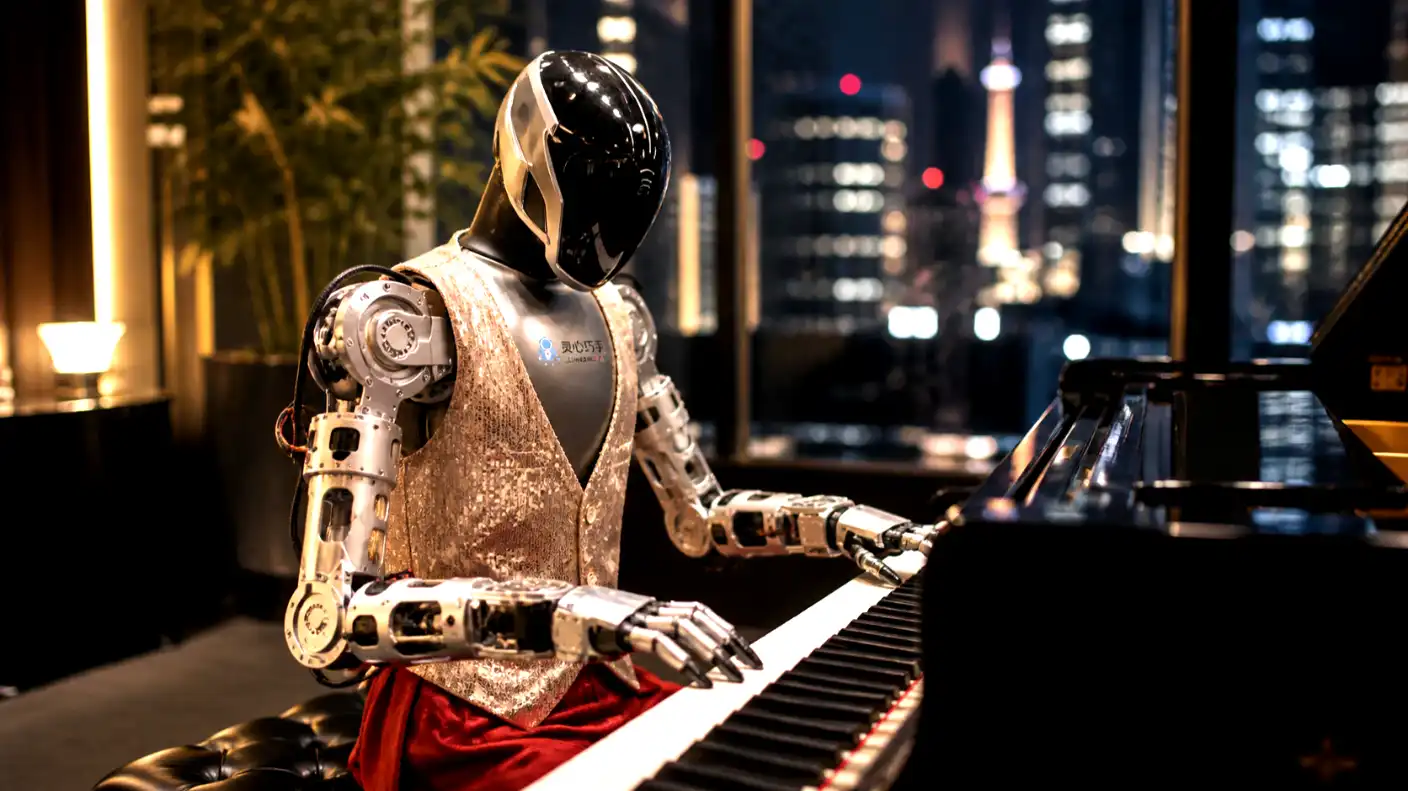
Ren is helping to run what Chinese state media openly describe as a humanoid-robot school. This specialized academy has a very clear and ambitious mission. China wants to advance its robots beyond simple entertainment or novelty acts quickly. Policymakers have officially identified humanoid robots as a major national priority leading up to the year 2030. Much like their highly successful pushes to dominate the global electric vehicle and artificial intelligence markets, Chinese leaders want to control the future supply chains of the robotics industry. The U.S. Chamber of Commerce and research firm Rhodium Group published a joint research report on May 11, noting that China’s next-generation industrial policy represents a massive shift from targeting individual sectors to what they call an “industrial policy of everything.”
The Beijing-based training center relies on a massive network of similar facilities operating across the country. Inside these state-backed centers, hundreds of human instructors work daily to prepare their robotic pupils for the real world. Fudi Luo serves as one of the primary teachers on the campus. She previously worked as a traditional school art teacher. Still, she now spends her days instructing cyborg students on how to sort and organize items on a busy factory assembly line. She uses high-tech cameras, manual controllers, and wearable motion-capture sensors to guide her artificial intelligence-enabled pupils through basic, repetitive physical motions.
Luo explained that the teaching process requires incredible patience. At the very beginning of the training, the fresh robots have absolutely zero spatial awareness. Instructors must manually control the machines’ limbs to guide them. However, as the human moves the metal arms, the system generates massive amounts of digital data. The robot’s internal artificial intelligence analyzes this data, learns the physical path, and quickly begins performing the entire task on its own. The school teaches these metallic pupils a wide range of useful tasks, including professional massage therapy, household cleaning, retail shelf stocking, and precision metal repair. Luo spends 8 hours a day making the same repetitive motions to generate the training data. She joked that while her robotic students never feel tired, her own human muscles certainly do.
Nearby, on the same technology campus, another innovative startup, Beijing Inspire-Robots Technology, focuses entirely on mastering the most difficult part of a robot: the hands. The company equips its high-tech robotic hands with advanced motion tracking and sensitive pressure sensors. Winston Zou, the secretary of the board of directors, explained the intense training regimen. He revealed that on average, a single robotic hand must perform a new task at least 10,000 times before it can successfully master the skill. Today, their advanced robotic hands can easily pick up a fragile egg without cracking it, lift a thin piece of string, and handle tiny, delicate objects.
This rapid progress has caught the attention of major global competitors, including Tesla Chief Executive Officer Elon Musk. During a recent earnings call, Musk boasted to investors that Tesla’s own Optimus humanoid robots remained superior to anything coming out of China. He argued that Tesla mastered hand design, which he called the single hardest engineering challenge in the entire robotics world. However, Musk openly acknowledged that China poses the biggest threat to his business. He admitted that Chinese companies are incredibly good at scaling up manufacturing and bringing products to market faster than anyone else.
China is not waiting until 2030 to put these machines to work. Across the country, businesses are already running active real-world test trials with these artificial intelligence-powered droids. Hungry customers can visit local restaurants to eat food prepared by robotic chefs or buy drinks from robotic bartenders. Humanoid robots also work as waiters, direct traffic on busy city streets as police officers, and run local convenience stores. While many of these machines still require a human to monitor their progress, developers say it is only a matter of time before the robots handle these daily tasks on their own.
Despite the rapid changes, creators urge the public not to panic about their jobs. Kenneth Ren explained that the training center’s ultimate goal is to help humans, not replace them. He stressed that they want the robots to take over dangerous industrial tasks or highly repetitive work that people simply do not want to do. He insisted that his company has absolutely no intention of replacing human workers in any field. Instead, they want to build a future where humans and robots work side by side to create a safer, more efficient society.