A sudden wave of panic swept through the global technology supply chain on Monday, July 6, 2026. The volatility was triggered by a report claiming that Nvidia Corp.’s highly anticipated, next-generation artificial intelligence server rack system was facing a year-long delay due to severe manufacturing difficulties.
The report, issued on Sunday by the prominent silicon research firm SemiAnalysis, suggested that Nvidia’s next-generation Kyber NVL144 server architecture had been pushed back from 2027 to 2028, sparking an immediate selloff across Asian technology stocks.
However, the market panic was short-lived. Nvidia moved quickly to stabilize investor confidence, issuing a direct and unambiguous statement to the financial community.
An Nvidia spokesperson confirmed that the company’s product roadmap remains unchanged, stating simply: “Our roadmap is intact.”
This swift denial helped reverse pre-market losses on Wall Street, allowing Nvidia shares to recover and trade flat to slightly positive near the $197 mark.
The rapid rise and subsequent defusing of these delay rumors highlight the extreme sensitivity of the global financial markets to any potential disruption in the artificial intelligence infrastructure buildout. After years of explosive gains, technology valuations are priced for perfection.
The incident also highlights a growing reality in the semiconductor industry: the primary bottlenecks in the AI race are no longer just the design of the GPU silicon itself.
Instead, the challenges have shifted to the physical packaging, high-density printed circuit boards, advanced liquid cooling systems, and massive electrical backplanes required to link these chips together into unified supercomputers.
This deep-dive analysis explores the technical specifications of the Kyber NVL144 architecture, the manufacturing hurdles associated with high-layer PCB midplanes, the market fallout across Asian supply chain partners, and how Nvidia’s official narrative manages to preserve its trillion-dollar capital moat.
Deconstructing the Kyber NVL144 and the Midplane Bottleneck
To understand why a reported delay in Nvidia’s server cabinets can wipe out tens of billions of dollars in market value in a single morning, we must examine the specific role that rack-scale systems play in the modern artificial intelligence economy.
As AI developers train increasingly complex large language models, they require massive, centralized pools of computing power.
Instead of purchasing individual graphics processing units (GPUs) and plugging them into standard computer motherboards, hyperscale cloud service providers are increasingly purchasing fully integrated, factory-assembled server cabinets.
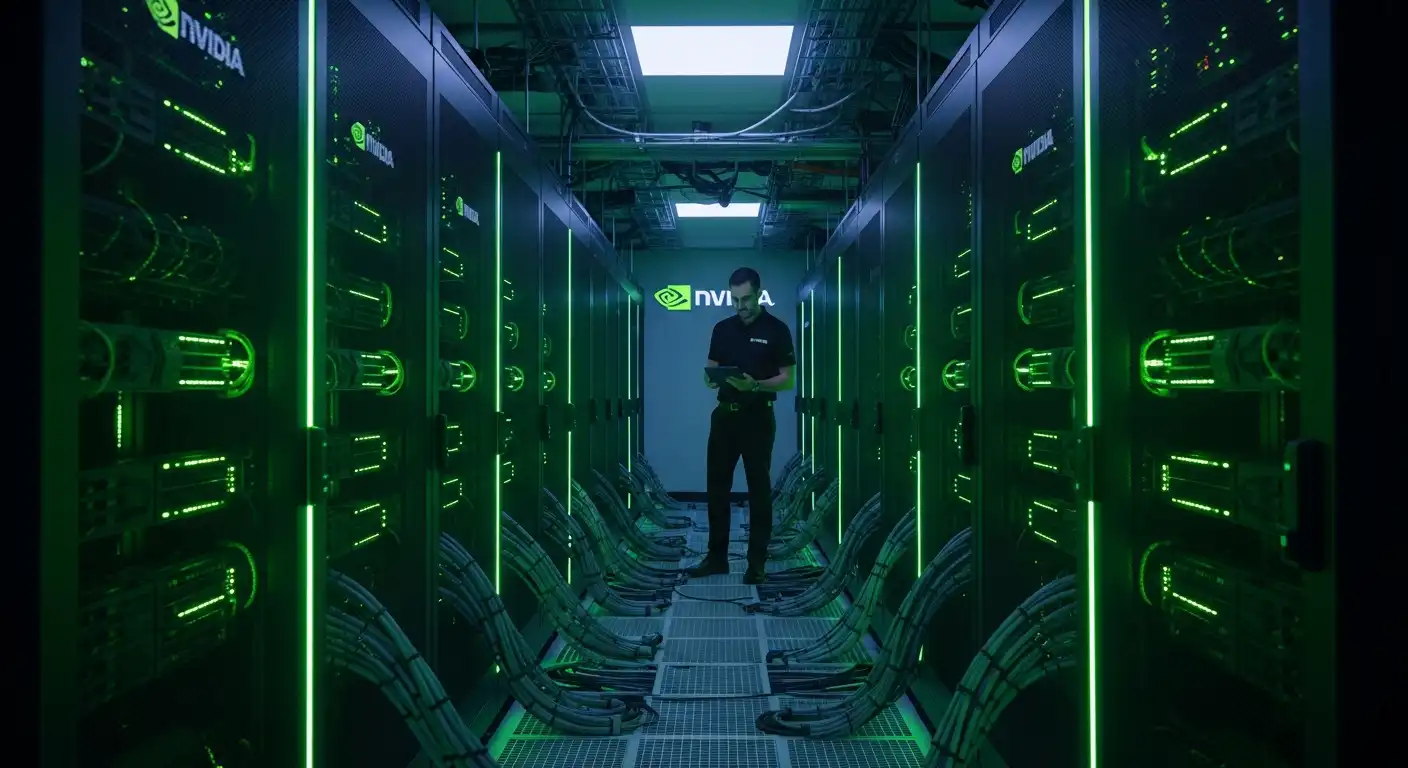
These cabinets house dozens of chips, cooling manifolds, and high-speed switches, acting as a single, giant, unified supercomputer.
The Vertical Compute Tray Design
Nvidia’s Kyber NVL144 is designed to be the flagship server cabinet of the upcoming 2027 Vera Rubin Ultra architecture. The system is designed to pack 144 of the company’s most advanced GPUs into a single, liquid-cooled cabinet, providing a massive increase in processing density compared to previous generations.
To achieve this extreme density, Nvidia’s engineers completely redesigned the physical layout of the server rack. In traditional server architectures, the compute trays containing the processors are mounted horizontally, stacked on top of each other like shelves in a cabinet.
The Kyber design, by contrast, rotates these trays to mount them vertically. This vertical configuration allows for much tighter physical packing and optimizes the flow of liquid coolant through the system, which is essential to manage the immense heat generated by 144 high-performance processors operating simultaneously.
The Complexity of the PCB Midplane
However, mounting compute trays vertically introduces a massive engineering challenge: how to connect them. In a standard horizontal server rack, compute trays are connected to high-speed networking switches using thousands of individual copper cable assemblies.
In a vertical, high-density system like the Kyber NVL144, the physical space required to route these thick cables simply does not exist.
To solve this routing bottleneck, Nvidia’s design utilizes a massive, passive printed circuit board (PCB) known as a midplane or an orthogonal backplane. The midplane acts as a solid, multi-layered electronic wall situated in the middle of the server cabinet.
The vertical compute trays plug directly into one side of this midplane, while the high-speed networking and switch modules plug directly into the opposite side.
This direct, board-to-board connection completely eliminates the need for physical cables, allowing data to flow directly through the copper traces laminated inside the midplane.
While the midplane design solves the physical cable routing problem, it introduces extreme manufacturing complexity. To carry high-speed NVLink signals at speeds of 448 gigabits per second without losing signal integrity, the midplane must be constructed with extraordinary precision:
- Layer Count and Lamination: The board is reported to consist of three separate, highly complex 26-layer PCBs that are laminated together under immense heat and pressure, resulting in a single, ultra-thick 78-layer composite board.
- Drilling and Aspect Ratios: Manufacturers must drill thousands of microscopic holes, known as microvias, through these 78 layers to establish electrical connections. Any minor misalignment during the drilling process will destroy the signal integrity, rendering the entire multi-thousand-dollar board useless.
- Impedance Control: To keep high-frequency signals from reflecting or degrading as they travel through the copper traces, the manufacturing impedance must be held within an incredibly tight tolerance of just 5%.
According to the SemiAnalysis report, it is the sheer physical difficulty of manufacturing these massive, 78-layer midplanes with consistent, high-yield rates that is causing the production bottlenecks, prompting claims of a year-long program slippage.
The Market Reaction: Slumping Asian Supply Chains
The speed at which these rumors traveled through the Asian markets on Monday, July 6, 2026, illustrates how tightly integrated and nervous the global technology supply chain has become.
Before Nvidia could issue its official clarification, stock prices of key component suppliers in Japan, Hong Kong, Taiwan, and South Korea plunged, reflecting deep investor sensitivity to any potential slowdown in the AI capital expenditure cycle.
The Slide in PCB and Laminate Manufacturers
The selloff was concentrated heavily among companies that manufacture high-end printed circuit boards and advanced laminates, the exact materials required to build Nvidia’s server backplanes.
- Ibiden Co. (Japan): As one of Nvidia’s largest and most critical PCB manufacturing partners, the Japanese company saw its stock price slide by as much as 10% during early Monday trading. Investors feared that any delay in the Kyber rack would delay Ibiden’s high-volume shipments of advanced server boards.
- Kingboard Laminates Holdings (Hong Kong): A major supplier of the specialized glass epoxy laminates used to build multi-layer circuit boards, Kingboard’s stock price tumbled by 18% in Hong Kong.
- Elite Material Co. (Taiwan): The prominent copper-clad laminate supplier saw its shares fall by 10% on the Taiwan Stock Exchange.
- Samsung Electro-Mechanics (South Korea): The company, which has spent the past year rapidly expanding its capacity to package high-end AI substrates, saw its shares slide by 11% in Seoul.
This rapid, coordinated decline across multiple Asian nations demonstrates that the AI hardware market is highly interconnected. A reported delay at a single layer of the server architecture—such as the PCB midplane—instantly disrupts the projected revenue streams of chemical suppliers, copper miners, laminate manufacturers, and advanced packaging firms across the globe.
The Vulnerability of a Priced-for-Perfection Market
The severe market reaction to the SemiAnalysis report highlights a broader structural risk in the technology sector. After years of continuous, record-breaking gains, AI-related stocks have built up massive valuations.
When a company like Nvidia or its core suppliers is trading at high multiples of trailing earnings, there is absolutely zero margin for error.
Investors are hyper-sensitive to any “marginal disruption” in the AI buildout. If a major platform launch is delayed by even a single quarter, it can push out the multi-billion-dollar capital expenditure plans of hyperscale cloud providers, creating a temporary revenue gap for suppliers down the line.
As a result, even unverified rumors can trigger massive, algorithmic selling, as institutional investors rush to lock in profits at the first sign of a supply chain bottleneck.
Nvidia’s Pushback and the Stabilization of NVDA
The rapid stabilization of Nvidia’s stock price on Monday afternoon demonstrates the immense power of official corporate communication in reclaiming control over market narratives.
By issuing a swift, direct email statement via Seeking Alpha and other financial news channels, Nvidia successfully neutralized the short-sellers who were attempting to capitalize on the delay rumors.
The simple assertion that the company’s product roadmap remains fully intact was enough to reassure institutional buyers, who quickly stepped in to purchase the dip, driving Nvidia shares back toward the $197 level.
This response is highly similar to the strategy Nvidia deployed in late 2024 and early 2025 during the initial rollout of its Blackwell architecture.
When early reports emerged claiming that Blackwell was facing manufacturing and design difficulties at TSMC, Nvidia initially downplayed the issues to stabilize market expectations.
While the company eventually worked closely with TSMC to redesign several layers of the Blackwell silicon and optimize its CoWoS-L packaging, the official narrative remained focused on steady execution.
This strategy allows Nvidia to protect its multi-billion-dollar capital moat. By maintaining absolute authority over its product timelines, the chipmaker can suppress the influence of external analysts and short-sellers, relying on the long-term trust of its primary customers—including Microsoft, Meta, Amazon, and Google—to maintain its dominant, 81% share of the global AI chip market.
Alternative Architectures: The Canceled NVL72x2 Stopgap
The SemiAnalysis report also highlighted another critical aspect of Nvidia’s server-level strategy: the reported cancellation of the NVL72x2 “back-to-back” rack architecture.
When semiconductor companies face manufacturing bottlenecks with a next-generation platform, they frequently design “stopgap” solutions using existing, mature hardware to tide customers over.
According to the analyst report, Nvidia’s planned stopgap for the transition to the Rubin Ultra generation was the NVL72x2, a massive, double-cabinet system that bolted together two current-generation Oberon racks to approximate the computing power of the upcoming Kyber system using existing copper cables.
However, the report claims that hyperscale cloud providers pushed back hard against this back-to-back design.
The NVL72x2 reportedly carried a highly awkward physical layout, occupied too much precious floor space in data centers, and placed an unsustainable power and cooling burden on existing infrastructure.
Faced with this customer resistance, Nvidia reportedly canceled the stopgap program entirely.
By axing this fallback option, Nvidia has placed all of its bets on the successful, on-time delivery of the vertical, liquid-cooled Kyber NVL144 system.
If the company does encounter future manufacturing bottlenecks with the 78-layer PCB midplane, it will not have a proven, large-scale stopgap solution ready to ship to customers.
This all-or-nothing approach increases the pressure on Nvidia’s supply chain partners to solve the midplane lamination and drilling challenges quickly, as any real delay could create a temporary competitive window for alternative AI platforms, such as AMD’s upcoming MI500 series or Google’s custom TPU v8i.
Conclusion and Future Outlook
The market volatility of July 6, 2026, serves as a vital reminder of the extreme complexity and high stakes of the global artificial intelligence infrastructure race. The swift denial from Nvidia has successfully stabilized the market, but the underlying technical challenges highlighted by the dispute remain highly real.
As the industry transitions to advanced liquid-cooled server racks and ultra-high-density vertical compute trays, the manufacturing boundaries of physical chemistry, signal integrity, and multi-layer lamination are being pushed to their absolute limits.
The era of simple chip design is over; the future of AI computing relies on the successful integration of complex, vertical server systems that couple GPU roadmaps, advanced packaging, and material science.
While short-term rumors will continue to create market volatility, Nvidia’s aggressive, annual product release cadence remains the primary engine driving the global technology sector.
As long as the company can maintain its tight execution, secure manufacturing capacity with partners like TSMC and Ibiden, and preserve the trust of its hyperscale clients, its position at the center of the AI revolution remains highly secure.
The road ahead is paved with incredibly complex, multi-layered copper and silicon, and the companies that can successfully manufacture these systems at scale will continue to dictate the terms of the global digital economy.