The global aerospace and defense sectors are entering a highly volatile, competitive era defined by an intense technological race between the United States and China. For over a decade, Space Exploration Technologies Corporation operated as the undisputed king of space transportation. By developing, mastering, and scaling reusable rocket technologies, the company pioneered an era of low-cost, high-frequency orbital access that competitors could not match. Today, that absolute American monopoly has officially been challenged.
In a comprehensive research note distributed to institutional clients, Wall Street brokerage firm Bernstein SocGen Group reiterated its positive investment outlook on SpaceX, maintaining its Outperform rating and $239 price target on the stock, which recently listed on the Nasdaq under the ticker SPCX. However, the firm’s analysts issued a serious, long-term warning: China has officially emerged as the company’s greatest competitive threat. The warning follows China’s successful recovery of a first-stage rocket booster, demonstrating that the country has solved the highly complex engineering challenges of orbital reusability.
The development has triggered significant market anxiety, dragging shares of SpaceX down by 3% to 5% to trade near its $135 to $138 initial public offering price floor, representing a painful 25% to 26% decline from its post-IPO peak near $220. Other prominent space equities, including Rocket Lab and AST SpaceMobile, also took heavy losses during the selloff. The market’s reaction proves that investors are beginning to realize that the technical barriers protecting the company’s rocket launch and satellite internet dominance are not permanent, setting up a high-stakes space race that will define the future of global communications and defense.
The New Space Race: Beijing Challenges SpaceX’s Reusability Monopoly
The primary catalyst driving this structural shift in investor sentiment is China’s successful recovery of an orbital-class rocket booster. On July 10, 2026, China’s state-supported space program launched its next-generation Long March 10B rocket from Hainan Island. After deploying its satellite payload into orbit, the first-stage booster successfully separated, performed controlled aerodynamic maneuvers through the upper atmosphere, and returned safely to a sea-based recovery platform approximately six minutes later.
This successful recovery came roughly six months earlier than Bernstein had originally projected, catching Western aerospace analysts by surprise. It proved that China has made significant progress in mastering the complex mathematics of retro-propulsion, guidance, and real-time flight path corrections.
The successful landing has shattered the historical narrative that rocket reusability is a uniquely American competitive moat. For years, Western analysts argued that state-owned, bureaucratic space agencies could never replicate the rapid, trial-by-fire engineering loops that allowed SpaceX to master booster recovery, but the Long March 10B success has proved that when backed by unlimited national resources, a sovereign space program can close the technology gap at a blistering pace.
The Innovative Net-and-Hook Recovery System
The technical details of China’s booster recovery reveal an extraordinary level of independent engineering innovation. While SpaceX’s Falcon 9 relies on heavy, deployable landing legs to touch down vertically on land-based zones or drone ships, the Chinese Long March 10B utilizes a completely different landing architecture.
The Chinese system uses a high-precision, sea-based “net-and-hook” capture platform. As the booster descends vertically toward the floating recovery barge, specialized mechanical arms equipped with high-tensile nets capture the rocket’s fuselage, hooking it securely in place before it can hit the deck.
This innovative approach eliminates the need for heavy, complex, and expensive landing legs on the rocket itself, reducing the total structural weight of the vehicle, maximizing the payload capacity of the first stage, and proving that China is developing its own unique, highly efficient path to orbital reusability.
Evaluating the Operational Gap: Why SpaceX Still Holds a Commanding Lead
While the successful landing of the Long March 10B is a major milestone, Bernstein’s analysts emphasize that China remains significantly behind SpaceX on an operational level. Recovering a single, prototype rocket booster in a highly controlled test is vastly different from running a commercial space transportation business that conducts hundreds of launches annually.
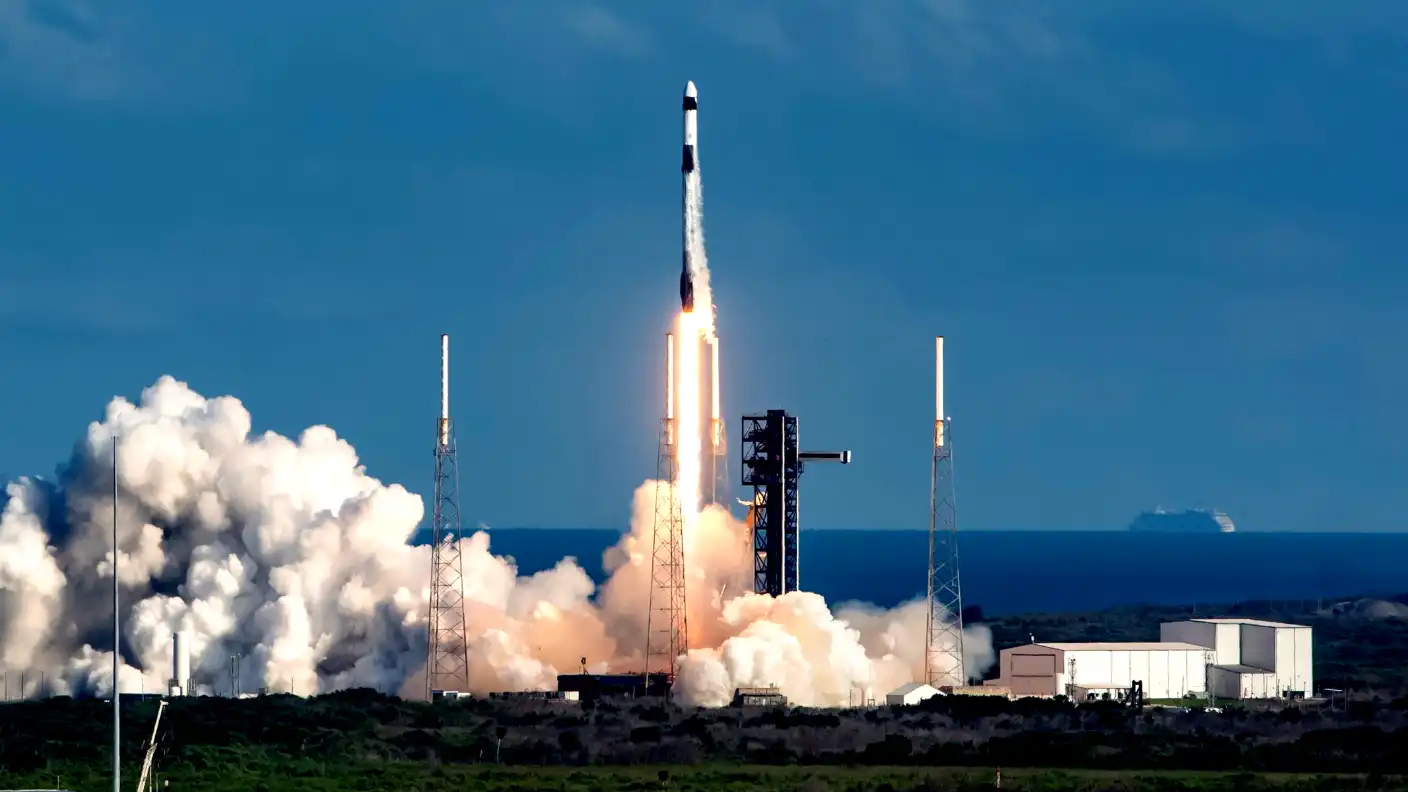
SpaceX has spent nearly ten years refining, scaling, and automating its booster recovery processes. The company’s workhorse Falcon 9 rocket has become the most successful launch vehicle in human history, completing a record-breaking 165 launches last year alone.
This incredible launch cadence allows SpaceX to amortize its manufacturing costs over dozens of flights per booster, delivering a cost-to-orbit structure that undercuts every other launcher in the world.
To challenge this dominance, China must move beyond single test flights to demonstrate rapid, reliable, and low-cost relaunch capabilities at an industrial scale.
The Limitations of First-Stage vs. Full Reusability
The technical gap between the two space programs becomes even more obvious when analyzing their respective technology roadmaps. The Long March 10B represents a first-generation reusable system, designed to recover only the first-stage booster while the expensive second stage is discarded in the ocean.
In contrast, SpaceX is actively testing its next-generation Starship launch system, which is designed for rapid, full reusability of both stages.
The Starship and its massive Super Heavy booster are engineered to fly, land, and relaunch within hours, completely redefining the economics of space travel.
If SpaceX successfully demonstrates full, rapid Starship reusability, it will reduce the cost of space logistics to less than $100 per kilogram, widening the technological gap with China once again and protecting its commercial launch monopoly for the foreseeable future.
The Challenge of High-Rate Manufacturing and Cadence
To match the operational capabilities of the American space giant, China must build out a massive, highly automated aerospace manufacturing infrastructure. Building a reusable rocket requires incredibly high-quality control standards, specialized metallurgy, and advanced robotic assembly lines.
Currently, China’s space program operates on a traditional, low-volume manufacturing model, producing a few dozen rockets annually.
To achieve the launch cadence required to deploy massive satellite networks, the Chinese space sector must transition to high-rate production, establishing standardized components, automated quality-control checks, and rapid turnaround maintenance facilities.
This transition is an incredibly complex engineering and economic challenge that will take years to complete, giving SpaceX a vital, multi-year window to cement its dominance.
The Geopolitical Scale: Why China’s State Resources Pose the Ultimate Threat
Despite the current operational gap, Bernstein argues that China poses the most credible, long-term threat to SpaceX because of its unlimited state resources and ambitious, long-term space goals. Unlike private Western aerospace startups that must constantly raise venture capital and answer to short-term Wall Street earnings expectations, China’s space program is backed by the entire financial and geopolitical power of the Chinese state.
The Chinese government has integrated space exploration and digital connectivity directly into its national development roadmaps, treating the space sector as a primary battleground for national security and geopolitical influence.
By funding massive, state-directed research institutes and coordinating private-sector tech companies, Beijing can execute long-term strategic plans without worrying about immediate profitability, making it an incredibly formidable competitor over a decade-long horizon.
The Two-Hundred Thousand Satellite LEO Constellation
The primary commercial battleground between the United States and China is the market for low-Earth orbit satellite broadband, currently dominated by SpaceX’s Starlink. Starlink has built a highly profitable first-mover advantage, with over 10 million active subscribers worldwide generating billions of dollars in high-margin recurring revenues.
To challenge this monopoly, China has launched its own ambitious sovereign satellite projects. In December, the Chinese government filed a comprehensive regulatory proposal with the International Telecommunication Union, outlining its plans to deploy more than 200,000 low-Earth orbit satellites across multiple constellations.
These state-supported networks are designed to provide alternative, low-cost digital connectivity to developing nations across Africa, Latin America, and Southeast Asia, directly challenging Starlink’s global expansion plans and turning satellite internet into a primary tool of digital diplomacy.
The Moon and Beyond: Crewed Lunar Landings and Permanent Research Stations
The geopolitical competition extends far beyond low-Earth orbit. China has launched an ambitious deep-space exploration roadmap that directly rivals NASA’s Artemis program, which relies heavily on SpaceX’s Starship HLS to land American astronauts on the moon.
China’s space agency has committed to executing its own crewed lunar landing by 2030, with plans to construct a permanent, international lunar research station near the moon’s south pole in collaboration with other nations.
By building this deep-space infrastructure, China is attempting to rewrite the rules of space commerce, claiming valuable lunar resource rights, establishing its own space-based navigation networks, and challenging the historic technological leadership of the United States.
Financial Performance and Valuation: Decoding the SpaceX Investment Thesis
The rising competition from China has introduced a healthy, necessary wave of financial discipline into the valuation of SpaceX stock. Since its historic public listing on June 12, the company’s share price has faced significant pressure, falling from its post-IPO peak near $220 to trade around its $135 floor.
While some bearish investors have labeled the stock a speculative bubble, pointing to its high price-to-sales multiple and the massive operational losses of its newly integrated xAI division, Bernstein SocGen Group has maintained its Outperform rating and $239 price target, arguing that the company’s long-term competitive advantages remain fully intact.
The bullish investment thesis relies heavily on the massive, recurring cash flows generated by Starlink. Unlike early-stage aerospace startups that rely entirely on high-risk rocket development, SpaceX has built a highly diversified business model.
The high-margin revenues from its global satellite internet business provide a reliable financial shield, allowing the company to fund the capital-intensive development of Starship internally, without relying entirely on volatile capital markets.
The New Space Race as a Growth Catalyst
Paradoxically, the intensifying technological competition with China serves as one of the most powerful, long-term growth catalysts for SpaceX. As the U.S. government and national security planners realize that Beijing is rapidly closing the technology gap, they will inevitably increase their support for domestic aerospace champions.
The Department of War, the National Security Agency, and NASA are highly likely to award massive, multi-billion-dollar contracts, research grants, and satellite communication licenses to SpaceX to protect American space-based national security.
This government-backed defense dividend will provide a highly stable, non-cyclical revenue base for the company, ensuring that even if commercial markets experience temporary slowdowns, the company’s financial future remains secure under the protective umbrella of national defense.
The successful de-risking of the space launch sector is a historic milestone for global commerce. By proving that rocket reusability is a viable, high-volume industrial reality, SpaceX has opened up an entirely new, multi-trillion-dollar space economy.
However, as the rapid progress of China’s Long March 10B demonstrates, maintaining a dominant lead in this fast-moving market requires constant, relentless innovation.
By continuing to advance its fully reusable Starship technology, scaling up its global Starlink constellation, and leveraging its strategic partnerships with the U.S. government, SpaceX is proving that it has the operational agility and technical depth needed to survive any competitive challenge, ensuring that the company remains the indispensable, primary gateway to the stars for decades to come.