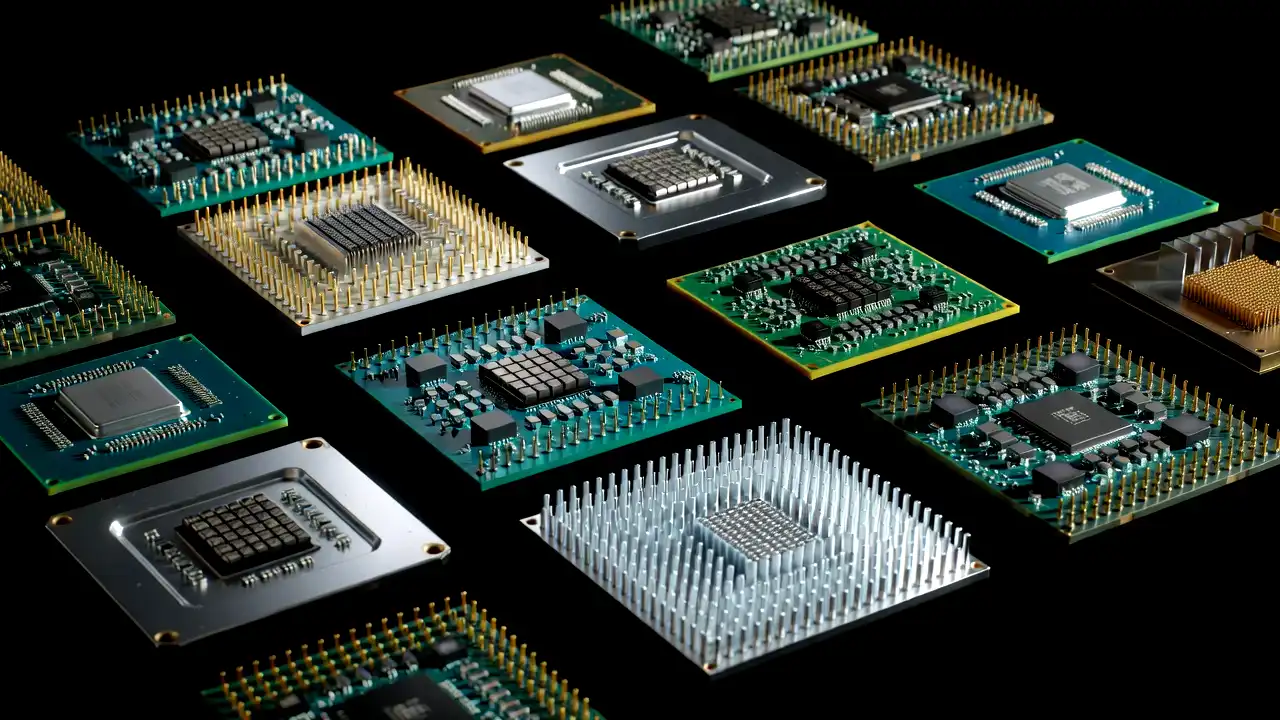
The global economy runs on silicon, and in 2026, the foundries that manufacture these chips are arguably the most important companies on Earth. As the demand for Generative AI, autonomous driving, and 6G connectivity reaches fever pitch, the “Chip War” has settled into a defined hierarchy of manufacturing powerhouses. While many design chips, only a select few possess the colossal capital and technical wizardry required to actually build them.
In 2026, the market is defined by a race to the bottom—in nanometers, that is—with leading-edge 2nm processes entering mass production. However, the battle for “legacy nodes” (older, essential chips for cars and appliances) remains just as fierce. Based on revenue, capacity, and technological reach, here are the top 5 semiconductor foundries dominating the market in 2026.
Taiwan Semiconductor Manufacturing Company Limited (TSMC)
TSMC remains the undisputed king of the semiconductor world, controlling over 60% of the global foundry market and serving as the exclusive manufacturer for tech giants like Apple, NVIDIA, and AMD. In 2026, their dominance is solidified by the successful mass production of their N2 (2-nanometer) technology, which offers unprecedented performance and power efficiency.
This company is the technological heartbeat of the modern world, maintaining a near-monopoly on the most advanced chips used in AI and high-performance computing. Their market leadership in 2026 is driven by:
- Technological Supremacy: TSMC continues to lead the pack in transistor density and power efficiency, with high yield rates on their 3nm and 2nm nodes that competitors struggle to match.
- The AI Boom: As the primary manufacturer for NVIDIA’s latest AI accelerators, TSMC captures the vast majority of value created by the generative AI revolution.
- Global Expansion: By 2026, TSMC’s new fabs in Arizona (USA), Kumamoto (Japan), and Dresden (Germany) are operational, diversifying their footprint and easing geopolitical concerns.
- Advanced Packaging: Their CoWoS (Chip-on-Wafer-on-Substrate) advanced packaging technology remains the industry standard, allowing customers to stack chips for maximum performance.
Key Focus: Leading-edge logic (2nm/3nm) for AI, smartphones, and HPC (High-Performance Computing).
Samsung Electronics Co., Ltd. (Samsung Foundry)
Samsung Foundry is the only other player in the world capable of competing with TSMC at the leading edge of physics, holding a firm second place in market share. Leveraging the massive resources of the Samsung conglomerate, they have bet the farm on Gate-All-Around (GAA) transistor architecture to try to leapfrog their Taiwanese rival.
In 2026, Samsung’s strategy focuses on being the “one-stop shop” for customers, offering memory, logic, and packaging all under one roof. Their key strengths include:
- Gate-All-Around (GAA) Leadership: Samsung was the first to implement GAA (Multi-Bridge-Channel FET), giving them a maturity advantage in this specific architecture as the industry moves beyond FinFET.
- Integrated Device Manufacturer (IDM) Synergy: Unlike pure-play foundries, Samsung can package its HBM (High Bandwidth Memory) directly with logic chips, a crucial advantage for AI hardware clients.
- Aggressive Pricing: To capture market share from TSMC, Samsung continues to offer competitive pricing structures, attracting second-source contracts from major fabless companies.
- US Capacity: Their massive new fab in Taylor, Texas, is fully online in 2026, serving as a critical hub for North American clients in aerospace and mobile.
Key Focus: Advanced nodes (3nm/2nm GAA), memory-logic integration, and competitive second-sourcing.
GlobalFoundries Inc. (GlobalFoundries)
Having wisely bowed out of the incredibly expensive “nanometer race” years ago, GlobalFoundries (GF) has secured a highly profitable and stable third place by focusing on feature-rich, specialized chips. They are the masters of the “essential” chips—the ones that manage power in your phone, connect your car to the internet, and drive IoT devices.
By 2026, GF has cemented itself as the trusted partner for the automotive and defense sectors, particularly in the United States and Europe. Their distinct advantages are:
- Specialized Technologies: They excel in FD-SOI (Fully Depleted Silicon On Insulator), a technology perfect for low-power, radio-frequency (RF), and automotive applications where battery life matters more than raw processing speed.
- Geopolitical Trust: As a US-headquartered company with a global footprint (US, Germany, Singapore), GF is a primary beneficiary of the US CHIPS Act and a preferred partner for government and defense contracts.
- Automotive Dominance: With cars becoming data centers on wheels, GF’s specialized nodes for sensors, power management, and connectivity are in higher demand than ever.
- Long-Term Agreements: GF has locked in diverse, long-term supply agreements with major automakers and industrial giants, insulating them from consumer electronics volatility.
Key Focus: Feature-rich chips for automotive, IoT, 5G/6G connectivity, and aerospace/defense.
United Microelectronics Corporation (UMC)
Based in Taiwan, UMC is the steady, reliable workhorse of the semiconductor industry, maintaining a strong hold on the fourth position. While they do not compete on the bleeding edge, their mastery of mature nodes (22nm to 28nm and above) makes them indispensable for the vast majority of consumer electronics and industrial controllers.
In 2026, UMC continues to profit from the structural shortage of mature capacity, as few new fabs are built for older technologies despite rising demand. Their strengths include:
- Mature Node Efficiency: UMC has fully depreciated many of its factories, allowing them to produce chips at a very low cost while maintaining high profit margins.
- Diversified Portfolio: They produce a massive variety of display drivers, power management ICs, and microcontrollers found in everything from smart fridges to electric vehicles.
- Partnership with Intel: Their strategic collaboration with Intel (co-developing 12nm platforms) has given UMC access to new capacities and technologies without massive capital expenditure.
- Singapore Expansion: Their expanded capacity in Singapore helps service global clients who require supply chain redundancy outside of Taiwan.
Key Focus: Mature logic nodes, display drivers, power management, and industrial microcontrollers.
Semiconductor Manufacturing International Corporation (SMIC)
Despite facing severe export controls and sanctions from the United States, SMIC remains the dominant foundry in China and a top 5 global player by sheer volume of domestic demand. In 2026, SMIC serves as the backbone of China’s push for technological self-sufficiency, supplying the vast internal market for smartphones, EVs, and consumer IoT.
SMIC has demonstrated surprising resilience, managing to produce 7nm-class chips using older DUV lithography techniques to keep China’s tech sector competitive. Their position is defined by:
- Captive Domestic Market: As the Chinese government mandates “Buy China” policies, SMIC has a guaranteed, massive customer base that international competitors cannot touch.
- Subsidized Growth: Massive state funding allows SMIC to expand capacity and R&D aggressively, even when profitability would be impossible for a free-market player.
- Legacy Node Volume: While high-end tech grabs headlines, SMIC pumps out enormous volumes of legacy chips for the world’s largest manufacturing economy.
- Technological Workarounds: They have developed expertise in pushing mature equipment to its absolute limits, achieving transistor densities that defy restriction efforts.
Key Focus: Domestic Chinese market supply, legacy nodes, and sanction-resistant manufacturing techniques.
Conclusion
The semiconductor landscape of 2026 is clearly stratified. At the top, TSMC and Samsung fight a duel of physics for the AI future. In the middle, GlobalFoundries and UMC provide the specialized and mature chips that keep the physical world running. Meanwhile, SMIC operates in its own parallel ecosystem, fueled by national interest. For investors and supply chain managers, understanding this hierarchy is essential for navigating the digital economy.