Key Points:
- Chinese electric-truck startup Windrose Technology is facing severe legal and financial turbulence amid multiple unpaid wage claims.
- A US federal judge ordered Windrose to pay former executive Jason Gies over $400,000 in unpaid wages and benefits.
- Former director Kyle Maki previously accused the company of running out of money and falling 90 days past due on employee payroll.
- Despite mounting legal disputes, founder and CEO Wen Han has denied insolvency claims while actively pursuing global expansion.
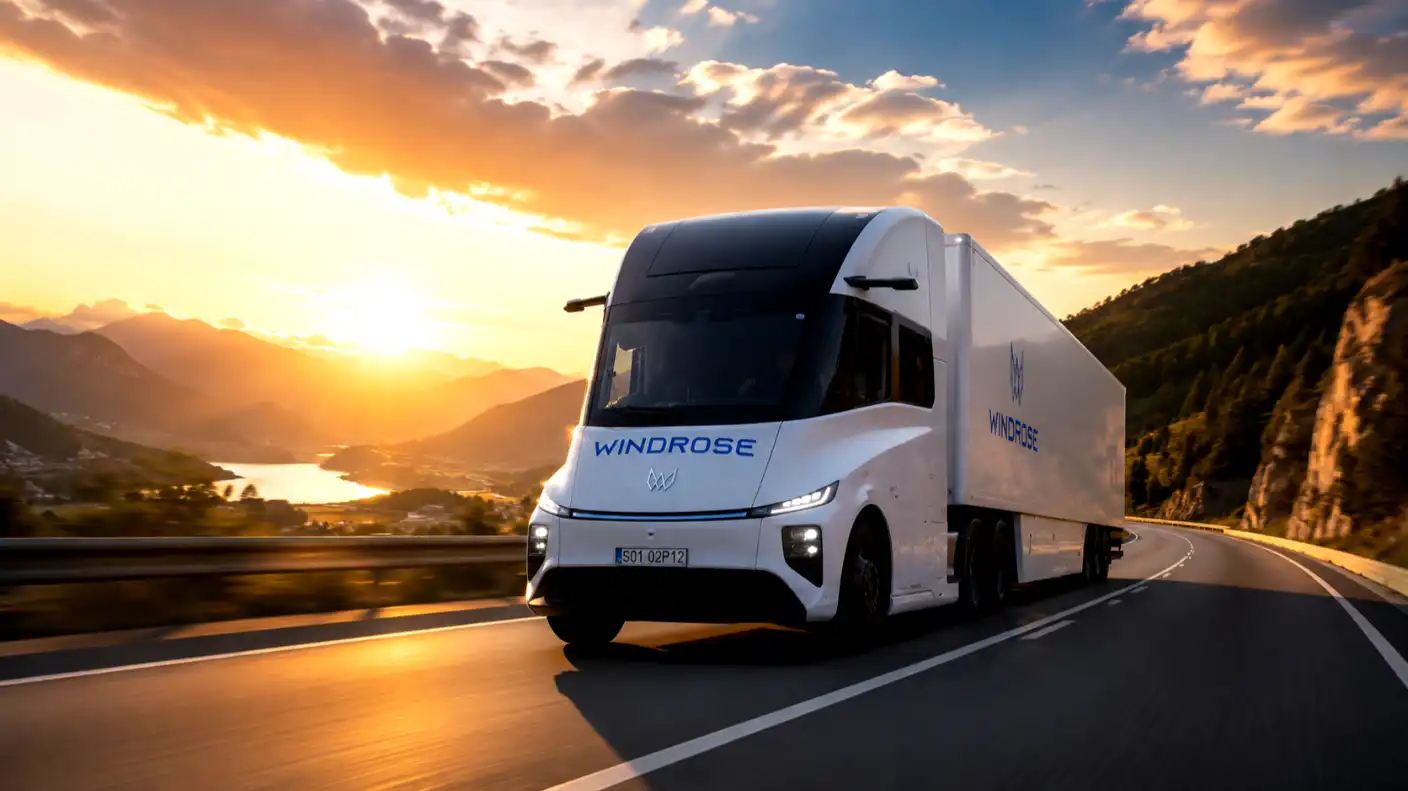
The high-stakes race to electrify the global heavy-duty trucking industry has turned highly volatile for one of its most ambitious newcomers. According to a detailed report from Nikkei Asia, Chinese electric semi-truck startup Windrose Technology is currently facing a series of damaging unpaid wage claims and accusations of severe financial distress. Led by charismatic, Stanford-educated founder and CEO Wen Han, the company has pitched its China-built electric big rigs as affordable, direct competitors to Tesla’s highly anticipated Semi. However, a series of high-profile lawsuits and public allegations from former executives suggest that the startup’s rapid-fire international expansion is actively outrunning its actual cash reserves.
The most severe legal blow to the startup’s reputation occurred in a U.S. District Court in Michigan earlier this year. Jason Gies, a former Windrose executive who left the company to join Tesla’s rival Semi program, filed a lawsuit against the firm for unpaid wages and benefits. In January, a federal judge ruled in Gies’s favor, ordering Windrose to pay him more than $400,000 in outstanding compensation. While the judgment represents a binding federal order, Windrose has yet to pay Gies. CEO Wen Han recently confirmed that the company has opted not to pay the judgment immediately, choosing instead to file a formal appeal against the court’s verdict.
The Gies lawsuit is not an isolated incident; it follows a highly public and damaging payroll scandal that previously erupted in late 2025. Kyle Maki, who served as Windrose’s Director of Customer Success and Operations, took to LinkedIn to accuse the company of falling 90 days past due on employee payroll. Maki painted a grim picture of the startup’s internal reality, claiming that the development team had been working out of a small caravan for two months because Windrose had lost access to its offices due to unpaid rent. He also claimed that the company’s vehicle cabs had been left stranded at the Port of Los Angeles because the firm could not afford to pay the outstanding shipping bills.
Wen Han strongly rejected Maki’s claims of insolvency, asserting that the startup is not facing financial difficulties. He blamed the payroll delays on administrative complications linked to a transition between payroll partners, noting that the firm’s legal headquarters in Belgium and capital holdings in China made paying U.S. staff highly complex. Han claimed that the company resolved those issues and that all active salaries are currently being paid on time. However, the public airing of the company’s financial laundry has left a persistent cloud of skepticism hanging over the startup’s broader credibility in the competitive U.S. and European markets.
To understand how a young startup could face such intense cash constraints, one must look at Windrose’s unique, asset-light manufacturing model. Unlike traditional automotive giants or even heavily funded EV rivals like Tesla, Windrose does not own or operate its own manufacturing plants in China. Instead, the company relies entirely on contract manufacturing agreements with established Chinese automotive firms, including Anhui Jianghuai Automobile (JAC) and Higer Bus. While this asset-light strategy allows the company to develop vehicles such as its flagship Global E700 semi-truck with a relatively small team of 150 employees, it also leaves it highly vulnerable to sudden supplier price shifts.
Adding to the startup’s operational challenges is the highly volatile geopolitical trade environment. The United States currently imposes a minimum 30% import tariff on Chinese-built electric vehicles under a fragile 90-day trade truce reached in mid-May. For Windrose, which builds its heavy-duty trucks in China, shipping fully assembled rigs across the Pacific has become financially impossible, with some early shipments incurring tariff rates exceeding 50%. To bypass these massive trade barriers, Han’s company is currently refurbishing an old assembly plant in California, scheduled for completion in July, where workers will assemble Chinese-manufactured chassis using imported battery cells.
Despite these rising import and manufacturing costs, Windrose has launched an aggressive, highly optimistic price-cutting strategy to stimulate consumer demand. In April, the company announced on LinkedIn that it had reduced the entry-level price of its Global E700 semi-truck from €250,000 to just €195,000 (roughly $180,000 in the United States and £139,000 in the United Kingdom). Han claimed that the price cut aims to accelerate the adoption of electric heavy goods vehicles and to reach diesel parity more quickly. While larger competitors like Nikola and Tesla have allocated over $1 billion to independent heavy-duty hydrogen and electric-truck development programs, Windrose must operate on a highly constrained budget. Some industry analysts warn that selling high-capacity electric trucks for less than $180,000. At the same time, individual battery cells remain so expensive that it is a highly risky gamble that could ultimately deepen the company’s losses.
The financial viability of such low prices remains highly questionable due to the extreme cost of modern heavy-duty batteries. The Global E700 requires a massive, high-performance 729-kilowatt-hour (kWh) battery pack—sourced from Chinese suppliers like CALB and EVE Energy—to deliver its promised 670-kilometer single-charge operating range. Because battery cells represent the single most expensive component of an electric truck, manufacturing these massive packs requires an incredible amount of capital. Even a minor 1.5% increase in global lithium or cobalt prices can add thousands of dollars to a vehicle’s production costs, making a low-margin pricing model highly dangerous for a cash-strapped startup.
To secure its long-term financial survival, Windrose is aggressively expanding its European presence, establishing its headquarters in the Belgian logistics hub of Antwerp earlier this year. The company is actively looking to build a dedicated European assembly plant at the Port of Antwerp-Bruges, while targeting France for a potential third assembly facility. By establishing these localized, European assembly lines, the company hopes to secure direct access to the European Union’s massive logistics corridors, which represent a highly lucrative, multi-billion-dollar market opportunity as regional logistics firms seek to decarbonize their fleets.
Ultimately, the ongoing wage claims and legal battles at Windrose Technology highlight the immense physical challenges facing young clean-tech startups. While the vision of delivering a cheap, long-haul electric truck capable of challenging Tesla’s Semi remains highly compelling, executing such an ambitious, three-continent strategy requires a massive, highly predictable capital base. As Wen Han and his legal team work to appeal the $400,000 Gies judgment over the coming months, the startup must quickly secure additional private capital to support its assembly plants, prove its financial solvency to skeptical corporate buyers, and ensure that its ambitious global roadmaps do not collapse under the weight of unpaid bills.