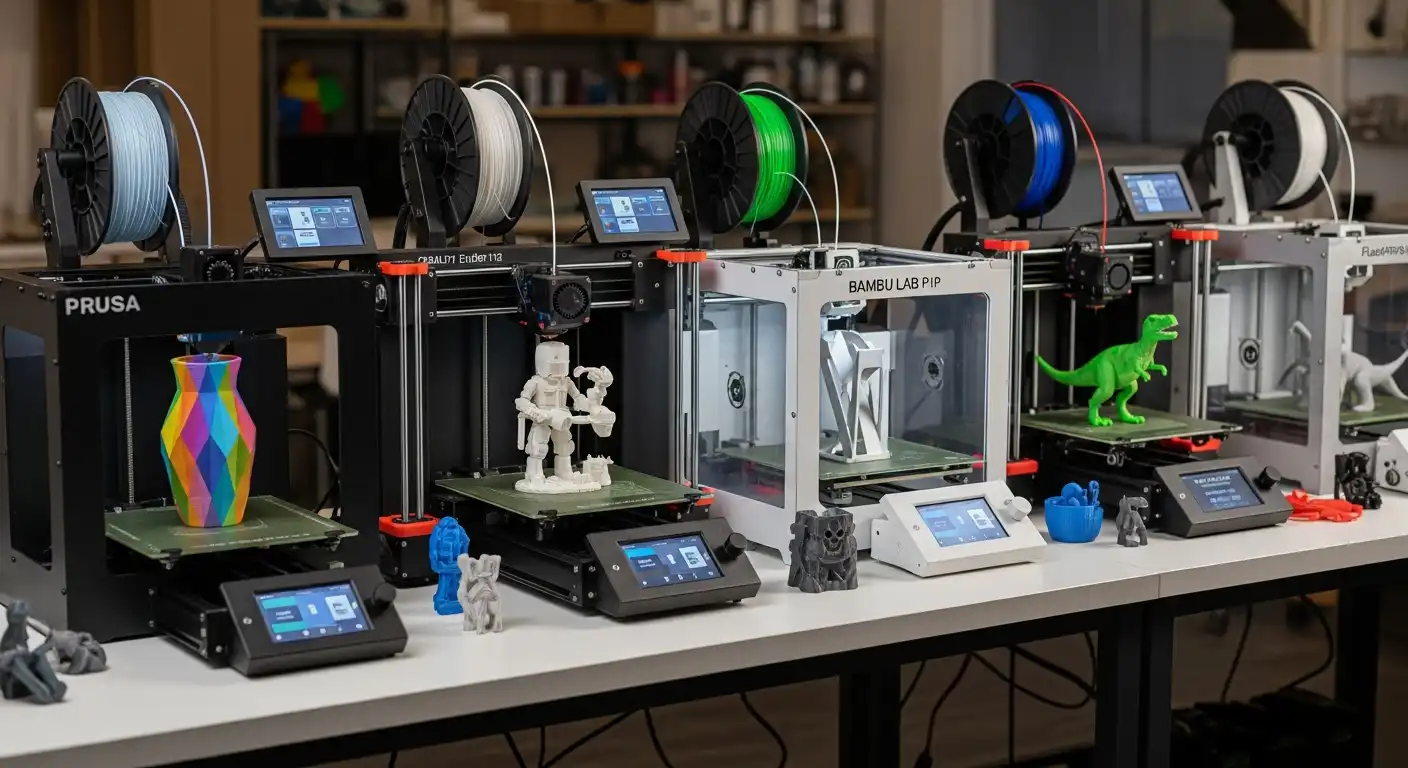
The world of 3D printing has undergone a stunning transformation. What was once a niche, complex, and expensive technology for engineers and hobbyists has become a user-friendly, affordable, and incredibly powerful tool for the home. The ability to turn a digital file into a physical object—a custom-designed part, a piece of art, a useful household gadget—is now at our fingertips.
The consumer-grade 3D printers of 2026 are defined by their incredible speed, ease of use, and intelligent, AI-assisted features that make printing more reliable than ever. To help you choose the right machine to bring your ideas to life, here are the top 5 consumer-grade 3D printers that are leading the market.
Bambu Lab P1S / P1X Series
Bambu Lab completely disrupted the consumer 3D printing market by bringing industrial-grade speed and reliability to a user-friendly, out-of-the-box experience. Their P1 series is the perfect workhorse for both beginners and experienced makers.
This printer is for users who want to spend more time printing and less time tinkering, delivering phenomenal speed and quality with minimal setup.
- Blazing-Fast Speed: Using a CoreXY motion system and advanced vibration compensation, it can print high-quality models up to 5x faster than traditional “bed slinger” printers.
- Enclosed for Advanced Materials: The fully enclosed design helps to maintain a stable temperature, which is crucial for printing with more demanding materials like ABS and ASA without warping.
- AMS for Multi-Color Printing: Its standout feature is the optional Automatic Material System (AMS), which allows the printer to automatically switch between up to four different colors or materials in a single print.
- Out-of-the-Box Experience: It arrives almost fully assembled and pre-calibrated, letting you go from unboxing to your first print in under 20 minutes.
Best For: Hobbyists, prototypers, and small businesses seeking a fast, reliable, easy-to-use printer with powerful multi-color capabilities.
Prusa MK4 / MK5
The Original Prusa series, designed by Josef Prusa, is the legendary, open-source champion of the maker community. It is renowned for its exceptional print quality, rock-solid reliability, and a fanatical dedication to detail and user support.
While it may not be the fastest printer on the market, its “it just works” reputation and unwavering print consistency make it a beloved workhorse.
- Unmatched Reliability and Print Quality: Prusa printers are renowned for producing beautiful, dimensionally accurate prints time after time with minimal fuss.
- Fully Automatic Bed Leveling: Features a next-generation “Load Cell Sensor” that delivers a perfectly calibrated first layer automatically every time.
- Open Source with a Massive Community: Being fully open source, it has a large, helpful global community, and all components and firmware are user-serviceable and upgradeable.
- Nextruder and Input Shaping: The modern extruder system and firmware features, such as Input Shaping (to reduce ringing) and Pressure Advance, ensure high-quality prints even at higher speeds.
Best For: Tinkerers, makers, and anyone who values reliability, print quality, and the principles of the open-source community above all else.
Creality K1C
Creality has long been the leader in the budget 3D printing market, and its K1 series represents a powerful entry into the high-speed, CoreXY printer segment. The K1C is a refined version that is built for speed and versatility.
This printer is the ideal choice for the budget-conscious user who wants the incredible speed of a Bambu Lab printer at a more accessible price point.
- Incredible Speed-to-Price Ratio: Offers a fully enclosed CoreXY printer capable of speeds up to 600 mm/s at a price often significantly lower than competitors’.
- “C” for Carbon Fiber and Clog-Free: The “C” version features an all-metal hotend with a hardened steel nozzle, enabling printing of abrasive, carbon-fiber-reinforced filaments right out of the box.
- AI Lidar and Camera: Includes an AI-powered lidar sensor that scans the first layer for imperfections and a built-in camera for remote monitoring and AI-powered failure detection.
- Creality OS and Slicer: The ecosystem is powered by a user-friendly Klipper-based operating system and the “Creality Print” slicer, which are easy for beginners to use.
Best For: Budget-conscious makers and hobbyists who want a high-speed, enclosed printer with advanced features without breaking the bank.
Elegoo Neptune 4 Pro
For those who still love the classic “bed slinger” design and the affordability it brings, the Elegoo Neptune series has become a dominant force—the Neptune 4 Pro packs an incredible number of modern, high-speed features into a very affordable package.
It demonstrates that you don’t need a CoreXY system to achieve impressive speeds and is ideal for beginners who want to learn the basics.
- Klipper Pre-Installed: A huge advantage at this price point. It comes with Klipper firmware pre-installed, enabling high-speed printing features such as Input Shaping and Pressure Advance, which were once reserved for advanced users.
- Direct Drive Extruder: Features a dual-gear direct-drive extruder that provides excellent filament control and is ideal for printing flexible materials like TPU.
- Rapid Bed Heating: The high-power heated bed features a segmented heating design, enabling the center printing area to heat up faster.
- Unbeatable Value: Delivers a feature set and print speed that is almost unheard of at its price, making it one of the best value propositions in 3D printing.
Best For: Beginners, hobbyists on a tight budget, and anyone who wants to experience the benefits of high-speed Klipper printing at a very low entry cost.
Anycubic Photon Mono M7 Pro (or successor)
While the other printers on this list use filament (FDM), this final entry is for resin (SLA/DLP) printing. Resin printers are used to create incredibly detailed, high-resolution models that are perfect for miniatures, jewelry, and prototypes. Anycubic is a leader in this space.
The Photon series is renowned for its combination of high resolution, fast print speeds, and user-friendly features.
- Incredible Detail and Resolution: Uses a high-resolution monochrome LCD screen to cure liquid resin layer by layer, producing models with a level of detail that is impossible to achieve with FDM printers.
- Fast Printing Speeds: A monochrome screen enables much faster layer cure times than older RGB screen technology.
- Intelligent Features: Modern resin printers often include features like automatic resin feeding, air heaters to maintain optimal temperature, and an air purifier to reduce odors.
- Improved User Experience: Features such as a laser-engraved build plate for improved adhesion and a larger, more intuitive touchscreen make the printing process easier and more reliable.
Best For: Miniature painters, jewelry designers, and anyone who needs to produce small, highly detailed, and smooth-surface models.
Conclusion
The consumer-grade 3D printer of 2026 is a mature, powerful, and accessible tool that is no longer just for the dedicated hobbyist. The “best” printer is the one that aligns with your goals and budget. For a seamless, high-speed experience, the Bambu Lab P1 series is a game-changer. For ultimate reliability and open-source spirit, the Original Prusa is a legend. For speed on a budget, the Creality K1C is a powerful contender. For an incredible value, the Elegoo Neptune 4 Pro is unmatched. And for breathtaking detail, a resin printer like the Anycubic Photon is the perfect choice.
By choosing one of these incredible machines, you’re not just buying a printer; you’re gaining the power to turn your digital imagination into a physical reality.