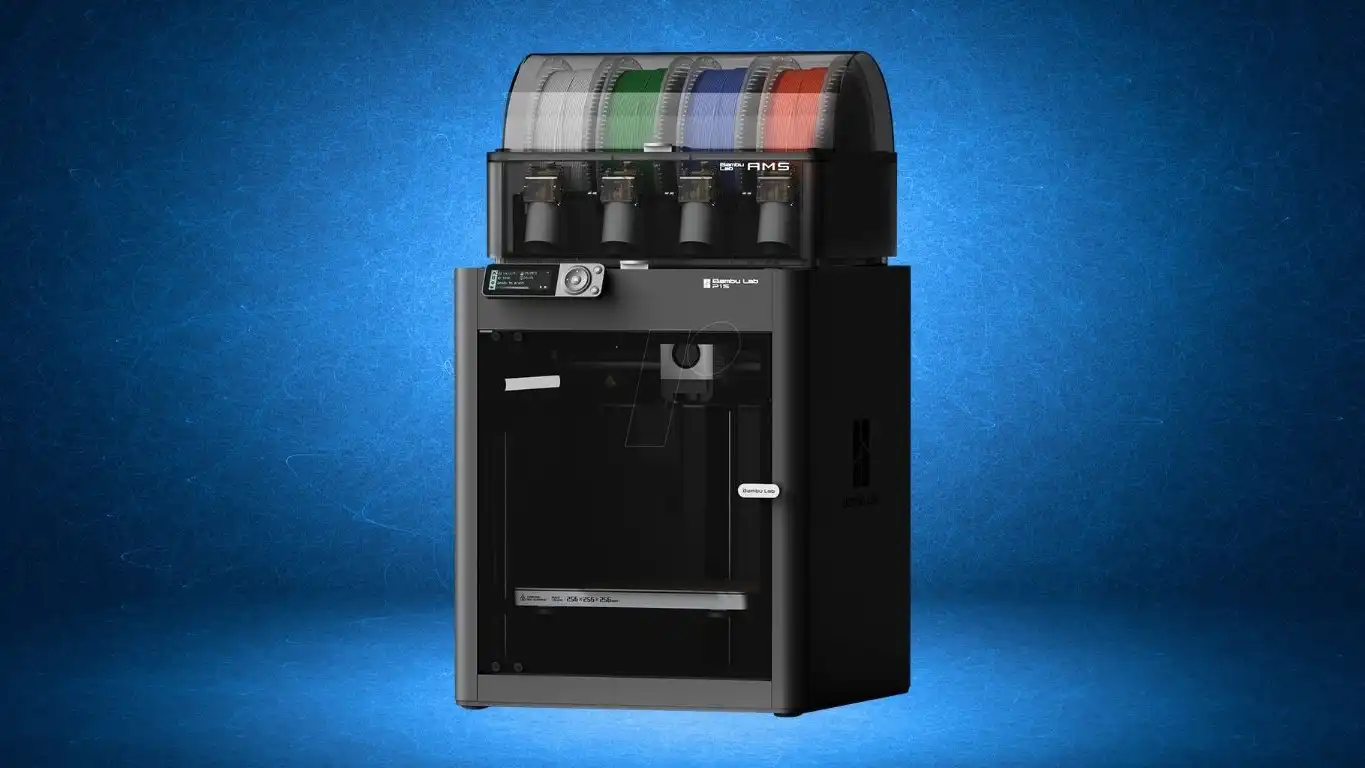
For years, the 3D printing hobby was defined by a choice: spend thousands on an industrial machine, or buy a budget kit and spend half your life tinkering with it. Bambu Lab shattered this dichotomy with the release of the X1 Carbon, but it was the Bambu Lab P1 Series (P1P and P1S) that truly democratized high-speed, reliable printing.
The Bambu Lab P1S is essentially the “Goldilocks” printer of the current market. It takes the core kinematics of the flagship X1C, strips away the expensive AI features, and packages it into an enclosed unit that costs a fraction of the price. In this review, we analyze whether the P1S is the ultimate “it just works” machine for makers, or if the cost-cutting measures went too far.
What is the Bambu Lab P1 Series?
The P1 Series is Bambu Lab’s mid-range offering, designed to bridge the gap between open-frame bed slingers and high-end industrial enclosures. While the P1P (the earlier open-frame model) disrupted the market, the P1S is the refined, fully enclosed evolution that opens the door to engineering materials.
This printer is built on a CoreXY motion system, which keeps the bed stationary (mostly) while the print head moves rapidly on the X and Y axes. This architecture allows for speeds that were previously unimaginable in consumer printers, effectively changing the standard for what users expect from a desktop machine.
- CoreXY Kinematics: Allows for blindingly fast print speeds up to 500mm/s.
- Fully Enclosed: The P1S comes with side panels and a glass door, essential for temperature control.
- AMS Compatible: Works seamlessly with the Automatic Material System for multi-color printing.
Key Features and Specifications
Bambu Lab has packed the P1S with hardware that punches well above its weight class, offering performance metrics that rival machines costing three times as much. The focus here is on mechanical reliability and speed rather than the flashy AI sensors found in the X1 series.
Speed and Motion System
The headline feature of the P1S is undoubtedly its speed; it can print a standard #3DBenchy boat in under 20 minutes with impeccable quality. By utilizing carbon fiber rods for the X-axis and a lightweight print head, the machine achieves acceleration rates that eliminate the bottleneck of travel time.
- 500 mm/s Max Speed: Drastically reduces print times for large prototypes.
- 20,000 mm/s² Acceleration: Ensures the printer reaches top speed almost instantly.
- Vibration Compensation: Active input shaping algorithms cancel out “ghosting” artifacts at high speeds.
Enclosure and Cooling
Unlike its predecessor, the P1P, the P1S comes fully enclosed right out of the box, which is a game-changer for printing materials prone to warping. To manage the heat within this chamber, Bambu Lab has upgraded the cooling solution to include a dedicated auxiliary part cooling fan and a chamber regulator fan.
- Activated Carbon Filter: Helps reduce the odors (VOCs) associated with melting plastics like ABS.
- Auxiliary Part Cooling Fan: A massive side-mounted fan that blasts air on the print to cool layers instantly during high-speed moves.
- Chamber Temperature Regulation: The closed loop allows for printing ABS, ASA, and PA (Nylon) without warping.
The AMS: Multi-Color Printing for Everyone
One of the most revolutionary aspects of the Bambu ecosystem is the seamless integration of the Automatic Material System (AMS). This add-on unit sits on top of the printer and allows the P1S to switch between four different filaments automatically, unlocking multicolor printing and soluble support interfaces.
While multi-material printing used to be a nightmare of dual-extruders and calibration, the AMS makes it “click and print.” The system handles the loading, unloading, and cutting of filament on its own, though it does generate “poop” (purged filament waste) during color changes.
- 4-Color Printing: Mix and match colors or materials (e.g., PLA supports for PETG) in a single print.
- Humidity Protection: The AMS acts as a dry box, keeping your filament crisp and dry.
- RFID Detection: Automatically detects Bambu Lab spools to set the correct print parameters without user input.
Usability and Software
While the hardware is impressive, the software ecosystem is what truly sets Bambu Lab apart from the disjointed workflows of competitors like Creality or Prusa. Using Bambu Studio (the desktop slicer) and the Bambu Handy mobile app feels modern and polished, offering a cloud-based workflow that lets you start prints from anywhere.
However, the on-device interface is where the budget cuts become obvious. Unlike the beautiful touchscreen on the X1 Carbon, the P1S uses a small, monochrome LCD screen with a directional pad that feels like it belongs in the 1990s.
- Bambu Studio: A robust slicer based on PrusaSlicer but optimized for network control and multi-color painting.
- Bambu Handy App: Allows you to monitor the built-in 720p camera and stop prints remotely if they fail.
- The Onboard Screen: A low-resolution text interface that is clunky to navigate, forcing users to rely on the app.
Pros and Cons
The P1S is arguably the best value printer on the market, but it is not without its compromises. To hit this aggressive price point, Bambu Lab had to sacrifice the “premium” feel of the interface and some of the automated calibration features found in the X1 series.
Pros:
- Plug-and-Play: Requires almost zero assembly or tuning out of the box; it just works.
- Incredible Speed: Delivers production-level speed without sacrificing surface quality.
- Material Versatility: The enclosure allows for printing advanced engineering materials like ABS and ASA.
- Ecosystem: The integration with the AMS and mobile app is seamless and user-friendly.
Cons:
- Terrible Screen: The outdated onboard display is difficult to use and feels cheap.
- Noise Level: Between the high-speed fans and the motor movements, this printer is quite loud.
- Proprietary Parts: The hotend and nozzle are proprietary, making them harder to source than generic nozzles.
- Walled Garden: The cloud-based nature of the software raises some privacy concerns for enterprise users.
Conclusion
The Bambu Lab P1S is a triumph of engineering and value. It effectively renders the vast majority of “bed slinger” printers obsolete by offering CoreXY speed and reliability at a mid-range price point.
If you are a hobbyist who wants to print multi-color models, or a small business needing a reliable workhorse for ABS parts, the P1S is the clear choice. While you lose the AI spaghetti detection and fancy touchscreen of the X1 Carbon, the P1S delivers 95% of the performance for half the price. It is, quite simply, the new benchmark for consumer 3D printing.