

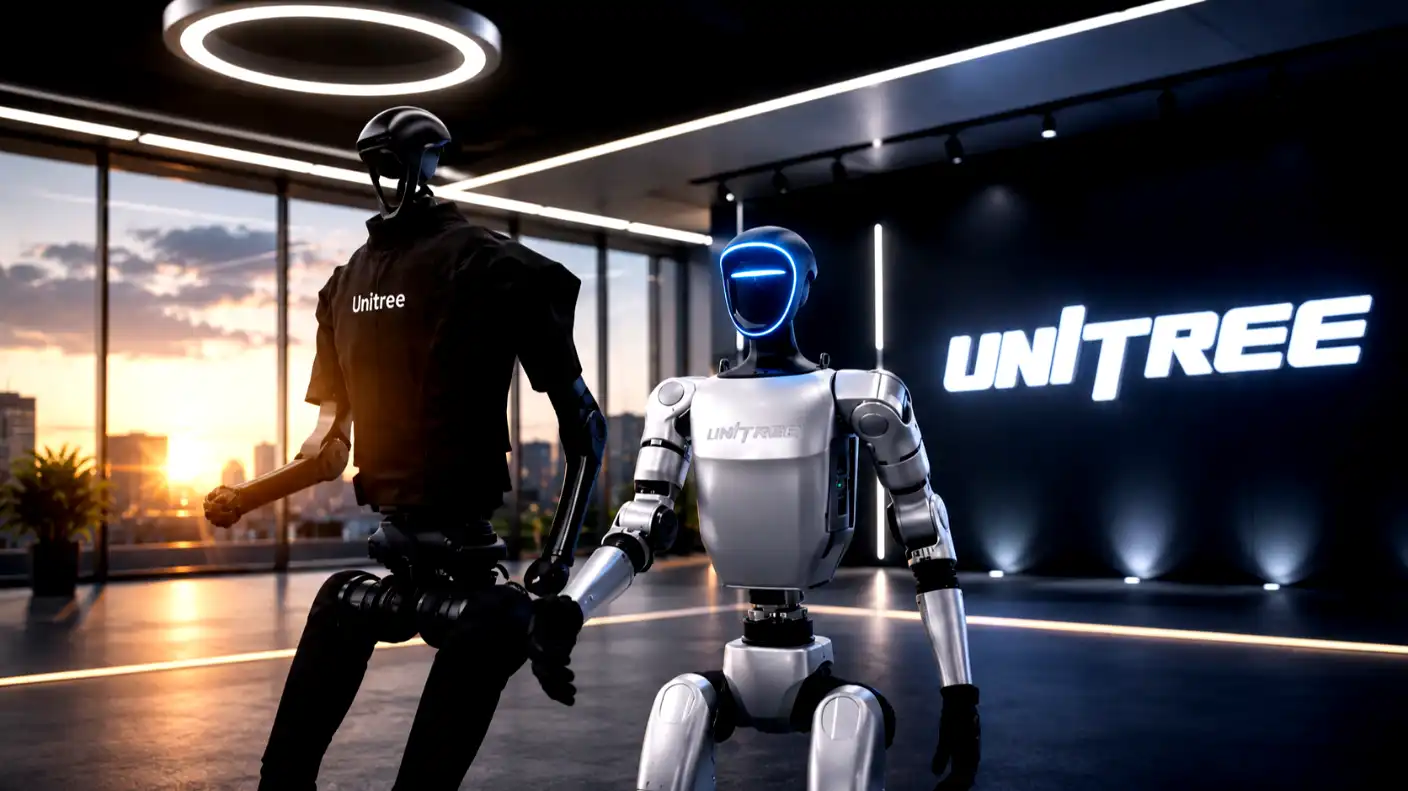
The physical and digital layers of the global technology landscape are rapidly converging, setting the stage for an unprecedented industrial transformation. In August 2026, during the annual World Robot Conference in Beijing, Wang Xingxing, the founder and Chief Executive Officer of Chinese humanoid robotics pioneer Unitree Robotics, delivered a highly anticipated address. Wang declared that the embodied intelligence industry is actively marching toward a “ChatGPT moment” for robot brains, where physical machines will finally develop the cognitive capabilities required to navigate and operate autonomously within unfamiliar real-world environments.
This bold, forward-looking assessment arrived just one day after Unitree completed a historic, blockbuster stock market debut on Shanghai’s tech-focused STAR Market. Trading under the ticker symbol 688836.SH, the company’s shares soared nearly sixfold on their first day, closing at 883.87 yuan compared to their initial public offering price of 150.80 yuan and valuing the company at over $50 billion. On Thursday, August 20, 2026, the stock pared some of those massive gains, falling approximately 11% as cautious investors chose to lock in profits, illustrating the high volatility that defines early-stage deeptech listings.
Despite this short-term trading volatility, the successful IPO and the CEO’s confident technological roadmap have permanently altered the narrative surrounding advanced robotics. By establishing a clear, quantitative definition for the industry’s ultimate tipping point—the so-called “80/80 benchmark”—Unitree has provided both developers and investors with a vital, realistic blueprint. This blueprint maps out the exact software and cognitive breakthroughs required to transform humanoid robots from expensive laboratory experiments into a ubiquitous, multi-billion-dollar public utility.
Defining the Tipping Point: The “Eighty-Eighty” Benchmark
The term “ChatGPT moment” has been widely used across the technology sector to describe a sudden, paradigm-shifting event comparable to OpenAI’s release of ChatGPT in late 2022, which successfully proved the viability of large language models and sparked a massive wave of global adoption.
The Operational Parameters of the “80/80” Goal
For the physical robotics industry, however, achieving a comparable inflection point is significantly more difficult. In an address to an audience of scientists, policymakers, and tech executives, Wang explained that the “ChatGPT moment” for embodied intelligence will only arrive once a humanoid robot can successfully satisfy what he calls the “80/80 benchmark.”
This rigorous, highly specific target establishes two distinct operational parameters:
- Task Success Rate: A humanoid robot must be able to successfully complete approximately 80% of tasks commanded by simple voice or text instructions.
- Scene Generalization: The robot must achieve this 80% success rate across at least 80% of unfamiliar, real-world scenes, completely without prior, scene-specific training or pre-mapped environmental data.
- Sovereign Autonomy: The machine must execute these tasks autonomously, adapting its physical movements and decision-making on the fly as it encounters unexpected obstacles.
Reaching for True Generalization in Unstructured Environments
The “80/80” target addresses the single most important bottleneck currently holding back the mass deployment of humanoid robots: the generalization gap. Under current technology limits, developers can easily program a robot to perform a highly complex, precise task inside a controlled, pre-mapped laboratory or factory cleanroom.
However, if that same robot is placed inside a standard, unfamiliar human household, it will quickly become paralyzed by basic physical obstacles, such as an unexpectedly moved chair, a change in lighting, or a different style of door handle.
To achieve true utility, a robot must possess a “world model”—a highly advanced cognitive system capable of simulating and understanding the physical laws of its immediate surroundings in real-time.
By setting a clear, quantitative threshold of 80% task completion in 80% of unfamiliar environments, Wang has defined the exact boundary where a robot transitions from a pre-programmed machine into an autonomous, useful assistant.
The first company or country that successfully crosses this threshold will undoubtedly lead the global embodied AI market, unlocking a massive wave of commercial adoption that will permanently transform the global labor force.
The Reality Check: Why Robot Brains Still Lag Behind Hardware
While the physical agility and locomotion of humanoid robots have advanced at a breathtaking pace over the past several years, the development of the underlying cognitive software remains a slow, highly difficult process.
A Candid Assessment of Current Cognitive Software
Despite his ambitious predictions for the future, the Unitree chief delivered a highly candid and pragmatic reality check regarding the current state of the industry.
He admitted that progress on large-scale robotic “world models” and cognitive software has been significantly slower than initially hoped.
Wang estimated that the industry’s current software capabilities are at a level analogous to “one to three years before the launch of ChatGPT.”
This means that while the physical bodies of the robots are highly advanced—featuring complex bipedal joints, high-purity carbon-fiber structures, and advanced sensory arrays—their cognitive brains are still in their infancy, lacking the generalization capabilities and the real-time reasoning needed to execute complex, multi-step real-world tasks without human supervision.
The Timeline to the Breakthrough: Two to Ten Years
This software bottleneck has forced industry experts to establish highly varied timelines for the eventual arrival of the “80/80” breakthrough.
Under an optimistic development scenario, where global tech labs successfully apply advanced machine learning and synthetic physical data to train robot brains, Wang believes a major leap in cognitive software could arrive within two to three years.
However, if developers continue to struggle with the complexities of real-world generalization and data scarcity, the breakthrough could easily take five to ten years to materialize.
This technological gap is highly visible at major exhibitions like the World Robot Conference.
While visitors can watch highly impressive demonstrations of robots performing martial arts, doing backflips, and playing musical instruments, these actions are still heavily pre-programmed and executed within highly controlled, pre-mapped environments, proving that the development of a truly generalized, autonomous robot brain remains the single most important and difficult challenge of the modern digital age.
Inside the Blockbuster Shanghai Listing: Unitree’s Six-Fold Surge
The strategic importance of the robotics sector to the national economy was on full display during Unitree’s historic public market debut on the Shanghai Stock Exchange’s tech-heavy STAR Market on Wednesday, August 19, 2026.
Shifting the Valuation Metrics of the STAR Market
The market’s response to the Unitree offering (688836.SH) was historic, demonstrating the immense, non-discretionary capital that public-market investors are willing to allocate to physical AI champions.
The stock price opened at a day’s high of 1,100 yuan before closing its morning session at 883.87 yuan, representing an extraordinary, nearly six-fold surge over its initial offering price of 150.80 yuan.
This spectacular trading debut pushed the company’s valuation past 360 billion yuan (approximately $50 billion), making it the most valuable onshore-listed semiconductor and hardware company in China.
Venture capitalists and market analysts noted that this premium valuation was driven heavily by political and strategic considerations rather than traditional valuation models.
By fast-tracking Unitree’s listing in just 104 days under its new “preliminary review” pilot, the Chinese government has signaled its deep, unwavering commitment to building a self-reliant, domestic robotics supply chain, ensuring that local innovators have the massive capital reserves required to win the global technology race against the United States.
The Standard Post-Debut Volatility on August Twentieth
Following the historic first-day surge, Unitree’s stock faced a standard, highly predictable period of profit-taking on Thursday, August 20.
The shares fell by approximately 11% during regular trading, closing at around 786 yuan as cautious investors chose to lock in their massive first-day gains.
This minor correction is a common, well-documented feature of high-profile deeptech listings.
Because the company currently trades at a highly demanding trailing price-to-earnings ratio of over 219 times, any minor operational delays or changes in revenue guidance will naturally trigger sharp, volatile price swings.
However, long-term institutional backers—including China’s National Social Security Fund, China Telecom, and advanced AI startup DeepSeek—maintain their positions under strict, multi-year lock-up agreements, ensuring that the company’s long-term capital structure remains highly stable and secure as it transitions to the public markets.
The Competitive Arena: Challenging Tesla and Boston Dynamics
The massive cash injection from the $904 million IPO will provide Unitree with the vital financial resources required to accelerate its technological development and challenge its traditional global competitors.
Squeezing the Market Share of Hyundai and Musk’s Optimus
The global market for advanced bipedal and quadruped robotics is currently a highly contested, multi-billion-dollar corporate battlefield.
Unitree’s primary international competitors are some of the most well-funded companies in the world, including the Hyundai Motor Group-owned pioneer Boston Dynamics and Elon Musk’s Tesla, which is investing heavily to integrate its Full Self-Driving software with its humanoid project, Optimus.
To defend its market share against these massive rivals, Unitree is leveraging its highly competitive pricing structure.
By offering its advanced G1 and H1 humanoid models at prices that are significantly cheaper than Western alternatives, the company has successfully captured a massive, global developer base.
This high-volume sales strategy allows Unitree to gather real-world performance data from thousands of independent researchers worldwide, creating a powerful, self-reinforcing data feedback loop that will accelerate its software development and help the company out-navigate its competitors, especially in large-scale projects requiring over $1 billion in capital investments, and where even a 1.5% improvement in processing latency or a 1.5% reduction in motor weight can save manufacturers millions of dollars annually.
The Uniqueness of Unitree’s Corporate Profitability
A key financial characteristic that distinguishes Unitree from its international and domestic competitors is its unique, highly disciplined corporate profitability.
While other prominent robotics companies are currently burning through massive amounts of venture capital and reporting severe annual losses as they struggle to commercialize their prototypes, Unitree has managed to operate profitably.
The company achieved this profitability by building a highly scalable, domestic manufacturing supply chain that can produce high-performance quadruped robodogs and bipedal humanoids at a fraction of the cost of Western competitors.
By selling tens of thousands of its quadrupeds to commercial security firms, agricultural operators, and public utilities, the company has generated a steady, reliable stream of cash flow to fund its advanced humanoid R&D, proving that a deeptech hardware startup can successfully combine technological innovation with absolute capital discipline.
Reforming the National Robotic Baseline
The finalization of the Unitree Robotics IPO on the STAR Market and the landmark “80/80” address delivered by CEO Wang Xingxing represent a defining milestone in the global technology race. By demonstrating an extraordinary, nearly six-fold first-day stock surge and outlining a clear, quantitative roadmap for the arrival of the “ChatGPT moment” in robotics, the company has proven that the era of embodied intelligence has officially entered its most exciting chapter.
While the physical AI sector must continue to navigate severe cognitive software bottlenecks, high operational costs, and the volatile realities of the public stock markets, the strong, collaborative partnership between local hardware makers, advanced AI developers, and state-backed institutional giants has built a highly resilient foundation for growth.
As the company continues to construct its advanced manufacturing facilities, refine its joint motion controls, and partner with cutting-edge software developers like DeepSeek, this massive corporate offensive will ensure that Unitree remains at the absolute forefront of the global robotics revolution.
This strategic integration of advanced intelligence with physical hardware will ensure that the country remains the undisputed capital of the emerging machine economy, providing the world with the highly intelligent, capable, and affordable physical systems of the future.






