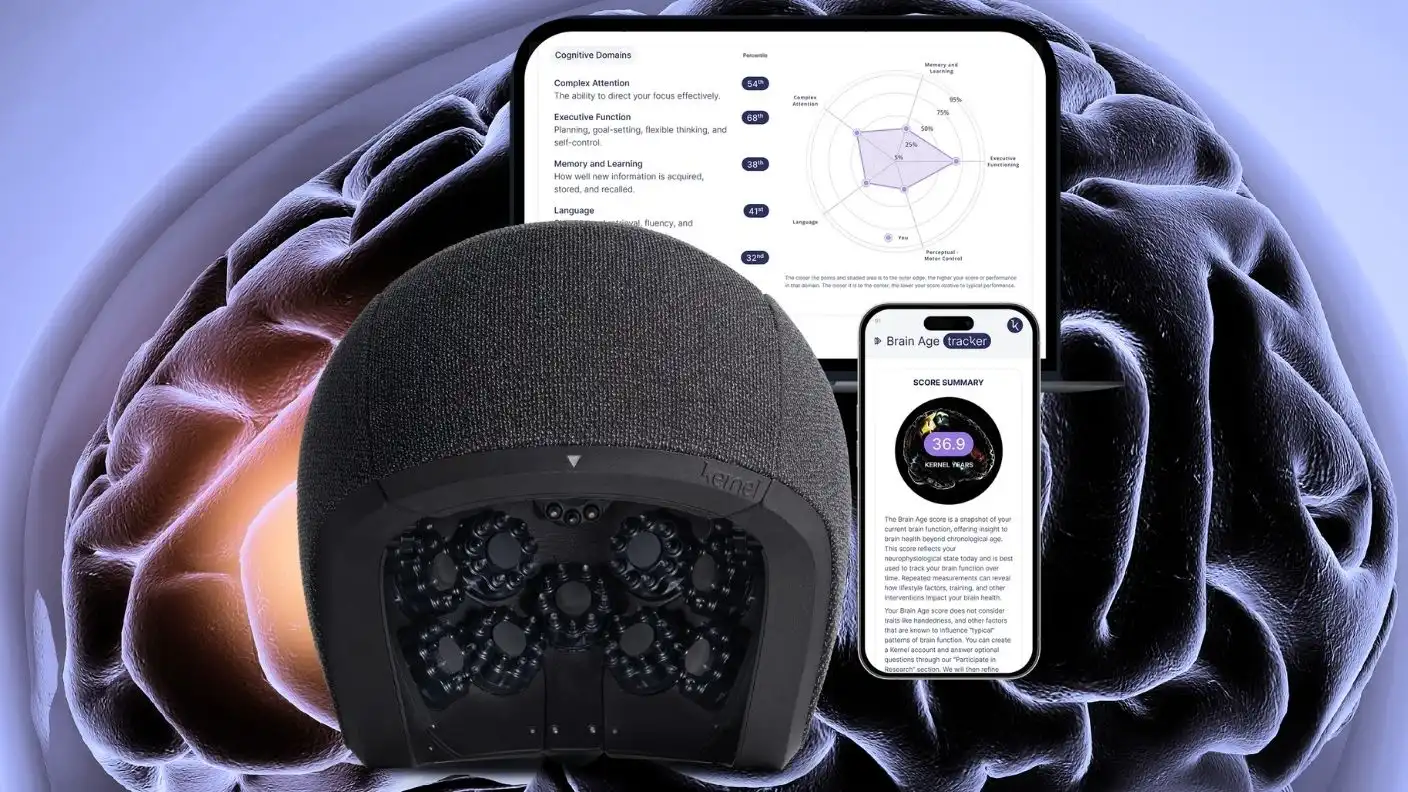
For decades, non-invasive brain imaging was confined to massive, multi-million dollar hospital machines like fMRI scanners. The Kernel Flow C (Consumer Edition) is the first device of its kind to bring sophisticated Time-Domain Functional Near-Infrared Spectroscopy (TD-fNIRS) to the home office. By measuring blood oxygenation in the brain, the Flow C promises to provide deep insights into cognitive load, focus, and mental effort in real-time.
As we move through 2026, the intersection of wearable tech and neuroscience is heating up. Whether you are a programmer looking to optimize your “flow state” or a researcher exploring neural responses to media, the Flow C offers insight previously unavailable to non-clinical users. In this review, we examine the hardware, the software ecosystem, and the practical utility of this groundbreaking neural headset.
What is the Kernel Flow C?
The Kernel Flow C is a wearable, high-density neuroimaging headset designed for consumer and prosumer applications. It uses light-based sensors to track hemodynamic responses in the cerebral cortex—essentially measuring how hard your brain is working by tracking blood flow.
Unlike basic EEG headbands that only measure electrical surface activity, the Flow C captures activity from deeper within the brain’s outer layers. It is designed to be comfortable enough for hour-long sessions, making it an ideal companion for high-stakes professional work, meditation training, or experimental neuroscience at home.
Key Features and Capabilities
Kernel has engineered the Flow C to be a “plug-and-play” laboratory. The device uses sophisticated optical modules calibrated for varying head shapes, ensuring the signal-to-noise ratio remains high across a diverse user base.
High-Density Neural Mapping
The headset is equipped with an array of optical fibers and detectors that provide a high-resolution map of brain activity. This density enables precise localization of cognitive tasks, such as distinguishing between linguistic processing and mathematical problem-solving.
- TD-fNIRS Technology: Provides superior depth and accuracy compared to standard continuous-wave fNIRS systems.
- Real-time Visualization: The companion software renders your brain activity in 3D, allowing you to see which regions are active as you work.
- Motion Correction: Advanced algorithms filter out artifacts caused by jaw movement or blinking, ensuring your data isn’t skewed by physical activity.
The “Flow” Ecosystem and API
The hardware is only as good as the software that interprets the data. Kernel provides a robust developer platform that allows users to export raw data for custom analysis or utilize pre-built “Flow” apps designed to track cognitive metrics.
- API for Developers: Seamless integration with Python and MATLAB for researchers building custom neural experiments.
- Cognitive Load Tracking: Pre-configured metrics that measure how much mental effort you are exerting on a specific task.
- Cross-Platform Syncing: Automatically correlates brain data with your computer’s productivity software to show you exactly which apps cause you the most (or least) mental stress.
Advantages and Disadvantages
Entering the world of personal neuroimaging is a significant commitment. Before you invest in the Flow C, it is important to understand its unique benefits and the inherent limitations of current non-invasive consumer hardware.
Advantages
The following features make the Kernel Flow C a unique and powerful tool for the quantified-self movement.
- Unrivaled Neural Depth: Offers physiological detail that far exceeds consumer-grade EEG headbands.
- Non-Invasive Comfort: The headset is lightweight and requires no messy conductive gels, making it suitable for long-duration use.
- Actionable Insights: It provides real, biological feedback on mental fatigue, helping users optimize their work hours for peak productivity.
Disadvantages
These limitations are important to note, particularly regarding the price and the complexity of interpreting the data provided.
- High Barrier to Entry: The cost of the consumer edition is still quite high, placing it firmly in the “enthusiast/pro” price bracket.
- Data Interpretation: Without a background in neuroscience or data science, the raw output can be extremely difficult to interpret.
- Form Factor: While much better than a hospital machine, it is still a large headset that may feel awkward to wear in public or casual environments.
Final Verdict: Who Should Buy It?
The Kernel Flow C is currently the most sophisticated window into the human mind available to the public. It is an exceptional tool for biohackers, software engineers seeking to optimize their focus, and researchers conducting small-scale studies.
If you are just looking to track your sleep or basic heart rate, this is far more technology than you need. However, if you are genuinely interested in the “Quantified Self” and want to see the physiological footprint of your own thoughts, the Kernel Flow C is a revolutionary piece of hardware. It represents the first step toward a future where we understand our own brains as clearly as we understand our fitness metrics.