Key Points:
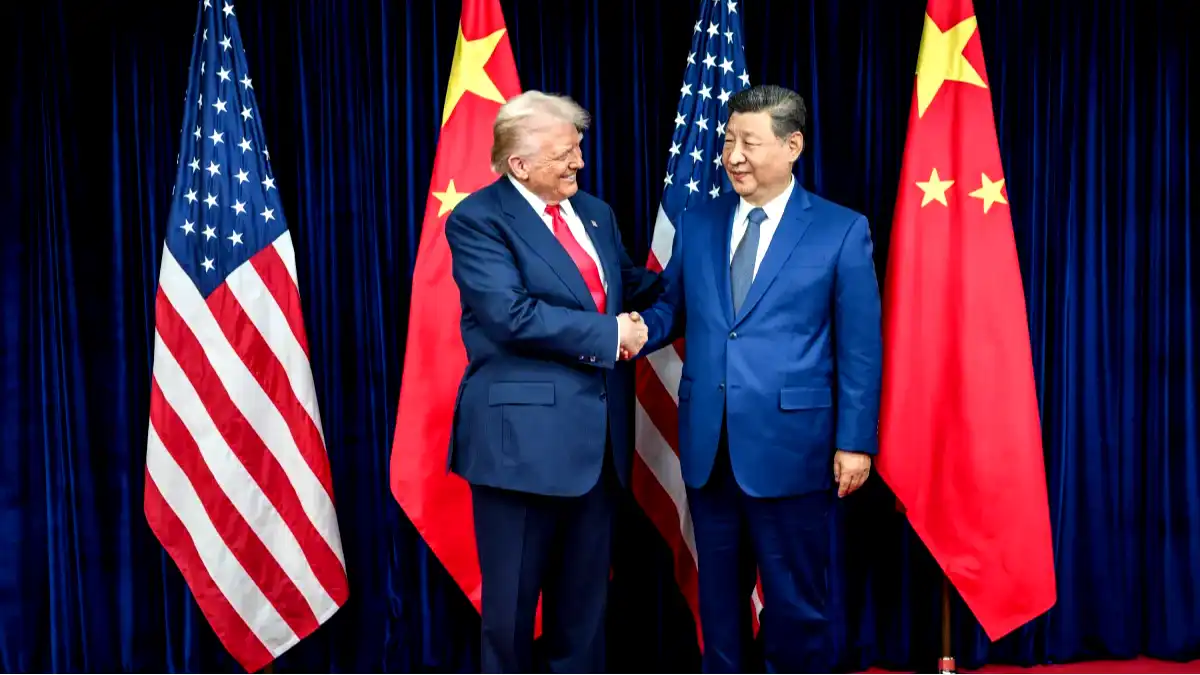
- U.S. President Donald Trump and Chinese President Xi Jinping met in Beijing to secure bilateral economic and political stability.
- The two nations established a “Board of Trade” to regulate and split Chinese exports into sensitive tech and non-sensitive categories.
- Beijing agreed to purchase over $15 billion in U.S. agricultural products and Boeing aircraft while establishing an AI dialogue framework.
- U.S. military demonstrations in Venezuela and the Middle East prompted Chinese military hawks to adopt a more cautious, muted tone.
U.S. President Donald Trump and Chinese President Xi Jinping met in Beijing in mid-May 2026 to stabilize their highly complex bilateral relationship. The high-profile summit, though delayed by approximately six weeks due to U.S. military strikes in Iran, successfully achieved Beijing’s immediate diplomatic objectives. By holding his own against Trump and projecting an image of a major global leader, President Xi successfully consolidated his foreign policy footing as he prepares to secure a historic fourth term as Communist Party leader in the fall of 2027.
The cornerstone of the newly negotiated economic framework is the creation of a bilateral “Board of Trade.” This specialized regulatory body directly reflects President Trump’s intense focus on reducing the massive U.S. trade deficit with China. To ensure that the new mechanism does not damage its domestic manufacturing sector, China negotiated a split of its exports into sensitive and non-sensitive categories. Under this arrangement, the sensitive category will cover advanced technologies. In contrast, the non-sensitive category will govern daily necessities, allowing both nations to manage trade flows in a more orderly manner.
Under the bilateral trade agreements, Beijing agreed to purchase over $15 billion in American agricultural products, including soybeans and beef, as well as large fleets of Boeing aircraft. At the same time, the two superpowers established a formal framework for ongoing dialogue on artificial intelligence, representing a 1.5% step-up in bilateral technology integration. By keeping trade and business dealings at the absolute center of the Beijing summit, the two leaders avoided major diplomatic bottlenecks and successfully kept Taiwan out of the core discussions.
Furthermore, recent U.S. military demonstrations in Venezuela and Iran have had a profound impact on China’s long-term strategic thinking. The rapid deployment of American military power served as a stark wake-up call for Chinese war hawks, who had previously claimed that Western influence was in permanent decline. This military reality check has prompted Beijing’s military leadership to adopt a far more cautious, muted tone, guiding their focus away from regional expansion and toward domestic economic stabilization.
While the two leaders did not include Taiwan in their core trade discussions, the island remains a non-negotiable “red-line” issue for Beijing. Despite the United States leveraging arms sales and military support to fortify the island, mainland officials remain cautious about taking confrontational steps that could disrupt the regional order. Having recently purged its top military ranks, China is still modernizing its command structure and is not yet ready to manage the immense legal and administrative challenges of governing the island.
This strategic caution comes as local demographics in Taiwan move further away from mainland interests. Independent public opinion polls show that more than 80 percent of younger Taiwanese adults identify themselves as primarily Taiwanese rather than Chinese. This low cultural identification means that the longer Beijing drags out the issue of unification, the more difficult peaceful integration will become. Under President Xi’s long-term revitalization plan, China aims to achieve unification by 2049, which will mark the 100th anniversary of the founding of the People’s Republic of China.
Analysts note that a relatively long-lasting peace in the Taiwan Strait depends heavily on Taiwan’s pro-China main opposition party, the Kuomintang (KMT), winning the upcoming 2028 presidential election. If the Kuomintang loses, the risk of a military escalation rises significantly. To promote peaceful ties, Beijing gave KMT Chairperson Cheng Li-wun a warm reception during her April visit to China, signaling mutual efforts to avoid a worst-case scenario.
While the current status quo remains intact, the Taiwan issue could return to the global spotlight in the latter half of Trump’s second term, particularly after the U.S. midterm elections in November 2026. As both superpowers work to implement their newly negotiated trade boundaries, the global tech and manufacturing sectors must navigate a fragile peace defined by economic pragmatism and strategic caution.