Key Points:
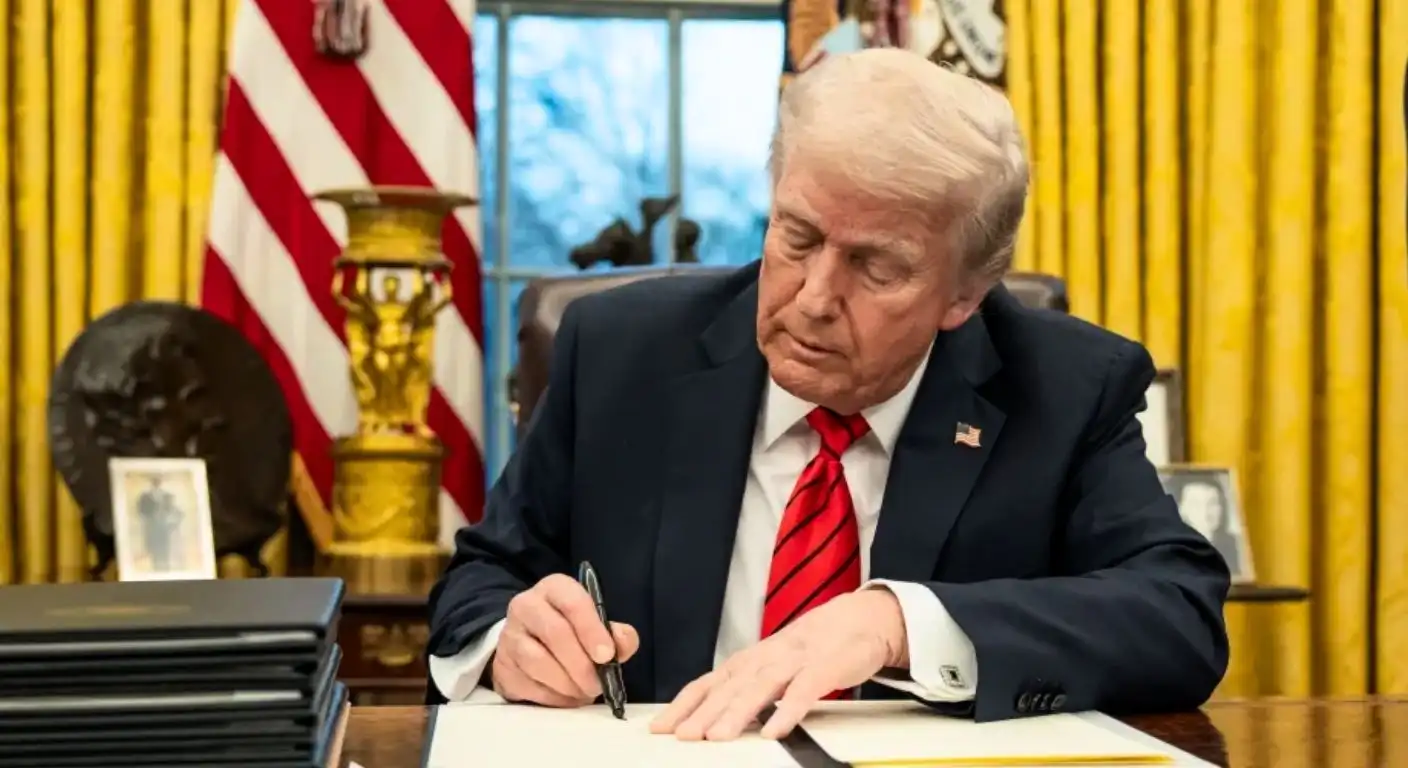
- U.S. President Donald Trump has officially signed a new executive order, “Promoting Advanced Artificial Intelligence Innovation and Security,” on June 2, 2026.
- The order establishes a voluntary framework for developers to report new frontier AI releases, aiming to preempt a confusing patchwork of state-level AI regulations.
- Unlike traditional regulatory bills, the directive avoids burdensome mandates on private firms, focusing instead on hardening federal networks against AI-driven cyber threats.
- In a highly unusual bureaucratic detail, the official text mandates that the “Department of War” must bear all publication costs for the executive order.
The White House has officially launched its most formal and ambitious effort yet to secure America’s lead in the global artificial intelligence arms race. On Tuesday, June 2, 2026, U.S. President Donald Trump signed a landmark executive order titled “Promoting Advanced Artificial Intelligence Innovation and Security.” This sweeping directive aims to accelerate domestic technological breakthroughs, secure critical intellectual property from foreign exploitation, and harden the federal government’s own networks against next-generation cyber threats. By signing the order, the administration is establishing a unified national standard to govern the emerging AI sector, seeking to protect national security without stifling private sector innovation.
The signing of the executive order follows a highly dramatic and public delay that occurred just two weeks ago. The White House had originally scheduled a high-profile signing ceremony with top Silicon Valley executives in the Oval Office on Thursday, May 21, 2026. However, in a sudden move that shocked invitees, Trump called off the ceremony just three hours before it was set to begin. At the time, Trump told reporters that he had postponed the signing because he disliked certain aspects of the draft text. He expressed deep concern that the proposed guidelines might inadvertently slow down American developers, stating that he would not do anything that would dull the country’s competitive edge over China.
The finalized version of the executive order addresses these competitiveness concerns by steering completely clear of heavy-handed private sector regulations. Rather than imposing rigid, legally binding mandates on commercial software developers, the bulk of the order directs federal agencies to modernize and harden their own digital infrastructures. By focusing on government defense rather than private restrictions, the White House plans to protect the nation’s critical networks from being penetrated by advanced algorithms. While these new automated cyber audits account for only 1.5% of the overall federal technology budget, the strategic return is massive. The Cybersecurity and Infrastructure Security Agency (CISA) and the National Security Agency (NSA) will play leading roles in helping federal departments shield their data systems from foreign cyber threats.
To maintain a clear line of sight on emerging technology without suffocating startup growth, the order introduces a voluntary reporting framework for leading AI developers. Under this collaborative model, top Silicon Valley laboratories—including OpenAI, Anthropic, and Google—can voluntarily inform the federal government about the national security and cyber risks of their most advanced frontier models before releasing them to the general public. This cooperative approach aims to foster a strong, collaborative partnership between Washington and the private sector, enabling the government to assess potential catastrophic risks without resorting to heavy-handed bureaucratic oversight.
A primary strategic goal of the new executive order is to establish a single, unified national standard to preempt the growing patchwork of conflicting state-level AI regulations. Over the past year, state legislatures in California, New York, and Texas have introduced highly restrictive safety bills, creating a chaotic regulatory landscape for American tech companies. Technology advocates have warned that navigating 50 different sets of state laws would severely hamstring domestic startup growth. By introducing a centralized, voluntary national framework, the Trump administration is attempting to override these fragmented local laws, providing developers with a stable, predictable, and cohesive regulatory environment across the entire country.
The sudden urgency to establish some form of federal oversight stems from growing panic among national security officials over the rapid evolution of specialized, code-hacking AI models. In April, Treasury Secretary Scott Bessent and outgoing Federal Reserve Chairman Jerome Powell convened an emergency meeting with Wall Street CEOs in Washington. During the briefing, regulatory officials warned that a newly developed, unreleased model from Anthropic, known as “Claude Mythos,” possessed an alarming capability to automatically locate and exploit zero-day software vulnerabilities across global banking networks. This massive threat potential convinced the White House that the government must establish a formal system to monitor and mitigate the use of these high-power autonomous hacking tools.
The final text of the executive order also includes a highly unusual, historic detail that has triggered intense curiosity among bureaucratic watchdogs. In the closing section of the document, the text explicitly mandates that “the Department of War shall bear the costs for publication of this order.” This archaic phrasing, referring to the pre-1947 predecessor of the Department of Defense, reflects a broader, highly controversial effort by the Trump administration to rename the Department of Defense back to its historical roots, or a highly deliberate messaging campaign designed to highlight the military significance of the technological Cold War.
Despite these national security and military concerns, the administration continues to promote the massive economic benefits of its pro-innovation, light-touch regulatory approach. White House briefings highlight that the administration’s policies have helped secure more than $2.7 trillion in total domestic tech and AI investments since last year, including a massive $90 billion in integrated AI and energy infrastructure projects in Pennsylvania alone. By keeping government intervention minimal, the White House aims to encourage private corporations to continue investing their massive capital reserves into building domestic data centers, securing advanced semiconductor supply chains, and keeping America’s technology lead firmly intact.
Ultimately, the signing of the “Promoting Advanced Artificial Intelligence Innovation and Security” executive order represents a decisive and highly strategic balancing act for the United States. By opting for a voluntary, collaborative framework with Silicon Valley rather than imposing restrictive public regulations, President Trump is betting that private ingenuity remains America’s best defense against global competitors. As the June 2 effective date begins, the federal government faces a difficult path as it works to modernize its own legacy computer networks while monitoring highly volatile frontier models. For now, the new directive confirms a simple truth: in the modern digital era, protecting the nation’s security no longer just depends on physical borders but also on the silicon chips and code that run them.