Key Points:
- Volvo Group expects its autonomous transportation business to generate nearly $3 billion in annual revenue within the next five years.
- The Swedish truckmaker plans to launch commercial, driverless robo-truck operations on United States highways in the first quarter of 2027.
- Volvo aims to deploy more than 300 factory-built autonomous rigs in the United States by the end of 2027 to scale operations.
- Partnering with generative artificial intelligence pioneer Waabi, Volvo integrates self-driving systems directly on its factory assembly lines.
The global freight and logistics industries are on the verge of a profound technological shift as autonomous heavy-duty vehicles prepare to enter commercial operations on public highways. Swedish truck manufacturing giant Volvo Group has officially unveiled its most detailed roadmap yet for turning driverless transport into a highly profitable business. Speaking at a high-profile investor meeting in Sweden, Nils Jaeger, president of Volvo Autonomous Solutions, announced that the company expects its Volvo autonomous truck revenue to reach nearly $3 billion over the next five years. This bold target underscores Volvo’s ambition to establish a dominant, first-mover advantage in the rapidly growing market for automated freight.
The central pillar of Volvo’s commercialization strategy is a high-profile rollout on United States highways, where the company plans to launch fully driverless operations in the first quarter of 2027. To achieve the necessary operational scale, the Swedish manufacturer aims to deploy more than 300 autonomous big rigs on major U.S. freight corridors by the end of 2027. This aggressive timeline represents a major milestone, as the company transitions from highly controlled private test tracks to active, real-world highway commercialization, offering fleet operators a ready-to-scale alternative to traditional human-driven logistics.
To power the digital brains of these autonomous big rigs, Volvo is leveraging cutting-edge developments in generative artificial intelligence. In February, the truckmaker’s autonomous division entered a deep strategic partnership with Toronto-based AI pioneer Waabi. This collaboration integrates Waabi’s revolutionary, world-model-based virtual driver system directly into Volvo’s purpose-built trucks. Unlike traditional self-driving software that relies on rigid, hand-coded rules, Waabi’s generative AI can generalize and adapt to highly complex, unpredictable highway scenarios, providing the high-safety guarantees necessary to operate a 40-tonne semi-truck completely driverless.
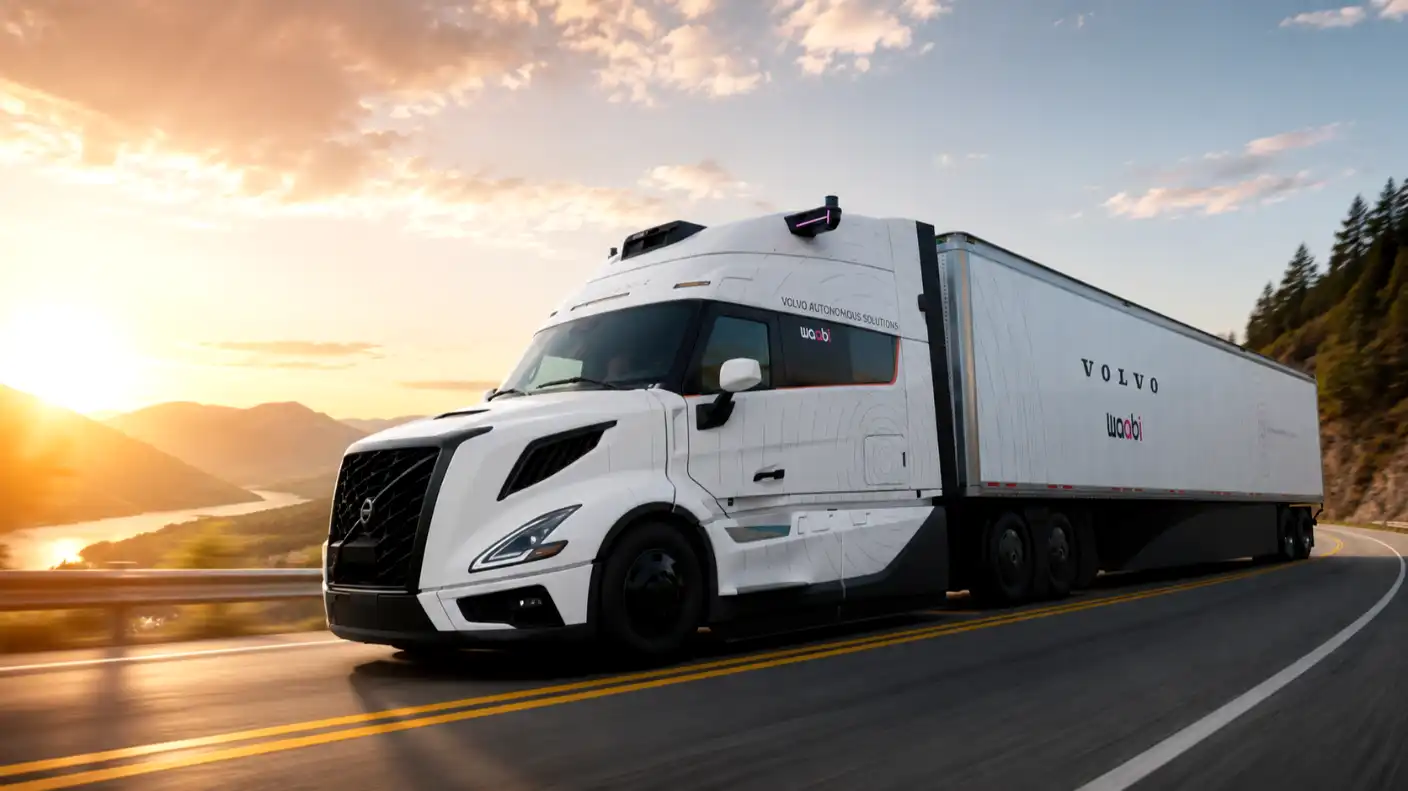
A key differentiator that sets Volvo apart from other self-driving startups is its commitment to industrial-scale manufacturing. While many software companies must buy standard trucks and manually retrofit them with expensive sensors and computer racks in small workshops, Volvo integrates autonomous technology directly on its factory assembly lines. The company manufactures its flagship VNL Autonomous truck from the ground up at its massive New River Valley facility in Virginia. By embedding redundant steering, braking, and electrical actuators directly into the chassis during the initial build, Volvo ensures consistent manufacturing quality, strict regulatory compliance, and rapid mass-production capacity.
The economic logic driving this massive shift toward autonomous transport is incredibly compelling for fleet managers. Jaeger pointed out that a driverless truck can successfully operate beyond the strict, legal driving limits mandated for human drivers, allowing logistics firms to double their vehicle utilization rates. Instead of sitting idle during mandatory driver rest periods, a robotic truck can run nearly 24 hours a day, stopping only for refueling and routine maintenance. This continuous operation allows transport networks to bypass chronic driver shortages, significantly accelerate delivery times, and dramatically improve overall fleet productivity.
Volvo’s ambitious technology goals occur amidst a highly resilient, although macroeconomically challenging, global trade environment. In a trading update presented to investors, Chief Executive Officer Martin Lundstedt and Chief Financial Officer Mats Backman confirmed that customer demand and vehicle deliveries remained solid through May across both European and North American markets. However, the executives also cautioned that rising raw material and global freight costs—exacerbated by ongoing geopolitical conflicts in the Middle East and the closure of the strategic Strait of Hormuz—are putting significant upward pressure on second-quarter cost inflation.
To navigate rising macroeconomic pressures and protect its long-term profit margins, Volvo is investing substantial capital in structural efficiency and green-transition technologies. The company is actively investing in dual-track research, expanding its zero-emission electric and hydrogen-powered platforms alongside its autonomous software systems. As global transport giants collectively allocate over $100 billion to modernize their fleets, the demand for highly efficient hardware remains intense. Even a minor 1.5% delay in fleet modernization can translate into millions in wasted fuel overhead, prompting logistics providers to partner with legacy manufacturers who can deliver factory-built, low-emission, and automated platforms.
The broader investment landscape is reflecting this intense enthusiasm for automated logistics. On the same day as Volvo’s investor event, fellow Swedish autonomous transport startup Einride AB officially made its public market debut on the New York Stock Exchange. The successful listing highlights a massive, multi-billion-dollar investor interest in next-generation transport networks, proving that Wall Street is highly eager to fund the physical hardware of the green and digital logistics transition. This favorable market sentiment provides established players like Volvo with a supportive environment to raise capital and scale their autonomous operations.
A detailed market report published by Bloomberg indicated that the global market for autonomous trucking is on track to expand significantly over the next decade, growing into a massive multi-billion-dollar sector by 2035. As shipping rates remain volatile and fuel costs consume nearly a third of all fleet operating budgets, major logistics carriers are actively looking to diversify their transport networks to reduce their reliance on human labor. By providing a fully integrated, factory-built autonomous solution, Volvo is successfully positioning itself to capture a significant portion of this infrastructure spend, which is easily eclipsing the $1 billion funding rounds of traditional technology startups.
Ultimately, the plan to generate nearly $3 billion in Volvo autonomous-truck revenue within five years marks a vital milestone for the global shipping industry. By combining its massive, industrial-scale manufacturing precision with Waabi’s advanced generative AI, the Swedish pioneer is showing the rest of the technology world how to build sustainable, highly efficient, and safe logistics systems for the digital age. As the first 300 driverless VNL Autonomous trucks begin shipping to U.S. highways in early 2027, this landmark commercialization effort will prove that the future of global logistics relies heavily on the perfect, highly automated integration of physical machinery and artificial intelligence.